


Lesson 7 – What is a Plane?
Introduction
In the lesson “What is a Geometric Plane?” we explore a fundamental concept in geometry that serves as the foundation for many other geometrical ideas. A geometric plane is a two-dimensional, infinite, and flat surface that consists of an endless number of points arranged in a straight line without any bends. Although it is an imaginary construct, the concept of a geometric plane allows us to study the properties and relationships of solid objects. By the end of this lesson, you will have a solid understanding of geometric planes and their significance in geometry. This knowledge is crucial for delving into more advanced geometrical concepts, such as studying three-dimensional shapes and solid geometry. Let’s embark on this journey of exploring the world of geometric planes and their role in understanding our three-dimensional space.
I. Definition
1. What is the geometric plane?
A geometric plane is a two-dimensional flat surface that extends infinitely in all directions, with no thickness or curvature. It is typically represented as a flat, infinitely large sheet of paper or a chalkboard. It is used in geometry and other mathematical fields to study two-dimensional shapes, angles, and measurements.
A plane is defined by any three points that are not collinear, which uniquely determine a flat surface that passes through all three points.
2. Main parts of a geometric plane
Points:
A point is a location on the plane with no size or shape. Points define lines, angles, and conditions on the plane.
Lines:
A line is a straight path that goes on indefinitely in both directions. Two points on the plane define it.
Angles:
An angle is formed when two lines or line segments meet. It is measured in degrees and can be acute, obtuse, or right.
Shapes:
Shapes on the plane include two-dimensional figures such as triangles, squares, and circles. They are defined by their sides, angles, and vertices.
Coordinates:
Coordinates are used to locate points on the plane. They are written as ordered pairs (x, y) where x and y are horizontal. The origin (0,0) is where the x-axis and y-axis intersect.
Distance:
The distance between two points on the plane is the length of the shortest path between them. It is calculated using the Pythagorean theorem.
3. Different geometric plane types
There are several types of geometric planes based on their properties and characteristics. Here are some of them:
Euclidean plane:
This is the most common type of geometric plane, and it follows the rules of Euclidean geometry. It is a flat, two-dimensional surface that extends infinitely in all directions and contains points, lines, and shapes.
Cartesian plane:
Also known as the coordinate plane, this type of plane is used extensively in mathematics to plot graphs. It is a two-dimensional plane with two perpendicular axes (x and y) intersecting at the origin (0,0).
Projective plane:
This is a more advanced type of geometric plane used in projective geometry. It is a two-dimensional plane with points, lines, and shapes but with some additional properties. In a projective plane, parallel lines meet at a single point, and every pair of points has a unique string that passes through them.
Affine plane:
This type of plane is used in affine geometry. It is like a projective plane but without the additional properties. In an affine plane, parallel lines do not meet at a single point.
Hyperbolic plane:
This is a non-Euclidean plane, which means it does not follow the rules of Euclidean geometry. It is a two-dimensional surface with constant negative curvature and can be represented by a saddle shape. In a hyperbolic plane, parallel lines diverge and do not meet at infinity.
Elliptic plane:
This is another non-Euclidean plane with constant positive curvature. It is a two-dimensional surface that a sphere can represent, and in an elliptic plane, parallel lines intersect at a single point.
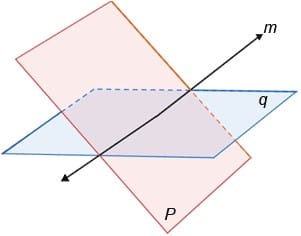
4. How to draw and name planes?
To draw a plane
you need at least three non-collinear points. Use a ruler or straightedge to connect these points, creating a flat surface that extends infinitely in all directions.
To name a plane
choose any three non-collinear points on the plane. You can use the capital letters associated with these points or a single uppercase letter, often in italics, to represent the plane. For example, if the facts on the plane are A, B, and C, you can name the plane as plane ABC or simply as plane P. The important thing is to ensure that the name is clear and distinguishes the plane from others.
II. Example
Example 1:
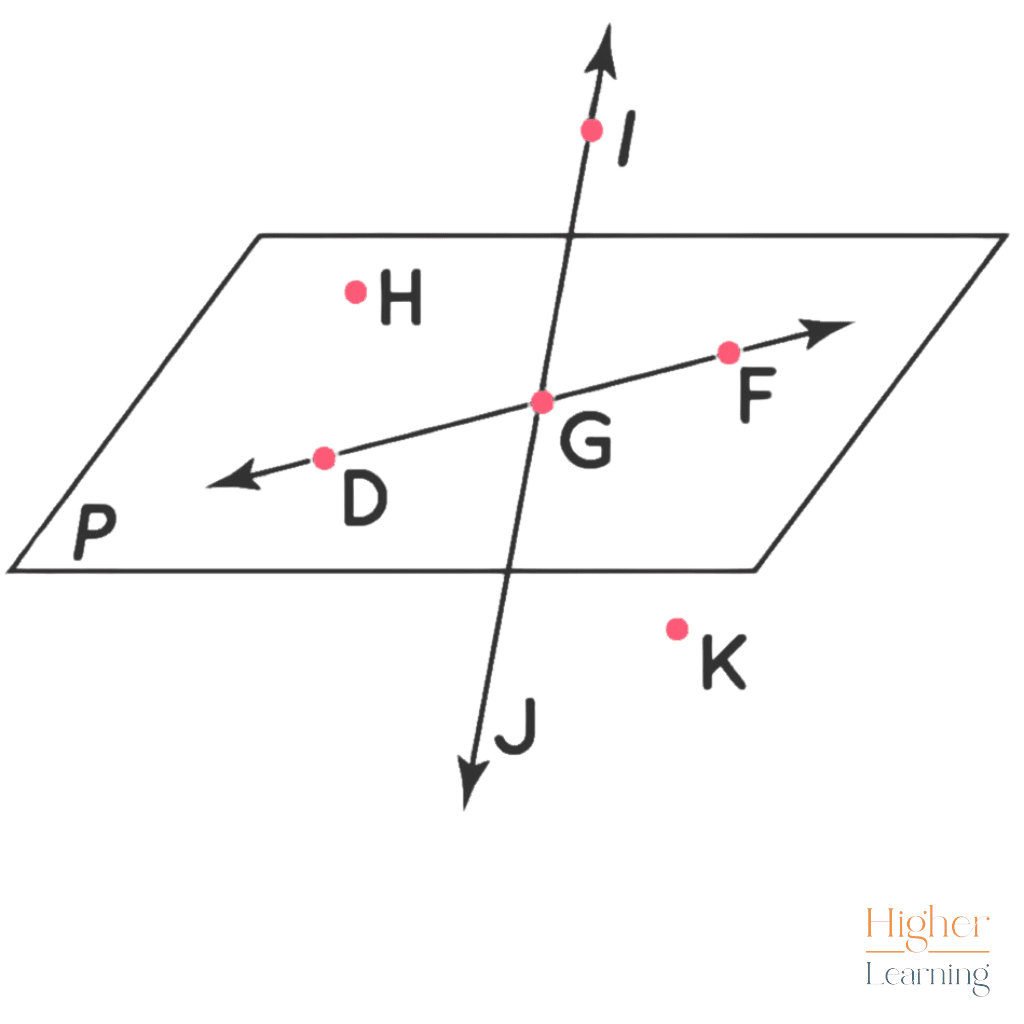
Can you suggest other names for this plane below:
Solution
The plane’s vertices can be given names. Therefore, the plane in the above diagram might go by the names HDF, HGF, or HGD.
Example 2:
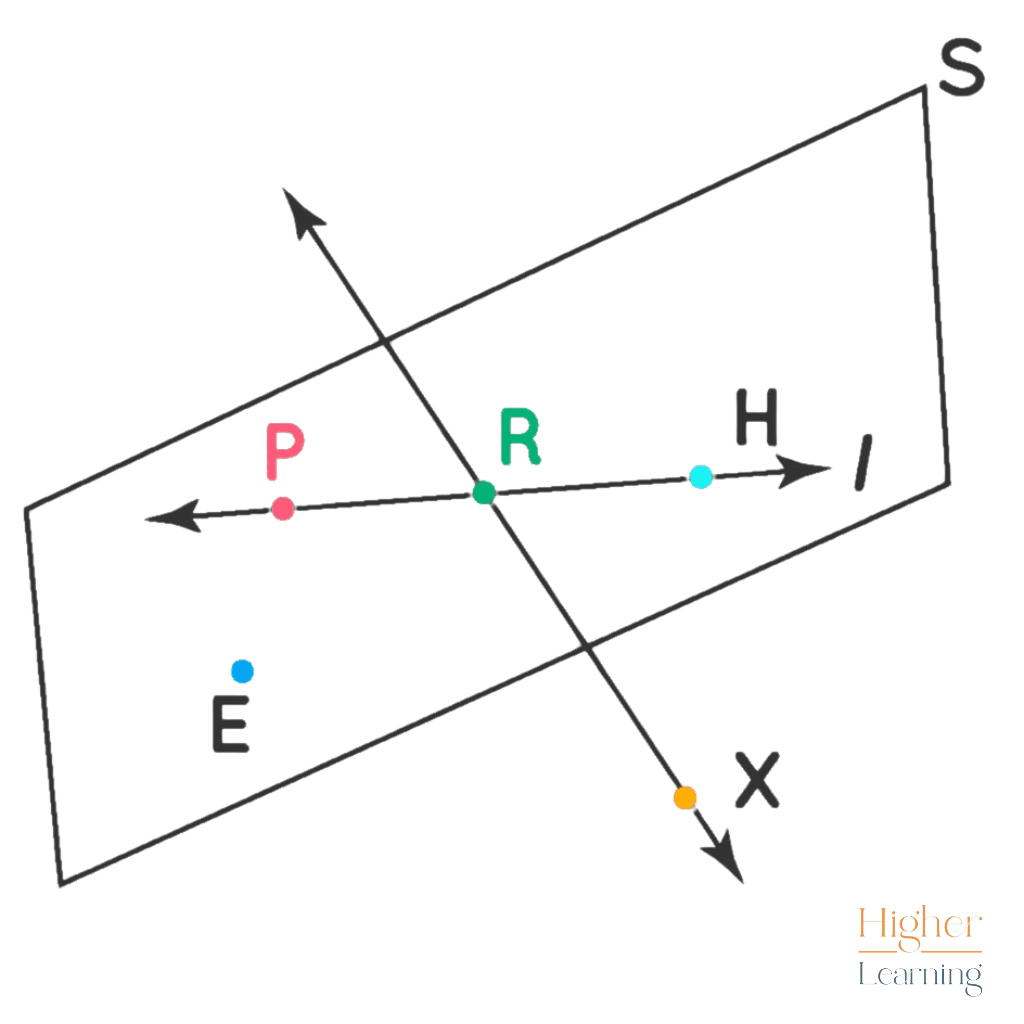
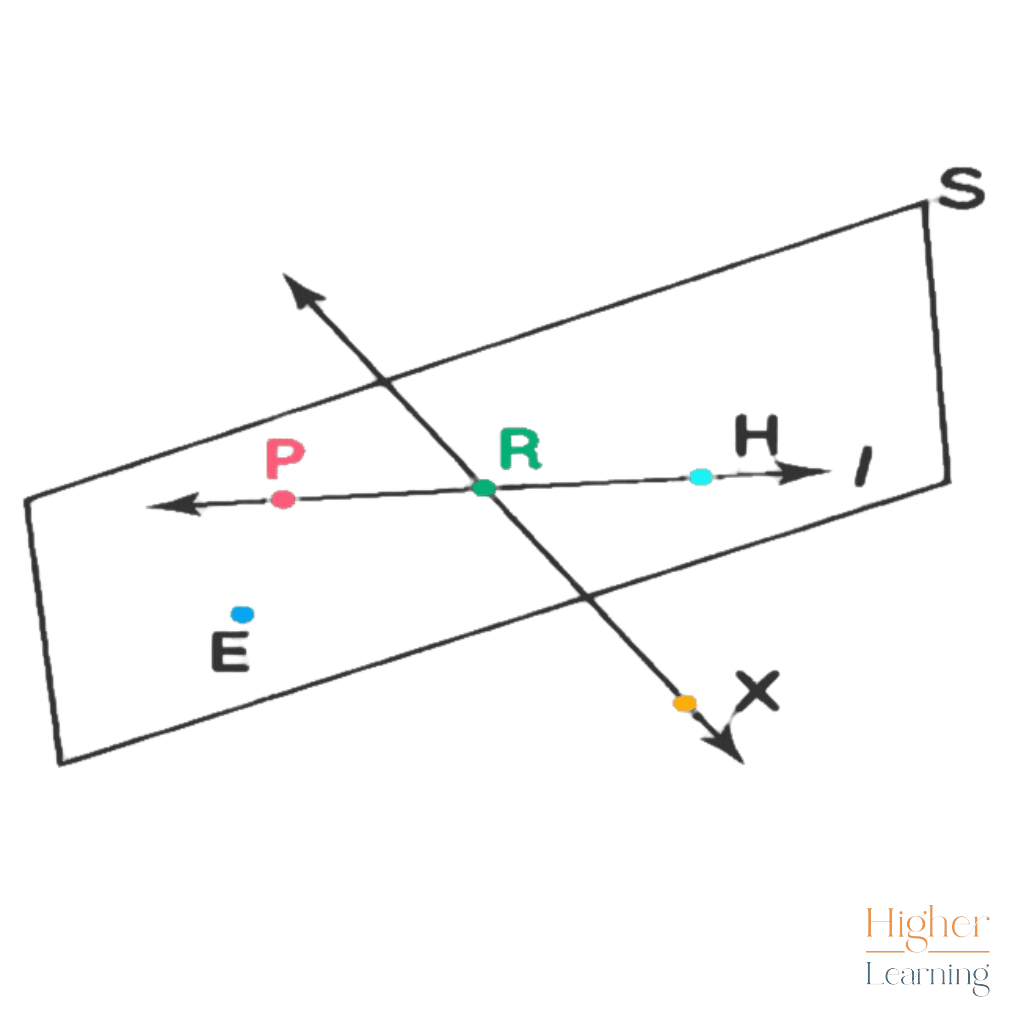
Teacher Sophie is posing a question to her pupils. Are P, E, R, and H points coplanar?
Solution
To verify if points P, E, R, and H are coplanar, we’ll check if the vectors formed by connecting three of the points lie on the same plane.
Let’s choose points P, E, and R to form two vectors:
– Vector \(\vec{PE}\) = \(E – P\)
– Vector \(\vec{PR}\) = \(R – P\)
Next, we’ll use the scalar triple product:
\[\vec{PE} \cdot (\vec{PR} \times \vec{PH}) = 0\]
If the scalar triple product equals zero, then points P, E, R, and H are coplanar.
By performing the calculations, if \(\vec{PE} \cdot (\vec{PR} \times \vec{PH}) = 0\), then we confirm that points P, E, R, and H are coplanar.
Therefore, point P, E, R, and H are coplanar.
III. FAQ
1. What Kinds of Surfaces Are Planes?
Flat surfaces are referred to as plane surfaces. The floor of a room, table surface, book cover, etc. are all flat surfaces.
2. Is the shape of a diamond plane?
A diamond is a two-dimensional flat shape with four closed, straight sides. Given that it has two dimensions– length and width– it is indeed a plane shape.
3. What Number of Points Are Required for a Plane?
A plane is made up of any three noncollinear points.
Conclusion
A geometric plane is a flat, two-dimensional surface that extends infinitely in all directions. It is a fundamental concept in geometry that aids in understanding shapes and figures. Three non-collinear points define the plane; any two points can be connected by a straight line that lies entirely on the plane. We have explored the properties of planes, such as equations, angle relationships, parallelism, and perpendicularity. Mastery of this concept is vital for problem-solving, mathematical analysis, and real-life applications like map reading and design. Understanding geometric planes establishes a strong foundation in geometry for further mathematical exploration.