


Chapter 1, Lesson 7
In Progress
Lesson 7 – Brackets, Hyphen, Semi-Colons and Quotation Marks
Chapter Progress
0% Complete
Introduction
Effective writing involves more than just stringing words together. It requires understanding punctuation marks and powerful tools for clarity and meaning. Brackets, hyphens, semi-colons, and quotation marks are essential elements of written communication that can enhance the structure and impact of your writing. However, many writers need help with when and how to use these punctuation marks correctly. In this lesson, we will explore the functions and proper usage of brackets, hyphens, semi-colons, and quotation marks, providing practical guidelines and examples to help you master these punctuation marks.
I. The function of Brackets, Hyphen, Semi-Colons and Quotation Marks
1. Brackets
Brackets, or parentheses, are used to enclose additional information or clarifications within a sentence. They help separate non-essential phrases or provide further details that can be omitted without affecting the sentence’s overall meaning.
For example, in the sentence “The conference (scheduled for next week) has been postponed,” the information within the brackets provides additional context but can be removed without altering the sentence’s core message.
2. Hyphen
Hyphens are used to join words or parts of words together. They serve various purposes, including forming compound words, connecting prefixes and suffixes, indicating ranges or breaks in terms, and clarifying meaning. For instance, in the phrase “well-known,” the hyphen joins the words “well” and “known” to create a compound adjective.
Semi-Colon: The semi-colon is a punctuation mark that helps connect two closely related independent clauses within a sentence. It is a more refreshing break than a comma but not as definitive as a period. It allows for a closer connection between the two clauses.
For example, “She went to the store; he stayed home.”
3. Quotation Marks
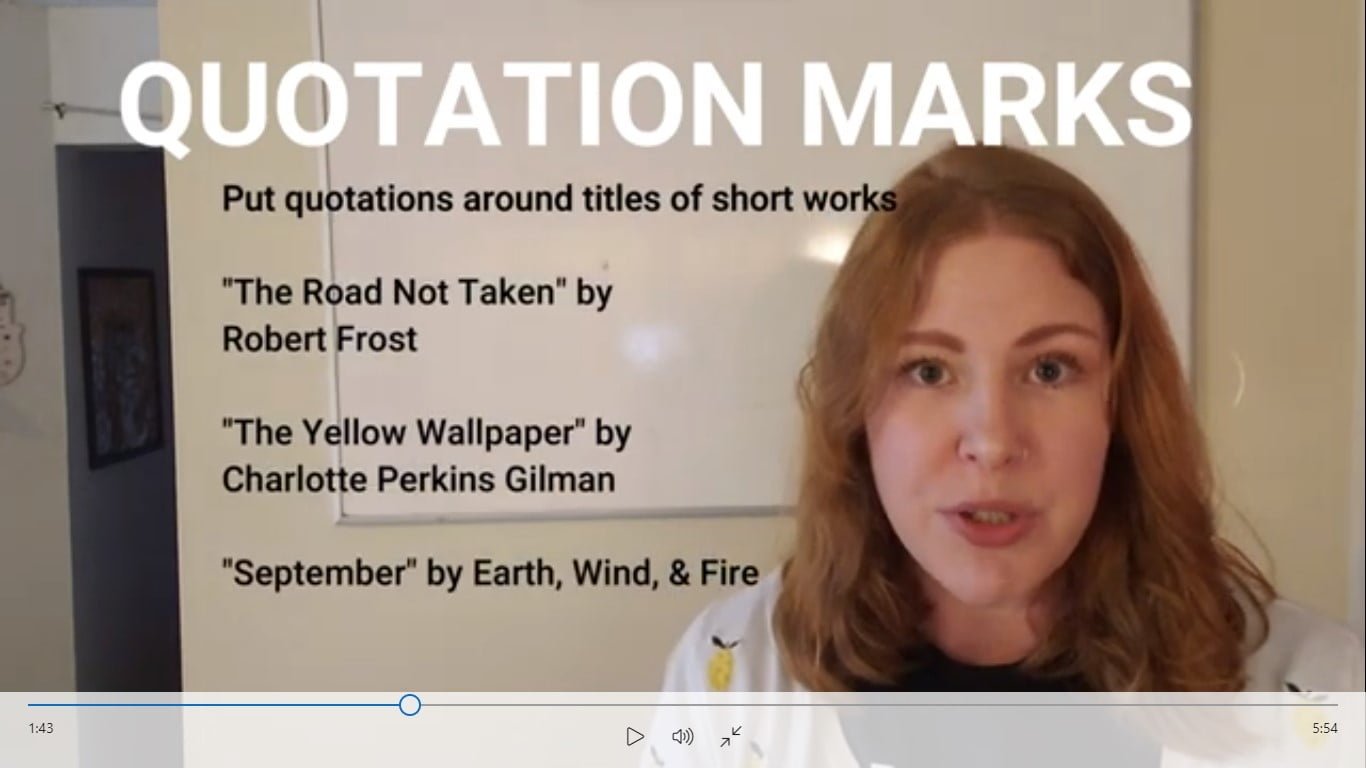
Quotation marks are used to enclose direct speech or a verbatim quotation. They indicate that the words in the quotation marks are attributed to someone else. Quotation marks can also denote titles of shorter works, such as articles, poems, or short stories.
For instance, “He said, ‘I’ll be there soon,'” or “I read the article ‘The Importance of Education.'”
II. When to use Brackets, Hyphen, Semi-Colons and Quotation Marks
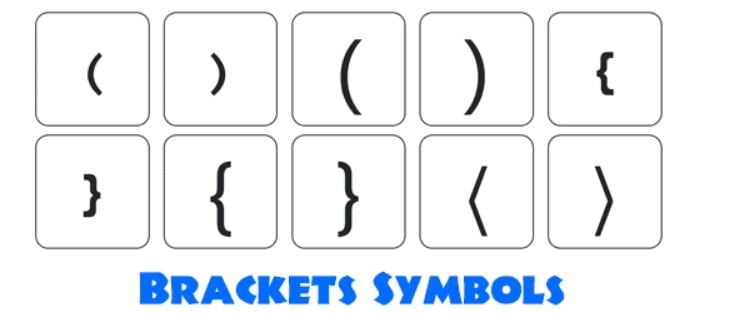
Another technique for placing more or clarifying information into a statement is by using brackets.
1. When to use Brackets:
a. Round Brackets
Round brackets, also known as parentheses, serve a similar purpose as dashes by separating non-essential phrases that provide additional information without disrupting the sentence’s overall meaning. If you were to remove the bracketed content, the sentence would remain coherent. For instance:
- Our sales team, located in North Africa, has surpassed its targets.
- Key statistics support the report's findings (refer to Appendix B).
Other examples:
- The event will take place at the stadium (next Saturday).
- The book (written by a renowned author) has received critical acclaim.
- We visited our friends in London (during our vacation).
b. Square Brackets
Square brackets are useful when you want to clarify quoted material, adding material that explains something that lies beyond the reader’s knowledge:
“I don’t know what effect these people [the newly arrived recruits] will have on the enemy, but they terrify me.”
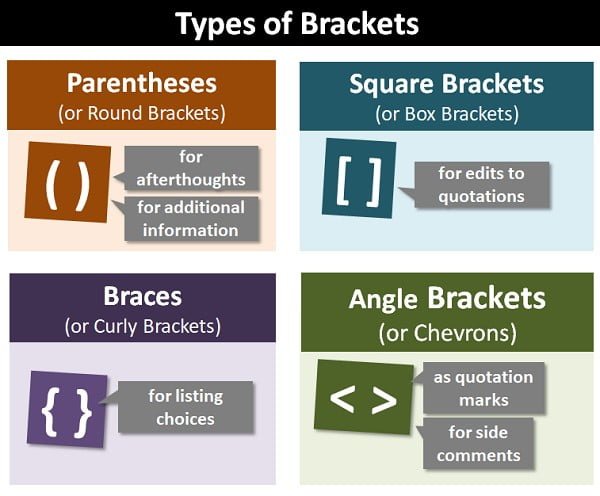
When you use parentheses or brackets at the end of a sentence, ensure that the period is placed after the closing bracket as the last punctuation in the sentence.
2. When to Use Hyphens
The hyphen (-) is a short horizontal rule that is almost always used without spaces before or after it. You use hyphens in three main situations:
- a. To join words together to form compound words.
- b. To add prefixes to words.
- c. To show word breaks at the ends of lines.
Examples:
- 1. The dark-haired man ran away / I bought a cloud-ready printer.
- 2. post-Newtonian science / pre-2010 credit agreements/ pre-owned/ co-operate.
3. When to Use Semicolons
a. To separate two main clauses.
You could also turn these two thoughts into separate sentences or link them with a conjunction.
Example: Many criminals leave clues; detectives follow the trail.
b. To separate a list of items that includes commas, such as names and titles or cities and states.
Example: The Century Club’s new officers are Rose Harper, president; Hans Klaus, vice president; and Leticia Perkins, treasurer.
4. When to Use Quotation Marks
a. To show the beginning and the end of "direct speech." Direct speech is a speaker's words written down as they were spoken.
For example: “I’m afraid you’ll have to come with me,” said the police officer.
b. To mark off a word or phrase directly quoted from somewhere else or emphasized as a point of discussion.
For example, Quotation marks show the beginning and end of “direct speech.”
How you utilize quotation marks varies depending on where you are in the world. In American English, quotation marks are double marks, whereas single quotation marks are used more often for direct speech in British English.
Make sure that you have prepared for your organization’s style and use it consistently throughout a piece of writing.
Also, in American English, any punctuation associated with the word or phrase in question comes before the closing quotation marks.
For example:
This is sometimes called “general relativity.”
Tighten the bolt with an “Allen key” tool before proceeding.
In British English, however, punctuation usually sits outside the closing quotation mark:
This is sometimes called ‘general relativity.’
In American English, when you quote a piece of direct speech within another piece of direct speech, you use single quotation marks.
For example: Emily said, “You may not know much, but even you understand ‘This meeting room is booked,’ I think.”
In British writing, the opposite is allowed (though it is not as strictly enforced as in American English). So: Emily said, ‘You may not know much, but even you understand “This meeting room is booked”, I think.’
Whatever style you employ, stick with one, and take care not to admixture the two within the same piece of writing.
Conclusion
As we bid farewell to brackets, hyphens, semicolons, and quotation marks, let us reflect on their significance beyond their mechanical functions. These tiny symbols are the gatekeepers of meaning, the architects of clarity, and the guardians of our written expressions. Their careful placement and purposeful deployment can elevate our writing from mere text to profound communication in a world saturated with words. So, embrace these punctuation allies, wield them with intention, and let them be your companions in pursuing impactful and thought-provoking writing.