


Lesson 6 – Skew Lines
Introduction
This lesson aims to help learners understand what a diagonal line is. Know how to determine the oblique line. Understand the characteristics of oblique lines through examples.
I. Definition
1. Introduction to skew lines
A skew line is a type of geometry that exists in three-dimensional space. A skew line is a new definition compared to regular lines in two-dimensional space, such as perpendiculars or parallel lines.
Skew lines are most commonly used in the field of design. Using slant lines to create multi-dimensional geometry will make 3D drawings more vivid and easier to visualize.
2. What is a skew line?
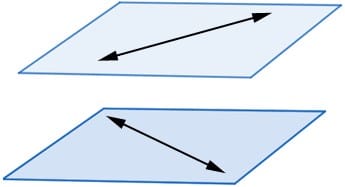
Skew lines are lines that are not parallel, coplanar, or intersecting. This indicates that skew lines are not similar and can never meet. Lines can intersect or parallel to exist in two dimensions or the same plane. Skew lines will never be coplanar since this condition does not apply to them; as a result, they always exist in three dimensions or more.
II. Explanation
1. How to determine the skew line?
To determine that two lines are a pair of skew lines, the first condition they must satisfy is that they lie in two distinct planes. The process of checking a couple of inclined lines consists of 3 steps:
Step 1:
Figure outlines that do not cross one another.
Step 2:
Verify that the lines in these pairings are not also parallel to one another
Step 3:
Next, determine if these non-parallel, non-intersecting lines are non-coplanar. If the answer is affirmative, the selected pair of lines is skew.
2. Distance between skew lines
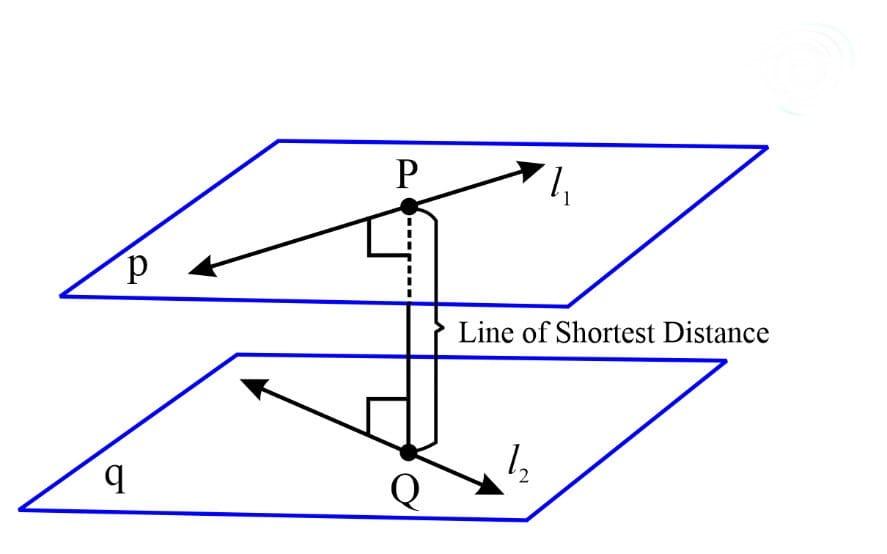
The line that runs perpendicular to the two skew lines, as opposed to any line that connects the two skew lines, provides information about the shortest distance between the two skew lines.
There are two methods to determine the distance between the slopes: the vector and the cartesian methods.
The following is the Vector Equation Method:
\[ \mathbf{v} = \begin{bmatrix} v_1 \\ v_2 \\ \vdots \\ v_n \end{bmatrix} \]
In this equation:
- \( \mathbf{v} \) represents the vector,
- \( v_1, v_2, \ldots, v_n \) are the components of the vector.
This method is used when parametric equations represent lines
The following is the Cartesian Method:
\[ \hat{y} = \beta_0 + \beta_1 x_1 + \beta_2 x_2 + \ldots + \beta_n x_n \]
In this formula:
- \( \hat{y} \) represents the predicted value,
- \( \beta_0 \) is the intercept term,
- \( \beta_1, \beta_2, \ldots, \beta_n \) are the coefficients for the features \( x_1, x_2, \ldots, x_n \) respectively.
\[ \left| \frac{{B_1C_2 – B_2C_1}}{{2}} \right| \left| \frac{{C_1A_2 – C_2A_1}}{{2}} \right| \left| \frac{{A_1B_2 – A_2B_1}}{{2}} \right| = 1 \]
This method is used when symmetry equations denote straight lines.
3. Example:
Example 1:
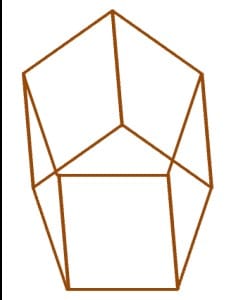
Draw two sets of skew lines on the image below after taking a screenshot or snipping it.
Solution:
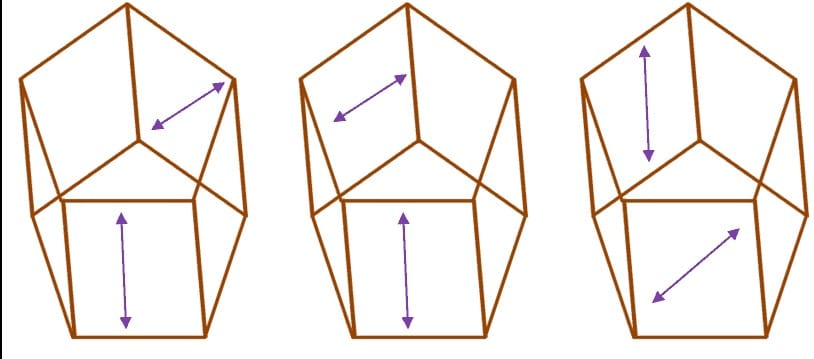
There are several ways to answer this question. Use the definition of the skew lines. Three potential skew line pairings are shown below.
Example 2:
You may detect skew lines in which of the following figures?
- A. Hexagon
- B. Cube
- C. The surface of a Sphere
- D. Octagon
Solution:
By definition, skew lines can only be discovered in figures with three dimensions or more. (A), (C) and (D) are no longer viable possibilities since planes can never include skew lines.
Cubes can have skew lines and are three-dimensional. Thus, it is B.
IV. FAQS
1. What are skew lines?
Skew lines are two non-parallel lines that exist in three-dimensional space and do not intersect. Unlike parallel lines, they are not coplanar and maintain a constant but non-zero distance from each other.
2. How can I differentiate between parallel and skew lines?
Parallel lines are equidistant and do not intersect even when extended infinitely. On the other hand, skew lines do not intersect and are not on the same plane.
3. Can skew lines ever become parallel or intersect?
Skew lines remain non-parallel and never intersect, regardless of how far they are extended.
4. How can I determine if two lines are skew lines?
To identify skew lines, check if they are non-parallel and not on the same plane. Calculate the angles between the lines or the distance between them to confirm their skewness.
Conclusion
In conclusion, the concept of skew lines provides a valuable perspective on the geometric relationships between lines in three-dimensional space. Skew lines are non-parallel lines that do not intersect and are not coplanar. Understanding skew lines involves grasping their distinct characteristics, such as maintaining a constant but non-zero distance between them. The study of skew lines is essential in geometry and has applications in various fields, including 3D modeling, engineering, and physics. By recognizing skew lines and their unique properties, we gain insights into the complexity of spatial relationships and enhance our ability to analyze and solve problems in three-dimensional environments.