

Lesson 6 – Rates of Evolution
Introduction
Evolutionary biology is a captivating field that unravels the mysteries of how species transform and adapt through the ages. In this article, we will delve into two intriguing theories that shed light on the pace of evolution: punctuated equilibrium and the molecular clock hypothesis. Understanding these concepts is essential for appreciating the dynamic nature of life on Earth. By reading this article, you will gain valuable insights into the fascinating processes that drive species change over time and grasp the significance of these theories in unraveling the complexities of evolution. Let’s embark on this enlightening journey into the rates of evolution and the wonders it reveals!
I. Punctuated Equilibrium
Punctuated equilibrium, a theory proposed by Niles Eldredge and Stephen Jay Gould in 1972, presents an alternative perspective to the prevailing view of gradualism in evolutionary biology. While gradualism suggests that evolution occurs through a continuous and steady accumulation of small changes over long periods of time, punctuated equilibrium suggests a different pattern.
According to punctuated equilibrium, species typically undergo long periods of stasis, where they experience relatively little evolutionary change. During stasis, species adapt to their environment and occupy a stable ecological niche. The prevailing selection pressures during this time act to maintain their characteristic features and ensure their survival.
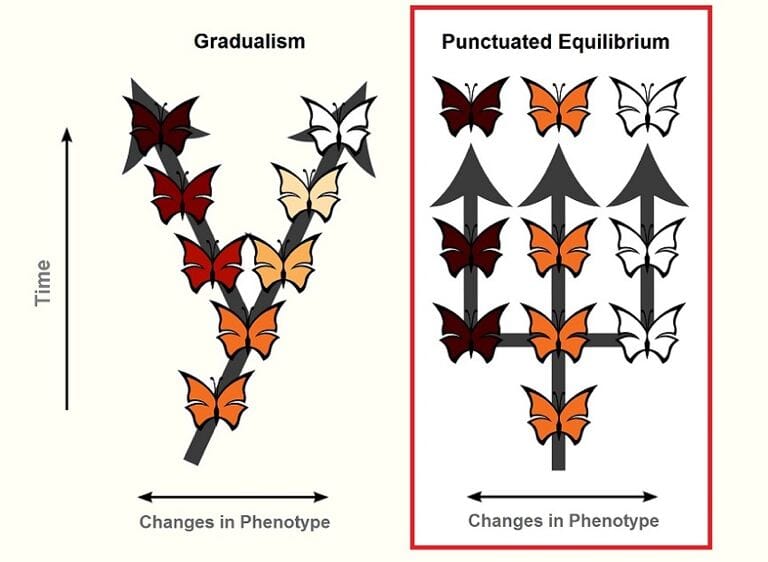
However, punctuated equilibrium proposes that species are also subject to relatively brief periods of rapid change, referred to as punctuations. These punctuations occur when significant environmental changes or disruptions create new selective pressures, driving the emergence of new species. Various factors, including habitat fragmentation, geographic isolation, or sudden environmental shifts can trigger these bursts of speciation.
During punctuations, genetic variations within a population that were previously not advantageous may become beneficial under the new environmental conditions. These variations can rapidly form new species as individuals with these advantageous traits have increased survival and reproductive success. As a result, new species can emerge relatively quickly, often in geologically short periods of time.
One of the consequences of punctuated equilibrium is the observation of gaps in the fossil record. These gaps occur because transitional forms, representing the intermediate stages of evolutionary change, may be rare and less likely to be preserved as fossils. The rapid nature of speciation events during punctuations means that the transitional forms between ancestral and descendant species may exist for relatively short periods and in limited geographic areas, making their fossilization less likely.

By emphasizing the intermittent and rapid nature of evolutionary change, punctuated equilibrium provides a framework for understand the dynamics of species formation and diversification. It highlights the importance of environmental factors and abrupt changes in driving speciation events, allowing for the rapid emergence of new species with distinct characteristics.
II. Molecular Clock Hypothesis
The Molecular Clock Hypothesis is a profound concept that grants us valuable insights into the dynamic rates of evolution. At its core, this hypothesis proposes that the rate at which molecular changes occur in DNA or protein sequences remains relatively constant over time. The foundation of this idea lies in the notion that mutations accumulate randomly in these genetic sequences, effectively creating a molecular “clock” that can be harnessed to estimate the timing of evolutionary events.
Understanding the Development Process:
The development of the Molecular Clock Hypothesis can be traced back to the mid-20th century when the eminent biologist, Linus Pauling and his colleague, Emile Zuckerkandl, introduced the concept of “molecular divergence.” They speculated that amino acid sequences in proteins could indicate evolutionary changes and the passage of time. Their groundbreaking work laid the groundwork for the molecular clock theory and sparked a new avenue of research in evolutionary biology.
At its inception, the hypothesis faced both support and skepticism. Critics questioned the reliability of using molecular sequences as a “clock” and whether the mutation rates remained constant. However, the hypothesis gained significant traction with advancements in DNA sequencing technologies and the accumulation of vast molecular data across different species.
How it Works:
The Molecular Clock Hypothesis operates on a straightforward premise: the more differences in DNA or protein sequences between species or populations, the longer they have been evolving independently. This assumption hinges on the idea that mutations in these sequences occur at a constant rate over time. As species diverge and grow, they accumulate fixed mutations that serve as genetic signatures of their evolutionary history.
Applications in Phylogenetics:
One of the significant applications of the Molecular Clock Hypothesis lies in phylogenetics, which aims to unravel the evolutionary relationships among different species. Researchers can construct phylogenetic trees that depict the branching patterns and divergence times between organisms by comparing molecular sequences. These trees provide a captivating visual representation of the intricate web of life and allow us to understand the common ancestry and relatedness between species.
Challenges and Refinements:
While the Molecular Clock Hypothesis has been an invaluable tool in studying evolutionary history, it is essential to acknowledge its limitations. Not all regions of the genome exhibit constant mutation rates, and factors like natural selection and genetic drift can influence the rate of molecular changes. As such, researchers must carefully select appropriate genes or regions to ensure accurate estimates of evolutionary time scales.

Despite these challenges, the Molecular Clock Hypothesis has revolutionized our understanding of evolution and given us a glimpse into the vastness of life’s history. As researchers continue to refine and expand upon this hypothesis, we uncover more profound insights into the rates of evolution, painting a clearer picture of the incredible journey that life has embarked upon through the ages. The Molecular Clock Hypothesis remains a powerful tool in our quest to explore the mysteries of evolution and the wondrous diversity of life on our planet.

Conclusion
Punctuated equilibrium and the molecular clock hypothesis provide complementary perspectives on the rates of evolution. Punctuated equilibrium highlights the intermittent bursts of rapid change amid long periods of stasis, emphasizing the role of environmental factors and selective pressures in driving evolutionary shifts. On the other hand, the molecular clock hypothesis offers a means to estimate divergence times based on accumulated mutations in DNA or protein sequences.
Although with limitations, these theories have significantly advanced our understanding of the dynamic nature of life on Earth. By exploring the rates of evolution, scientists gain profound insights into the complex processes that have shaped the remarkable diversity of species we see today. Further research and investigation into these theories will continue to enhance our knowledge of the intricate mechanisms driving evolutionary change.
In conclusion, studying punctuated equilibrium and the molecular clock hypothesis deepens our understanding of how species evolve and adapt over time. These concepts highlight the importance of environmental influences and provide tools to estimate the timing of evolutionary events. By unraveling the rates of evolution, we gain a profound appreciation for the ever-changing tapestry of life.