


Lesson 5 – The Effects of European Colonization
Introduction
The colonization process in Europe left an indelible mark on both the colonizers and the colonized, shaping economies, cultures, and societies. As European powers expanded their territories, they imposed their values, beliefs, and technologies, often overshadowing indigenous traditions and practices. This journey through the impacts of European colonization will offer deeper insights into Christopher Columbus and the Native Americans he encountered.
I. Before Columbus's Arrival in the Americas
Long before Christopher Columbus set foot on the New World, the Americas were home to advanced indigenous civilizations, each with its unique cultural identity. Among the most prominent were the Maya, with their intricate calendar systems and towering pyramids; the Aztec, known for their vast empire centered around the grand city of Tenochtitlán; and the Inca, who constructed the renowned city of Machu Picchu and had an extensive road system spanning their territory. These societies had sophisticated practices in agriculture, architecture, art, and governance. The daily lives of their citizens were deeply intertwined with their spiritual beliefs, rituals, and ceremonies. Each tribe and community held steadfast to traditions passed down through generations, creating a vibrant tapestry of cultures across the continent.”
II. Columbus and America
1. Christopher Columbus's First Voyage
Christopher Columbus, an Italian explorer sailing under the Spanish flag, embarked on a momentous journey in 1492, seeking a westward route to the riches of Asia. Contrary to popular belief at the time, Columbus hypothesized that by sailing west, he would find a direct route to the Orient. Instead, this expedition led to the discovery of the Americas for the European world. The voyage, backed by King Ferdinand and Queen Isabella of Spain, aimed primarily at finding new trade routes and treasures. However, its outcome was far more significant, as it bridged the Old World with the New, changing the course of history and global exploration forever.
2. The First Encounters
After a long and arduous journey across the Atlantic, Christopher Columbus and his crew finally made landfall on an island he named San Salvador, believed to be part of the present-day Bahamas. This marked the beginning of European exploration in the New World. As Columbus ventured further, he explored nearby areas, always in anticipation of discovering the riches of the East Indies.
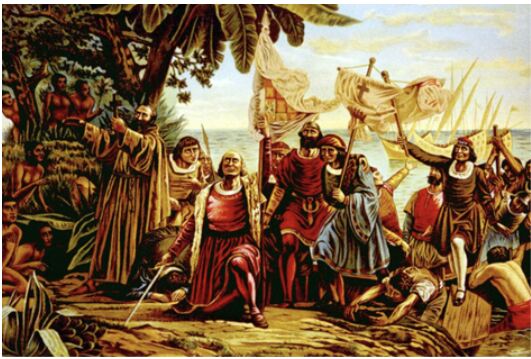
Figure 01: The First Encounters
Upon his arrival, the initial interactions between Columbus and the indigenous peoples were marked by a mix of curiosity and apprehension. The native inhabitants, having never seen such ships or people, approached with caution, intrigued by these foreign visitors. Columbus, on the other hand, saw them as subjects to be converted to Christianity and potential sources of information about the region’s wealth. While there were exchanges of gifts and some semblance of mutual respect in the beginning, the dynamics would shift dramatically as the true intentions of the European explorers became clear.”
3. Impacts of Columbus and the Spaniards on the Indigenous Peoples
The arrival of Columbus marked the onset of a period of European colonization and domination in the New World. The Spanish, under the banner of exploration and expansion, began establishing colonies, often at the expense of indigenous communities. This era of colonization was characterized by land seizures, forced labor systems like the ‘encomienda’, and the imposition of European governance structures and religious beliefs.
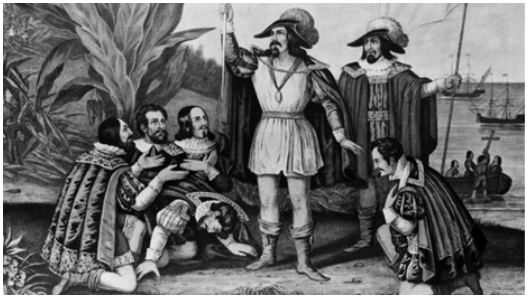
Figure 02: Currier and Ives print of Italian explorer Christopher Columbus (1451-1506), landing in the West Indies on October 11, 1492.
As the two worlds collided, there was an undeniable exchange of cultures and technologies. The indigenous people were introduced to European goods, livestock, and agricultural techniques. However, this exchange was not benign. Alongside these introductions came diseases like smallpox and measles, to which the native populations had no immunity. These diseases wreaked havoc, leading to catastrophic population declines in some regions.
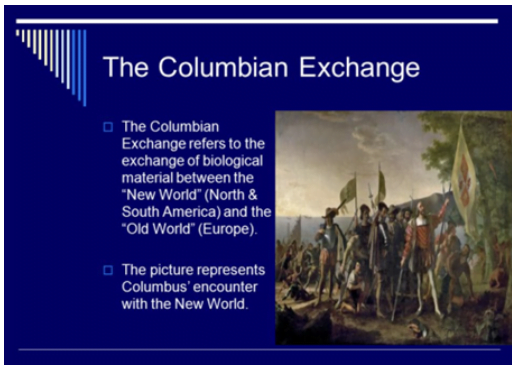
Figure 03: The Columbian Exchange
But the indigenous people were not mere passive recipients of European conquest. Many communities resisted Spanish domination, leading to conflicts and rebellions. From subtle acts of defiance to organized uprisings, the native inhabitants continually fought to maintain their way of life and autonomy in the face of overwhelming European influence.
III. Perspectives and Controversies Surrounding Columbus
Historically, Christopher Columbus has often been portrayed in a favorable light, celebrated as a brave explorer and navigator who paved the way for European exploration in the Americas. In many Western narratives, he’s been credited with ‘discovering’ a New World, and tales of his voyages were filled with heroism and daring feats.
However, in recent decades, a more critical perspective on Columbus has emerged, highlighting the darker aspects of his adventures. Critics argue that he was not the first to reach the Americas, pointing to evidence of Viking expeditions and possibly other explorers before him. More significantly, there’s a growing focus on the detrimental impact of his voyages on the indigenous populations. Columbus, and the Europeans who followed, are often blamed for initiating a sequence of colonization, forced labor, cultural erasure, and the introduction of deadly diseases which decimated native populations.
These controversies have sparked debates on how Columbus should be remembered and have led to re-evaluations of his legacy in curricula, public monuments, and annual observances like Columbus Day.
IV. FAQ
What were the long-term consequences of Columbus's arrival and the subsequent Spanish colonization on the indigenous peoples of the Americas?
The arrival of Columbus and subsequent Spanish colonization had long-term consequences for indigenous peoples in the Americas. These included forced labor, displacement, cultural assimilation, and the introduction of diseases that decimated native populations. Many indigenous societies and cultures were disrupted, leading to the loss of land, traditions, and autonomy.
Can you explain the concept of the Columbian Exchange and its impact on both the Old World and the New World?
The Columbian Exchange refers to the widespread exchange of goods, ideas, plants, animals, and diseases between the Old World and the New World following Columbus's arrival. This exchange had a profound impact on both regions. New World crops such as maize, potatoes, and tomatoes revolutionized Old World agriculture, while European diseases had devastating effects on indigenous populations. The exchange also led to the spread of new technologies, cultural practices, and the mixing of peoples.
What evidence exists to challenge the notion that Christopher Columbus was the first to reach the Americas?
Evidence challenging the notion that Columbus was the first to reach the Americas includes archaeological findings of pre-Columbian settlements and artifacts, such as the Viking settlement at L'Anse aux Meadows in Canada. Additionally, indigenous oral histories and navigational knowledge suggest that other groups may have reached the Americas before Columbus.
What are some of the controversies surrounding Christopher Columbus's legacy, particularly in relation to the indigenous populations?
Controversies surrounding Columbus's legacy stem from his role in initiating European colonization, which resulted in the displacement, oppression, and mistreatment of indigenous populations. Critics argue that celebrating Columbus overlooks the violence and exploitation associated with colonization and fails to acknowledge the perspectives and experiences of indigenous peoples.
In what ways did European colonization disrupt and alter the cultures and societies of the indigenous peoples in the Americas?
European colonization disrupted and altered indigenous cultures and societies in various ways. It included the imposition of new political systems, religious conversion efforts, forced labor systems, cultural assimilation, and the loss of land and resources. These disruptions often led to the erosion of indigenous languages, traditions, and social structures.
Conclusion
Christopher Columbus’s voyages undeniably transformed the course of global history, marking a monumental junction between two distinct civilizations. On one hand, his explorations paved the way for further European expeditions and the bridging of the Old and New Worlds, leading to a cross-pollination of cultures, ideas, and technologies. On the other hand, the negative repercussions of his voyages are evident in the devastating impact on indigenous populations, from cultural erosion to the introduction of deadly diseases.
It’s imperative to approach history with a multi-faceted lens, recognizing both the feats and follies of iconic figures like Columbus. Only by understanding history from varied perspectives can we truly grasp the nuances and learn from the past.