


Lesson 5 – Parts of Speech
Introduction
A verbal word comes from a verb and is used as a noun or modifier in a sentence. In simpler terms, a verbal is a verb in a different part of speech.
There are three types of verbals: infinitives, gerunds (also known as -ing forms), and participles (also known as -ing forms and -en forms). A group of words based on a verbal is called a verbal phrase. These verbals are often part of a phrase that includes other words like modifiers, objects, and complements.
I. Gerunds
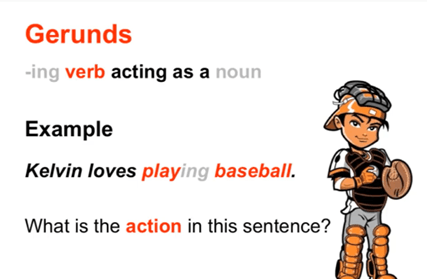
A gerund is a type of word that ends with “-ing” and functions as a noun. The “-ing” is added to a verb, but the result is a word that acts as a noun.
Let’s compare the following sentences:
- John is painting.
- John's hobby is painting.
In the first sentence, the word “painting” is the main verb, describing the action of painting. However, in the second sentence, “painting” is treated as the name of Roma’s hobby.
If we were to ask questions that these sentences answer, the questions would be:
- What is John doing?
- What is John's hobby?
As you can see, the first question asks about the action (What is Roma doing?), while the second question asks for the name of Roma’s hobby (What is Roma’s hobby?). In the second sentence, the action becomes a noun.
Here are some examples of sentences using gerunds:
- Traveling is good for the mind.
- They complimented me on my singing.
- His favorite hobby is sleeping.
- He has been booked for drunk driving.
A gerund phrase is a group of words that functions as a gerund. In the following sentences, the underlined phrases are gerund phrases:
- Climbing Mount Everest is easier than what we are climbing right now.
- Talking to my dog is more soothing to me than having a bowl of ice cream.
A gerund cannot be used in a sentence without a main verb, and gerunds do not use punctuation.
II. Infinitives
An infinitive is a verbal noun that can function as a noun, adjective, or adverb. It is formed by adding “to” before a verb in its simple form.

Let’s compare the following sentences:
- Lucy hates to wait.
- Lucy likes to paint.
In these sentences, the main verbs are “hates” and “likes,” while “to wait” and “to paint” are infinitives.
Now, let’s look at the gerund form of these sentences:
- Lucy hates waiting.
- Lucy likes painting.
In other words, if we remove the “-ing” ending from a gerund and add “to” before it, it becomes an infinitive.
When an infinitive or infinitive phrase is used at the beginning of a sentence, it should be followed by a comma.
For example:
- To arrive on time, Lucy took the metro.
- To master your aim, you must practice daily.
III. Participles
A participle is a type of verb that functions as an adjective and ends in “-ing”, “-ed”, “-en”, “-d”, “-t”, “-n”, or “-ne” depending on the root word.
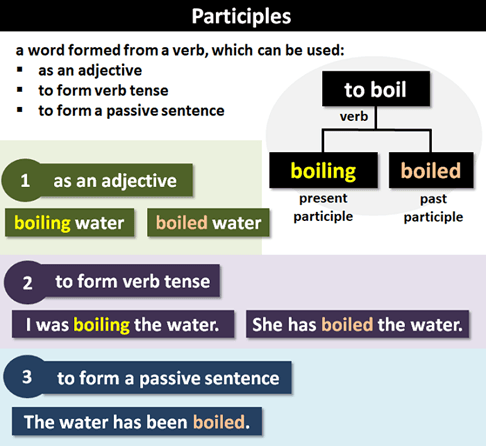
A participial phrase is a group of words that includes a participle and nouns or pronouns that work together as participles.
For example:
- Anna jumped into the river, removing her shoes.
- Delia noticed her dog running along the road.
When a sentence begins with a participial phrase, a comma should be used after the phrase. Additionally, the participial phrase should be placed close to the noun it describes to avoid confusion.
For instance:
- While talking to Rohan, I smiled at Tota.
- I smiled at Tota while talking to Rohan.
In these sentences, without the commas, it is unclear who is talking to Rohan. Therefore, when using participial phrases, it is important to place them close to the noun that is acting.
IV. Difference Between Finite and Non-Finite Verb
In grammar, the distinction between finite and non-finite verbs is crucial when analyzing sentence structure. A finite verb is a verb that has tense, number, and person agreement with the subject of a sentence. It functions as the main verb in a clause and can express actions or states with time reference. Non-finite verbs, on the other hand, lack these grammatical features and cannot function as main verbs alone. They include infinitives, gerunds, and participles. Infinitives are base forms of verbs preceded by “to” (e.g., to eat), gerunds are verb forms ending in “-ing” used as nouns (e.g., swimming is fun), and participles are verb forms that can act as adjectives (e.g., the broken lamp). Although both finite and non-finite verbs play important roles in constructing sentences, understanding their differences enhances clarity and accuracy in syntactic analysis.
V. Exercise: Identifying Verbals
In this exercise, you will determine whether the word or phrase in each of the following sentences is a participle, a gerund, or an infinitive.
- Our son singing and laughing woke me up.
- Peter likes to dance in the rain.
- There are many ways of breaking a heart.
- A broken heart will mend over time.
- Happiness is having a large, loving, caring, close-knit family in another city.
- I believe that laughing is the best calorie burner.
- I don't want to achieve immortality through my work. I want to achieve it through not dying.
- It is not enough to succeed.
- Succeeding is not enough.
Answers:
- In this sentence, the words "singing" and "laughing" are functioning as nouns, which makes them gerunds.
- You can identify "to dance" as an infinitive because it is preceded by the word "to".
- The word "breaking" is a verbal that serves as a noun and is also the object of the preposition "of".
- Implied in this sentence is the verbal phrase "that has been" preceding the verbal "broken", indicating that it is a past participle. This shows that something happened and was completed in the past.
- "Loving" and "caring" are verbal that indicate actions occurring in the present, making them present participles.
- "Laughing" is a noun and therefore a gerund.
- In both cases, the verbal "to achieve" is an infinitive because it is a verb preceded by "to".
- "Dying" is used as a noun in the sentence, making it a gerund.
- "To succeed" is an infinitive because it is a verb preceded by "to".
- "Succeeding" is a noun in this sentence and serves as the subject of the first sentence, making it a gerund.
VI. FAQs
1. What is the role of gerunds and infinitives in a sentence?
A gerund is a word formed from a verb that acts as a noun and always ends in -ing. It can function as a subject, subject complement, direct object, indirect object, or object of a preposition.
An infinitive is a verb form that functions as a noun, adjective, or adverb. It is formed by adding “to” before the base form of a verb. An infinitive expresses an action or a state of being.
2. What part of speech do verbal, such as gerunds, infinitives, and participles, belong to?
Verbals such as gerunds, infinitives, and participles are derived from verbs and can function in sentences as nouns, adjectives, or adverbs. Gerunds act as nouns by naming activities or actions and can perform all the functions typically associated with nouns, such as being a subject or an object in a sentence. Infinitives are formed by adding “to” before the base form of a verb and often act as nouns or modifiers. They can function as subjects, direct objects, predicate nominatives, or modifiers in a sentence. Participles are verb forms that function as adjectives by describing or modifying nouns or pronouns. There are two types of participles: present participles ending in -ing (e.g., running) and past participles ending in -ed (e.g., played). They provide detailed information to a sentence by attributing qualities to the subject or the object they modify. Understanding the different roles that verbal can play is essential for constructing grammatically correct and coherent sentences.
3. What are the different parts of speech that gerunds can be?
A gerund is a word formed from a verb that acts as a noun and always ends in -ing. As a noun, a gerund can serve as a subject, a subject complement, a direct object, an indirect object, or an object of a preposition.
Conclusion
To sum up, the lesson on Parts of Speech, with a specific focus on gerunds, participles, and infinitives, has effectively given a thorough comprehension of these intricate language structures. Throughout the lesson, the instructor effectively explained the key characteristics and functions of each component and demonstrated their practical usage in sentences using real-life examples. These examples showed how gerunds can function as nouns while ending in –ing, participles can act as adjectives or verbs depending on their role in a sentence, and infinitives serve as verb forms preceded by “to”.