


Lesson 4 – What Are Specialized Information Systems?
Introduction
The continual evolution of technology has ushered in various ways for information technology to integrate into the business realm. A prominent implementation gaining widespread acclaim is utilizing information systems, showcasing the synergy between human intelligence and technological capabilities for enhanced business outcomes.
The trajectory of information systems and their enduring significance in the business sphere hinges on their emphasis on automation and the integration of AI technology. This article delves into the essence of information systems, dissecting their components and diverse types.
I. Understanding Information Systems
An information system is an amalgamation of data sets designed to accomplish business objectives. Unlike a standalone model in the IT industry, its efficacy lies in integrating data and business processes. Envisaging the information system as a triangle is beneficial, with its three corners representing processes, people, and computers, each indispensable for optimal functioning.
1. Tools Employed in Information Systems
Information systems utilize a spectrum of equipment to facilitate seamless information distribution. This equipment includes diverse hardware forms and virtual tools comprising various systems and application software. Conceptualizing the information system as a software program underscores its role in organizing data and conducting multifaceted analyses, transforming raw data into meaningful information.
2. Applications of Information Systems
Information systems serve both general and specialized purposes. General-purpose systems, such as database management, cater to a broad spectrum of data organization and analysis. In contrast, technical information systems are meticulously tailored for specific organizational processes, exemplified by expert systems focused on solving intricate problems within distinct fields.
3. Components of An Information System
The information system triangle highlights three integral components: people, business processes, and information technology.
People
Encompasses individuals interacting with the specific process covered by the information system, like line workers managing tasks in a manufacturing factory.
Business Processes
Refers to activities conducted within a business that, in some capacity, interface with the information system, such as the production process in a manufacturing facility.
Information Technology
Constitutes the hardware and software components vital for the information system's functionality, ensuring data collection, storage, analysis, and organization.
II. Types of Information Systems
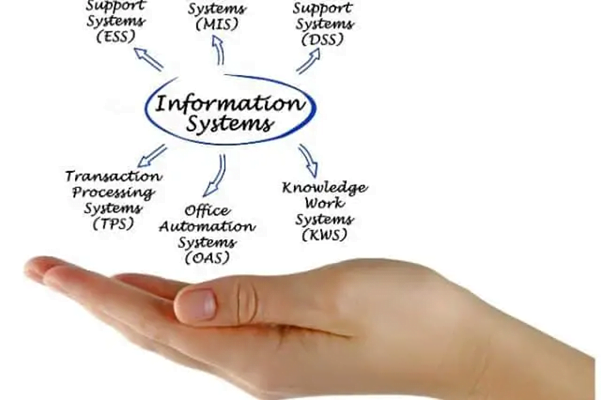
An information system type selection depends on an organization’s current and overarching business objectives. The four primary types include:
Operations Support Systems
Complementary to specific business operations, such as bank transaction processing systems.
Management Information Systems
Integrating hardware and software to gather and analyze data, aiding core organizational functions.
Decision Support Systems
Facilitating informed decisions through automated or human-operated systems, particularly in rapidly changing scenarios.
Executive Information Systems (ESS)
Advanced systems catering to senior-level decision-making needs, emphasizing graphical representation and a comprehensive overview.
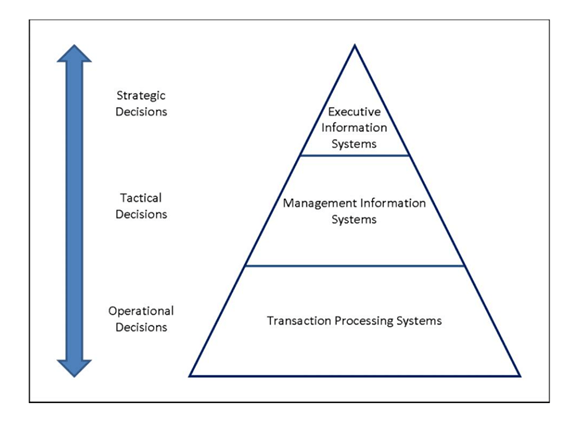
The three-level pyramid model is based on the type of decisions made at various organizational levels.
III. Applications of Information Technology
Although the system application descriptions hint at how they are best applied, Information systems find application in various domains.
1. Information/Data Storage
Companies need good information to generate better goods and services. Still, they also need a dependable, cost-effective system to store the information and allow quick data access when required. A sound information system lets firms keep track of important events and preserve valuable assets, including communication records, revision histories, activity logs, operational statistics, and other pertinent documents. Businesses understand why issues and blockages exist and how to fix them by keeping information orderly.
2. Rolling Out New Products and Services
Despite the ever-increasing need for new goods and services, each company that wants to stay competitive requires knowledge to make better decisions and, as a result, offer better products. Information systems aid in analyzing independent processes and the organization of the company’s work operations. As a result, an information system enables a company to understand better how to develop, manufacture, and sell services or goods that customers desire.
3. Simplified Decision Making
Making judgments is difficult enough, let alone constantly making the correct decisions. There is no certainty that an organization’s decisions will be successful. However, information systems alleviate some suffering by providing information quickly and simply.
4. Improving Employee Attitudes and Behaviors
Employers and workers can benefit from improved communication via information technology. An effective information system empowers employees by making important information more accessible, allowing them to participate in decision-making. This sense of empowerment enhances motivation and devotion to the project or job.
The following are some broad categories that emphasize different sorts of information system applications:
Communication
Information system applications make data exchange on a worldwide scale possible.
Education
Information systems facilitate remote learning (especially beneficial during pandemics) and assist individuals in getting more familiar with technological advances such as smartphones, tablets, and other network devices.
Employment
Information technology has directly led to new jobs, such as data analysts and cyber-security professionals.
Finance
Information systems make money transfers more managed and safe.
Healthcare
Healthcare practitioners may now access critical medical records more quickly, thanks to information systems.
Security
Data precautions are made more accessible to implement by information technology, reducing the probability of a data breach or infection.
Conclusion
Information systems are pivotal in steering operations and decision-making in the contemporary business landscape. As data security becomes increasingly critical, the demand for cybersecurity experts is rising. This lesson serves as a starting point for individuals aspiring to embark on a career in cybersecurity, providing insights into the dynamic and sought-after field. Take advantage of the opportunity to explore our comprehensive cybersecurity courses to kickstart an exciting and rewarding career.