


Chapter 1, Lesson 4
In Progress
Lesson 4 – How to Properly Use Capitalization While Writing
Chapter Progress
0% Complete
Introduction
Capitalization is an essential aspect of writing that often goes unnoticed once mistakes are made. Incorrect capitalization can undermine the credibility and professionalism of your written work, distracting readers from your intended message. The improper use of capital letters can be confusing, leading to misunderstandings and a lack of clarity. In this lesson, we will delve into the nuances of capitalization and provide valuable insights and guidelines to ensure that you use capital letters appropriately in your writing.
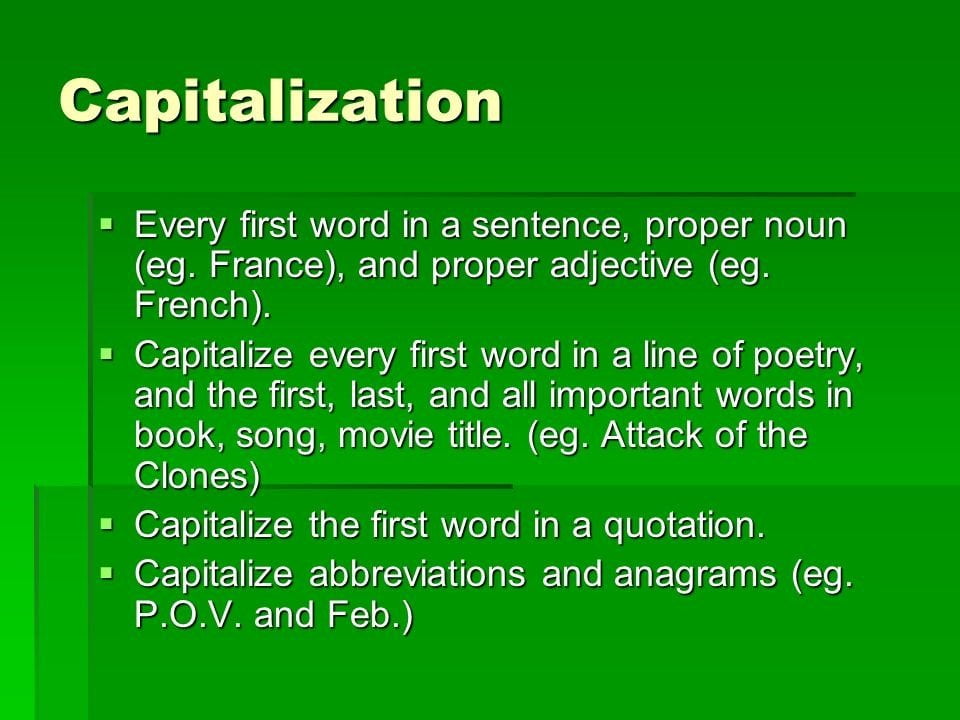
I. Capitalization Rules in English
Commas can be a particularly tricky punctuation mark. There are some cases where you know you should use a comma – such as when separating items in a list – but there are other times when you might be unsure whether or not a comma is needed.
| Capitalize | Don’t capitalize | |
|---|---|---|
|
People |
Names (and words derived from them); nationalities; titles when used as part of a name
|
Occupations; titles when not used as part of a name
|
|
Places |
Names of specific continents, countries, states, cities, regions, monuments and landmarks
|
Directions and general areas
|
|
Times |
Days of the week and months of the year; historical eras and named events; holidays
|
Centuries, decades, seasons
|
|
Others |
|
|
II. How to Use Proper Capitalize
1. Understanding Capitalization of Directions
Knowing when to capitalize directions is essential.
Cardinal and intercardinal directions (e.g., southwest, northwest) generally do not require capitalization. This is because demands often rely on standardized written and spoken patterns to provide specific and unique information. However, consider the following guidelines:
- Capitalizing the names of regions, such as "South" or "West," is generally considered accurate, although some scholars debate its necessity. For example:
- I’m traveling from the South to the North for my vacation.
- She moved out West to pursue her career.
- Differentiate between using a cardinal direction and mentioning the name of a region. For example, in the sentence "I'm driving west to Seattle from Chicago," the term "west" indicates the direction of travel, not the region's name. If you intend to specify the region's name, capitalize it. Be intentional in your choice. For instance:
- We’re moving to the West Coast next month.
- Let’s head south for our summer getaway.
- The capitalization of phrases like "southerner," which describe the residents of a region, is a topic of debate among academics. Both "Southerner" and "Southerner" are accepted forms. For example:
- The Southerner greeted us with a warm smile.
- She’s proud to be a Southerner, born and raised in Georgia.
2. Guidelines for Capitalizing Job Titles
Understanding when to capitalize job titles is essential. Here are some examples:
- Incorrect capitalization: "I work as a regional manager for Alpha Beta Video."
- Correct capitalization before a name: "Professor Richard Hofstadter delivered an inspiring lecture."
- Avoid capitalization for emphasis: "I am an engineer, not just an Engineer."
3. Capitalization of Seasons
Knowing when to capitalize on seasons depends on specific circumstances. Consider these examples:
- Capitalizing in titles or ceremonies: "Join us for the Annual Spring Festival."
- Capitalizing when referring to a particular semester: "I'm taking Biology 101 in the Fall semester."
- Combining capitalization with specificity: "We're planning a summer beach vacation in the Caribbean."
4. Capitalization of Animal Breeds and Plant Species
Capitalizing on animal breeds and plant species can take time and effort. Here are some examples:
- Lowercase for plant species: "I love the scent of lavender flowers."
- Capitalizing the person or location part: "We adopted a Labrador Retriever named Max."
- Binomial nomenclature capitalization: "The scientific name for the gray wolf is Canis lupus."
- Capitalizing genus but not species: "Canis lupus is the scientific name for the gray wolf, while Canis lupus familiaris refers to the domestic dog."

III. Exercises
Exercise 1: Rewrite the following sentences, correcting any capitalization errors:
1. i love to go hiking in the mountains.
2. my best friend is a doctor at the local hospital.
3. the golden gate bridge is a famous landmark in san francisco.
4. she works as a manager for a multinational corporation.
5. my favorite season is spring because of the blooming flowers.
Exercise 2: Add proper capitalization to the following sentences where necessary:
1. the ceo of the company announced a new product launch.
2. we’re planning a family trip to visit the grand canyon in the summer.
3. john studied english literature at oxford university.
4. the mayor will give a speech at the town hall meeting.
5. my dog, rover, is a labrador retriever.
Exercise 3: Write five sentences of your own, ensuring proper capitalization according to the rules discussed. Include a variety of scenarios, such as job titles, geographic locations, seasons, or names of people and animals.
Answer
Exercise 1:
1. I love to go hiking in the mountains.
2. My best friend is a doctor at the local hospital.
3. The Golden Gate Bridge is a famous landmark in San Francisco.
4. She works as a manager for a multinational corporation.
5. My favorite season is spring because of the blooming flowers.
Exercise 2:
1. The CEO of the company announced a new product launch.
2. We’re planning a family trip to visit the Grand Canyon in the summer.
3. John studied English literature at Oxford University.
4. The mayor will give a speech at the town hall meeting.
5. My dog, Rover, is a Labrador Retriever.
Exercise 3: (Sample sentences)
1. Professor Smith is a renowned expert in astrophysics.
2. I can’t wait to visit Paris, the City of Lights.
3. Fall semester at Harvard University begins in September.
4. The Pacific Ocean is the largest body of water on Earth.
5. Mark loves listening to classical music, especially Beethoven’s symphonies.
Conclusion
Capitalization plays a vital role in writing, extending beyond mere rules. It acts as a key that unlocks clarity, emphasis, and professionalism. Through the effective use of capital letters, we can lead our readers through our words and create a lasting impact. As you venture into the realm of writing, remember that proper capitalization is more than just technical correctness. It is an art that breathes life into your sentences and leaves a lasting impression.