


Lesson 4 – Characterization in Grendel
Introduction
The novel “Grendel” tells the story of a monster named Grendel, who shares his experiences of feeling disconnected from his mother, waging war against King Hrothgar’s Danes, engaging in a conversation with an existentialist dragon, and ultimately facing his fatal battle with the Scandinavian hero Beowulf.
John Gardner, born in Batavia, New York in 1933, carried a lifelong burden of guilt due to a tragic accident involving a tractor that took the life of his younger brother in 1945. At the age of 11, John was driving the vehicle when his brother, who was riding in the back, got caught under the heavy cultipacker, a device used to crush earth. Throughout his adult life, Gardner believed that “art begins in a wound.” Before he died in a motorcycle accident in 1982, he published several works that aimed to heal or at least alleviate the “wound inherent like life itself” (Gardner, On Moral Fiction, p. 181). Gardner strongly believed in the power of art to shape human experiences, whether positively or negatively. In his essay “On Moral Fiction,” Gardner criticized contemporary novelists for neglecting their responsibility to create morally impactful art. Although he was also a poet and critic, Gardner became best known for his novels, with “Grendel” being his third published work (following “The Resurrection” in 1966 and “The Wreckage of Agathon” in 1970). While he went on to write more novels, “Grendel” remained his most enduring work, as it delved into the profound philosophical questions of Gardner’s time. Essentially, the novel allows the inherent wounds of life to speak for themselves through the brutally cynical voice of a murderous monster, borrowed from an epic poem, who distrusts and fears the power of poetry to provide solace and create meaning.
I. Analysis
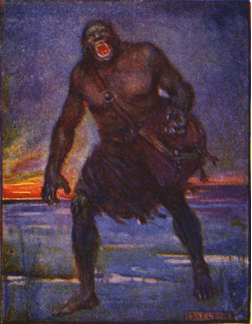
The second encounter between humans and Grendel establishes a new connection between them, incorporating Grendel into the humans’ developing religious system. Initially, the humans are unsure of what to make of Grendel and come up with absurd ideas, eventually settling on the belief that he is a tree spirit. The ensuing battle is chaotic and confusing, but Grendel realizes that these humans are more dangerous than they appear. They are capable of creating patterns, making them harder to defeat than the instinctual animals Grendel has encountered before. The Shaper, the most powerful patternmaker, weaves a story that not only provides humans with a religious framework but also assigns a role to Grendel, who has been an observer until now.
The Shaper’s song about the creation of the world reflects a Judeo-Christian view, which aligns with the perspective of the Beowulf poet. The Shaper’s tale, which tells of a feud between brothers resulting in a world divided between darkness and light, alludes to the biblical story of Cain and Abel. In this story, Cain becomes jealous of Abel and murders him. God curses Cain to wander the earth, but also marks him to protect him from harm. The idea that Grendel is a descendant of Cain is mentioned in the original Beowulf text and is foreshadowed by Gardner’s portrayal of Grendel’s mother. Grendel imagines his mother being haunted by an ancestral crime.
Grendel has mixed feelings about the role assigned to him by the Shaper. He takes most of the Shaper’s songs with skepticism, knowing they are fictional. Grendel has witnessed the brutality of humankind and believes that if he is cursed, so are they. However, he eventually breaks down and accepts the Shaper’s religious vision, finding beauty in the story of God. In this Judeo-Christian system, Grendel finds a place and purpose as an outsider, even though it is a savage and unsavory position. He cannot join the humans as a brother or friend, but he can join them by fighting against them.
In this chapter, Grendel becomes more aware of the power of language and how it connects and separates him from humans. He reluctantly relies on human language to tell his story and is influenced by the Shaper’s songs. Throughout the novel, Grendel incorporates elements of Anglo-Saxon poetry into his narrative style. When Grendel is rejected by the Danes and flees, he curses in human language and laments the fact that even his curses are borrowed. The tragic irony is that Grendel and the humans speak the same language, but the humans are too afraid and repulsed to understand him. Grendel experiments with different forms and styles of language, but he cannot use it for its fundamental purpose of communication.
II. Historical Events During the Time of the Novel
1. The Dark Ages
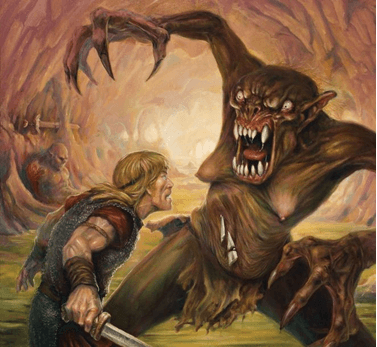
Gardner drew inspiration from the Old English epic Beowulf (also found in Literature and Its Times) to create the main characters and some of the incidents in Grendel. The novel’s protagonist and narrator, Grendel, is a humanoid monster who feeds on the followers of Hrothgar, the sixth-century king of the Scyldings, a Danish tribe. Beowulf, a hero from what is now southern Sweden, comes to Denmark to rid the Danes of this menace and succeeds. By the end of the poem, Beowulf has slain three monsters, with Grendel being the first.
The exact date of Beowulf’s composition is uncertain, with estimates ranging from the late seventh century to around 1000 CE, which is when the sole surviving manuscript copy of the poem was written. Regardless of the precise date, Beowulf was composed during the early Middle Ages, a period commonly referred to as the Dark Ages. This term not only describes the relatively impoverished state of the time but also carries a negative judgment, suggesting that the period lost or wasted many of the achievements of earlier antiquity.
According to convention, the Dark Ages began with the fall of Christian Rome to Germanic invaders in the late fifth century. In the years that followed, the European classical civilization inherited from the ancient Roman Empire suffered significant setbacks. Germanic invaders took control of several former Roman colonies, including Celtic Britain and Gaul, and many of these invaders, such as the Angles and Saxons who migrated to England, were pagans. By the time Beowulf was written down, the Anglo-Saxons had converted to Christianity and had learned to read and write using the Roman alphabet. However, for many regions of the former Roman Empire, the Dark Ages marked a period of declining literacy and learning, dwindling urban populations, and a struggling Mediterranean-based economy that took a long time to recover.
2. Germanic society
The exact place and date of Beowulf’s creation are uncertain, but historical references in the poem suggest that its events took place in mainland Europe during the sixth century CE. During this time, the Germanic immigrants in England, where Beowulf was written, still held onto the pagan beliefs of their counterparts on the continent. They also shared more than just beliefs with the pagan Scandinavians, specifically Hrothgar’s Danes and Beowulf’s Geats, who are the main focus of the poem. In addition to speaking similar languages, the pagan English and Scandinavians shared a heroic culture that revolved around the concept of the comitatus. The comitatus referred to a group of warrior-retainers, known as thanes in England, who pledged their loyalty to their chieftain or king in exchange for generous gifts. The poem describes a society that values honor, rewards bravery, and expects loyalty within the comitatus. When not engaged in battle, warriors gather in large wooden halls to drink and listen to poetic tales of warlike exploits, while also making boastful pledges of their future acts of valor.
3. The Anglo-Saxons and the Vikings
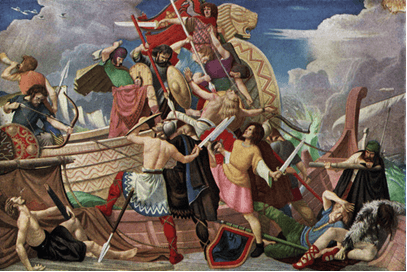
The Anglo-Saxons and the Vikings have a shared history, which may explain why the most famous poem of the Christian Anglo-Saxons tells the story of pagan Scandinavians.
In the late eighth century, the Scandinavians started attacking and raiding the English coast, earning themselves the name “the Vikings.” Some of these Viking raiders eventually settled in England, particularly in the northeast, and came close to conquering all the English tribal kingdoms. If Beowulf was written during the Viking Age, the poem’s focus on continental Scandinavians may reflect the arrival of Scandinavian settlers in England. Regardless, the Old English epic, like Gardner’s novel, looks back in time to examine the extraordinary events of a pagan past to understand the present.
III. The Novel In Focus
The plot of Grendel takes place during the last year of the monster’s life. Grendel reflects on important episodes from his past, some of which are adapted from Beowulf, while others are invented by Gardner. As spring arrives, Grendel’s anger toward the human race resurfaces. He believes that his feelings are as mechanical as the natural processes he observes. Standing at the edge of a cliff, Grendel contemplates his potential death but ultimately chooses to go on living.
Depressed, Grendel makes his way to Hart Hall, where he has been killing the thanes of the Danish king Hrothgar for the past 12 years. On his journey, Grendel thinks about his mother, an ancient hag who has lost the power of speech and could never answer his existential question of why they are here. Grendel also mentions the old dragon who later revealed the truth to him, but he does not discuss it further. Instead, Grendel continues to attack Hrothgar’s thanes, killing many before retreating to eat them in peace. He mocks their religious rites and theories, but their solace infuriates him. His anger reaches its peak when he witnesses their cremation ritual and sees them find comfort in it. This drives Grendel to retreat to his den and harm himself.
Grendel then recalls an episode from his childhood when he first emerged from his underground den and explored the surface world. As a child, Grendel believed that he and his mother were connected, but an accident shattered this belief. While following the scent of a newborn calf, Grendel got his foot stuck between two tree trunks. He was left hanging in pain, calling out for his mother. The unfamiliar light of morning hurt his eyes, and he was attacked by a bull trying to protect the calf. This experience made Grendel realize the mindless violence of the universe. That night, he saw men for the first time, and their attempts to communicate with him frightened them into violence. Grendel’s mother arrived just in time to save him. However, these experiences shattered Grendel’s belief in his connection with his mother and his faith in the universe. m dolor sit amet, consectetur adipiscing elit. Ut elit tellus, luctus nec ullamcorper mattis, pulvinar dapibus leo.
Returning to the present, the adult Grendel explains how he started his “war” against Hrothgar, which has been going on for twelve years. He describes the rivalries between Danish bands, the construction of halls and settlements, and the thanes’ exaggerated boasts of violence. Initially, Grendel doubted the seriousness of these threats, but he eventually came across a scene of carnage that made him sickened by his relation to these warlike people. He observed their battles until Hrothgar developed a theory of warfare, seeking to make allies instead of destroying his neighbors. Hrothgar formed a powerful coalition that thrived on tribute, making him the most powerful Danish leader. However, Grendel was shocked when a blind Scop arrived and sang a heroic poem about Hrothgar, making his cruelty seem admirable. Grendel realized that the lies of poetry had changed the world, as people preferred the falsehoods of poetry over their own experiences. Grendel ran away from the hall, feeling torn apart by poetry, and shrieked before fleeing on all fours.
Returning to the present once again, Grendel reflects on the old Scop, 12 years after their initial encounter with Hrothgar. The Scop had envisioned a magnificent hall, which has now become a reality in the form of Hart. However, the hall’s glory has been overshadowed by the horror of Grendel’s attacks. Grendel recalls his early thoughts on the Shaper’s art, which could create beauty even amid difficult circumstances. The Shaper’s songs depicted a vision of what could be, a projection of beauty. On one occasion, as Grendel approached the human dwellings, he stumbled upon the body of a murder victim. He held onto the corpse while listening to the Shaper’s song of creation, inspired by a passage from Beowulf.
The Scop had proclaimed that the Almighty had created the earth, a radiant and expansive plain surrounded by seas. The sun and moon were placed triumphantly in the sky to illuminate the land. The corners of the world were adorned with leaves and branches, and various creatures were brought to life to inhabit and move within it.
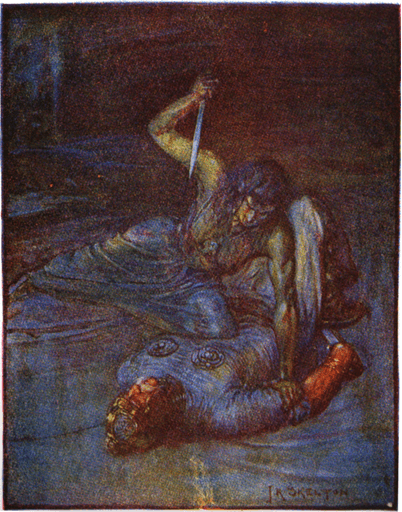
According to The Scop, the world was created by the greatest of gods. This god made everything in the world, including the plains, seas, sun, moon, and all living creatures. The Scop also mentioned that Grendel and his mother come from an accursed race, which is the evil twin of humanity. Grendel, holding a corpse as proof of the curse, went to the human crowd to ask for mercy and peace, but they tried to kill him instead. In anger, Grendel attacked the people and then retreated to his cave. He was troubled by the idea that poetry could create false truths, but he was also disturbed by a sense of an older, darker intelligence. This intelligence turned out to be a dragon, who may or may not be a figment of Grendel’s imagination. The dragon is a cynical creature who claims to know everything and tries to convince Grendel that human thought is foolish. The dragon believes that the universe is governed by chance and that there is no purpose to anything. However, he acknowledges that Grendel’s attacks on humans drive them to create poetry, science, and religion. The dragon advises Grendel to seek out gold and sit on it, even though he admits that his treasure is worthless.
After encountering the dragon, the younger Grendel feels a sense of hopelessness. He realizes that he is invulnerable to weapons, likely due to a charm placed on him by the dragon. He discovers this when one of Hrothgar’s guards attacks him, but is unable to harm him. This guard becomes Grendel’s first victim in his war against Hrothgar. Grendel briefly finds purpose in his new role as a destroyer of mead halls and kings, but he also feels more alone than ever. During one raid, he suddenly feels that his actions are as meaningless and mechanical as everything else in the universe.
Early on in Grendel’s war, Hrothgar’s thane Unferth challenges him with proud and warlike boasts. Grendel responds by attacking him with both insults and apples, leaving Unferth humiliated. To Grendel’s surprise, Unferth tracks him to his lair, determined to defeat him or die trying. However, Unferth is too exhausted to pose a threat, and Grendel refuses to give him the satisfaction of being another victim. Grendel brings the exhausted Unferth back to Hart Hall and kills two guards to make his intentions clear. Throughout his war on Hrothgar, Grendel continues to spare Unferth and the other Danes, using Unferth’s shame to respond to the idea that adversity can create heroes and meaning.
Grendel reflects on his thoughts of committing the ultimate act of nihilism, which would be the murder of Hrothgar’s queen, Wealtheow. He remembers when Wealtheow became Hrothgar’s queen and how he could hardly bear to witness her innocence being handed over to the old king. He is tormented by the idea that even the tenuous meaning of life could be based on an absurdity like the idea of a queen. Grendel considers killing Wealtheow to disprove this idea but ultimately decides it would be meaningless. From that point on, Grendel has no illusions about the theories and patterns that humans believe in.
Grendel then recounts the arrival of Hrothgar’s nephew Hrothulf at Hart Hall. Hrothulf accepts his uncle’s hospitality while secretly plotting to rebel against him. Grendel observes Hrothulf’s conversations with the peasant Red Horse, who advocates for a violent revolution to overthrow the government. Hrothulf argues that he would use violence to promote greater freedom, but Red Horse believes that all systems, including governments, are evil. Grendel sees the numerous dangers that threaten Hrothgar, including Hrothulf’s eventual treachery, but he feels no pity for the old king and is determined to continue his war on the Scyldings. Grendel believes that his raids have made Hrothgar noble and wonders if something meaningful will come out of all the grief.
Next, Grendel criticizes religion, sharing Red Horse’s view that it is sick. He sits among the idols that the Scyldings worship as gods and pretends to be the Destroyer they pray to for protection against Grendel. He converses with an old blind priest named Ork, who gives a complicated account of the King of the Gods and the nature of evil. Before Grendel can fully understand Ork’s speeches, a group of other priests arrive and argue about Ork’s vision. A younger priest celebrates the vision, but Grendel is put off by their discussions and leaves. He anxiously awaits the end of winter.
Conclusion
In conclusion, understanding the characterization of Grendel is essential for comprehending the complexity of the protagonist and other characters in this literary masterpiece. By closely examining the text, we can gain insights into Grendel’s mindset, motivations, and transformation throughout the story. Analyzing his actions, thoughts, and interactions with other characters allows us to see him as more than just a mindless monster. This analysis also highlights the author, John Gardner’s, skillful use of vivid imagery and precise language to shape each character’s essence. Additionally, this lesson teaches us about the importance of perspective and empathy when dealing with complex individuals or situations, which is valuable not only in literature but also in real-life experiences. Ultimately, understanding the intricacies of characterization helps readers navigate the moral ambiguities presented in Grendel and develop a deeper appreciation for its rich themes.