


Lesson 3 – Literary Passage Analysis and Steps
Introduction
When you read for pleasure, your main goal is to enjoy yourself. You may read to immerse yourself in an exciting story, to learn about an enjoyable time or place, or simply to pass the time. Perhaps you are seeking inspiration, guidance, or a reflection of your own life. There are countless ways to approach reading a book, each one valid and unique, just like the books themselves.
However, when you read a piece of literature in an English class, the purpose is different. You are asked to engage in literary analysis. To analyze something means to break it down into smaller parts and examine how those parts work individually and together. Literary analysis involves studying all the elements of a novel, play, short story, or poem, such as characters, setting, tone, and imagery. The goal is to understand how the author uses these elements to create specific effects.
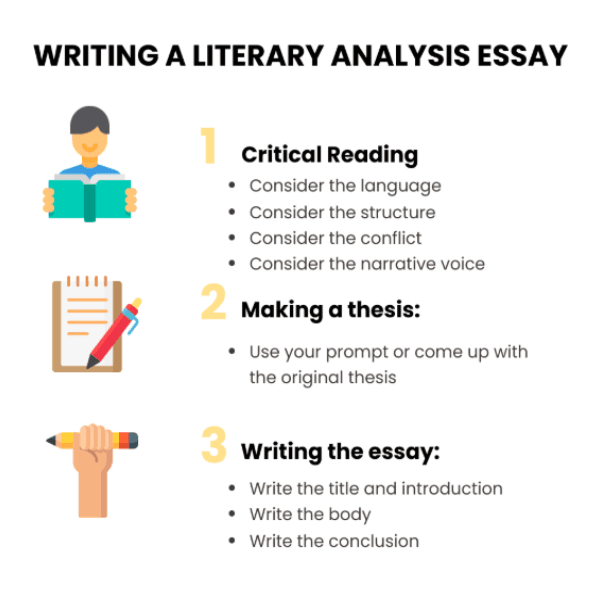
I. Step 1: Ask Questions
When you are given a literary essay assignment in class, your teacher will often give you a list of writing prompts. This is fortunate for you! Now, all you need to do is choose one. It would be wise to select a topic that genuinely interests you. Starting with something you enjoy thinking about will make the process easier and more enjoyable. However, if you are required to come up with a topic on your own, you may start to feel overwhelmed. You might have too many ideas or none at all. But don’t worry. Take a deep breath and begin by asking yourself the following questions:
- What struck you?
- What confused you?
- Did you notice any patterns?
- Did you notice any contradictions or ironies?
Good Questions
- “Are Romeo and Juliet’s parents responsible for the deaths of their children?”
- “Why do pigs keep showing up in Lord of the Flies?”
- “Are Dr. Frankenstein and his monster alike? How?”
Bad Questions
- “What happens to Scout in To Kill a Mockingbird?”
- “What do the other characters in Julius Caesar think about Caesar?”
- “How does Hester Prynne in The Scarlet Letter remind me of my sister?”
II. Step 2: Collect Evidence
When you have determined the question you want to answer, it is crucial to search through the book for information that will assist you in answering that question. It is not necessary to know exactly what you want to say at this point; the goal is to gather ideas and material and allow them to develop. Take note of any passages, symbols, images, or scenes that relate to your topic. Over time, you will establish connections between these examples, and your thesis will become apparent.
1. Elements of Story
The following information describes the main aspects of the work: what occurs, where it occurs, and who it involves.
- Plot: This content refers to all the events and actions in the work.
- Character: In a literary work, the individuals who act and are influenced by others are referred to as characters. The primary character in a work is called the protagonist.
- Conflict: The main conflict in a story usually revolves around the protagonist's desires and the obstacles they face from opposing forces, known as antagonists.
- Setting: The work occurs at a particular time and place, referred to as the setting. The setting encompasses different aspects like the location, period, time of day, weather, social atmosphere, and economic conditions.
- Narrator: The person telling the story. The narrator may straightforwardly report what happens, convey the subjective opinions and perceptions of one or more characters, or provide commentary and opinion in his or her voice.
- Themes: The main concepts or messages of a work are often abstract ideas about people, society, or life in general. A work can have multiple themes that may conflict with each other.
2. Elements of Style
These shows are evaluated based on how the characters communicate, how the story is built, and how language is utilized throughout the work.
2.1. Structure and organization
How a work is put together is called its structure. Novels can be told in a straightforward, chronological order or jump around in time. Plays can follow a traditional structure with three or five acts, or they can be a collection of loosely connected scenes. Some authors intentionally leave gaps in their works, forcing readers to fill in the missing information. The structure and organization of a work can give insight into the message it is trying to convey.
2.2. Point of view
The perspective from which a story is told can significantly impact the reader’s experience. There are two main points of view: first-person and third-person. In the first-person point of view, the narrator is directly involved in the story. They use pronouns like “I” and “we” to describe their experiences. For example, “I went to the store” or “We watched in horror as the bird slammed into the window.” The first-person narrator is usually the main character, but not always.
On the other hand, in the third-person point of view, the narrator does not participate in the story. They observe and describe the events from an outside perspective. A third-person narrator can either closely follow a specific character, sharing their thoughts and experiences, or they can be an omniscient narrator. An omniscient narrator has complete knowledge of everything happening in the story. They can witness any event at any time or place and know all the characters’ inner thoughts and feelings. It’s important to note that the narrator and the author are different. The narrator is the voice telling the story, while the author is the person who wrote the story.
2.3. Diction
The choice of words can reveal a character’s attitude and personality. For instance, using dry and clinical language versus flowery prose with many of exclamation points can provide insights into their demeanor.
2.4. Syntax
The arrangement of words and the structure of sentences are important in creating an author’s unique writing style. For instance, Ernest Hemingway is famous for using short and simple sentences, whereas James Joyce is known for his long and complex lines.
2.5. Tone
The tone of a text refers to the mood or feeling it conveys. The choice of words and sentence structure, known as diction and syntax, can greatly influence the tone of a piece of writing. For example, a novel that uses short, concise sentences with basic vocabulary can be abrupt, distant, or straightforward.
2.6. Imagery
Language that appeals to the senses represents things that can be perceived through sight, smell, hearing, taste, or touch.
2.7. Figurative language
Figurative language is a type of language that should not be taken literally. The two most common forms of figurative language are metaphors and similes. Metaphors and similes compare two things that are different to imply a similarity between them. For example, phrases like “All the world’s a stage” or “The moon is like a ball of green cheese” are examples of figurative language.
III. Step 3: Construct a Thesis
Once you have thoroughly analyzed the evidence you have gathered and have a clear idea of how you want to address the question, it is time to craft your thesis statement. A thesis is a statement that makes a claim about a piece of literature and must be backed up by evidence and arguments. The thesis statement is the central point of your literary essay, and the majority of your paper will be dedicated to supporting and proving this claim. A strong thesis statement should be:
- Arguable: “The Great Gatsby describes New York society in the 1920s” isn’t a thesis—it’s a fact.
- Provable through textual evidence: “Hamlet is a confusing but ultimately very well-written play” is a weak thesis because it offers the writer’s personal opinion about the book. While it can be debated, this claim cannot be proven or supported with examples from the play.
- Surprising: “Both George and Lenny change a great deal in Of Mice and Men” is a weak thesis because it’s obvious. A strong thesis will present an argument about the text that may not be obvious at first glance.
- Specific: The statement "Dr. Frankenstein's monster tells us a lot about the human condition" is a good start for a thesis, but it lacks clarity. What exactly does the writer mean by "a lot"? How does the monster convey information about the human condition?
IV. Step 4: Develop and Organize Arguments
1. Compare and contrast
In “The Adventures of Huckleberry Finn,” let’s compare and contrast the characters of Huck and Jim.
If you have written this type of essay before, chances are you are familiar with it. In an academic literary context, you will organize your arguments in the same way as you would in any other class. You can choose to discuss the subjects either one by one or point by point. In the former, you will talk about one character first and then move on to the second character. In the latter, you will select several traits of the characters (such as their attitude towards life, social status, images, and metaphors associated with them) and dedicate a paragraph to each trait. You may want to use a combination of these two approaches. For example, you can spend a paragraph each broadly describing the personalities of Huck and Jim before transitioning into a paragraph or two that highlights a few key points of comparison. This can be a highly effective strategy if you want to make a counterintuitive argument – that despite appearing different, the two objects being compared are similar in a significant way (or vice versa). Remember that your essay should reveal something fresh or unexpected about the text, so try to think beyond the obvious similarities and differences.
2. Trace
One way to analyze Macbeth is to select a specific image, such as birds, knives, or eyes, and examine how that image is used throughout the play.
It may seem like a simple task: just read the play, find every mention of a knife in Macbeth, and list them in your essay in the order they appear. However, it’s not that straightforward. Your teacher doesn’t want a mere collection of examples. They want you to make connections between those examples, which is the difference between summarizing and analyzing. In the example of Macbeth, consider the various contexts in which knives are mentioned in the play and the impact they have. There are real knives and imagined knives, knives that cause death, and knives that only pose a threat. Organize and categorize your examples to give them structure. Lastly, always keep in mind the overall effect. Once you have chosen and analyzed your examples, you should gain a deeper understanding of the work and the role your selected image, symbol, or phrase plays in developing the major themes and stylistic strategies of the play.
3. Debate
Is the society portrayed in “1984” beneficial for its citizens?
In this type of essay, you are required to discuss a moral, ethical, or aesthetic issue related to a particular work. You may be asked to evaluate a character or group of characters (such as whether Caesar is responsible for his downfall) or the work itself (such as whether “Jane Eyre” is a feminist novel). When writing this kind of essay, it is important to remember two key points.
Firstly, avoid solely relying on your personal feelings and reactions. A literary essay expects you to read and analyze the work, so look for evidence within the text. For example, what do the characters in “1984” say about the government of Oceania? What imagery does Orwell use that may indicate his attitude towards the government? Secondly, like in any debate, defining all the necessary terms is crucial before presenting your arguments. What does it mean to have a “good” society? What qualifies a novel as “feminist”? Clearly define these terms in the first paragraph after your introduction.
Secondly, it is important to keep in mind that effective literary essays present arguments that are contrary and surprising. It is beneficial to think creatively and consider unconventional perspectives. For instance, in the example of “1984” mentioned earlier, the immediate response might be that the totalitarian society portrayed in Orwell’s novel is unquestionably detrimental to its citizens. However, can you come up with any arguments favoring the opposite viewpoint? Even if your ultimate conclusion is that the novel portrays a harsh, oppressive, and thus harmful society, acknowledging and addressing counterarguments will enhance the overall strength of your argument.
V. Step 5: Write the Introduction
The length of an introduction can vary depending on the overall length of the essay. In a traditional five-paragraph essay, it should not exceed one paragraph. Regardless of its length, your introduction should accomplish the following:
- Provide any necessary context: When writing an introduction, it is important to provide context for the reader and inform them about what they can expect from the discussion. Specify the book you will be discussing, the characters involved, and the topic that will be addressed.
- Answer the “So what?” question: Why is this topic important, and why is your particular position noteworthy? Your introduction should capture the reader's attention by highlighting how your argument is surprising or goes against common belief. Literary essays excel at making unexpected connections and uncovering truths that may not be immediately apparent.
- Present your thesis: This typically occurs towards the end of your introduction.
- Indicate the shape of the essay to come: After reading your introduction, your reader should clearly understand what your essay will cover and how you will support your thesis. You don't have to explain every single step, but you should indicate the overall structure you will be using.
VI. Step 6: Write the Body Paragraphs
To ensure a well-structured and coherent essay, it is important to develop a paragraph for each point mentioned in the thesis statement. For a 500-750 word essay, three paragraphs should suffice. Each body paragraph should focus on a specific topic or aspect related to the thesis. To maintain consistency, it is recommended to use the following template for all body paragraphs:
Begin with a topic sentence that clearly states the paragraph’s main idea. Avoid using long phrases with complex grammar in the first sentence. This will give the reader a quick overview of the section and help them understand the content. Transition words can also be used to smoothly connect ideas and create a cohesive flow between paragraphs. Examples of transition words include “moreover,” “however,” and “in addition.”
Continue providing evidence and support for your claims. It is acceptable to use quotes when they are short, no longer than 30 words. However, for longer quotes, it is better to paraphrase or summarize the information, including only the most important details. Always remember to provide a clear explanation when using quotes or paraphrases. Conclude each paragraph with a concise one-sentence summary of the main idea discussed.
VII. Step 7: Write the Conclusion
This paragraph is the conclusion of your literary analysis paper, which will provide a sense of closure. In this section, you can summarize the main points discussed, provide your thoughts on the work, express your emotions, and more. Finally, restate the thesis statement, emphasizing the new perspective that the essay has presented.
Conclusion
A literary essay is not a book review. It does not ask for your personal opinion on whether you liked the book or would recommend it to others. It is also different from the book reports you wrote in the past, where you simply summarized the plot. Instead, a high school or college-level literary essay asks how a piece of literature works, how it achieves its goals, and why the author made certain choices.
Analyzing literature is not something you are born knowing how to do. It is a skill that can be learned and mastered. With practice, you can develop a method that works best for you.