


Lesson 3 – How to Use Context Clues to Understand Word Meanings
Introduction
Are you often faced with the frustration of encountering unfamiliar words while reading? Do these unknown words disrupt your flow and hinder your comprehension? Understanding word meanings is vital for grasping the whole essence of a text. However, fret not, as there is a powerful tool at your disposal: context clues. In this lesson, we will delve into the art of using context clues to unravel the meanings of unknown words, empowering you to navigate through any text confidently.
I. Context Clues Definitions
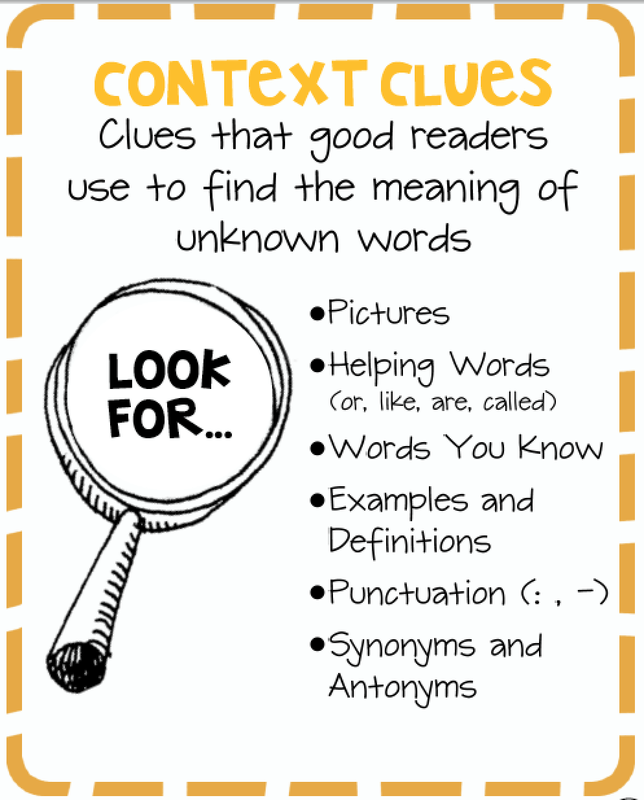
Authors use context clues when they want to help readers understand the meaning of an unfamiliar word. This technique is especially common in nonfiction texts, where technical terms and jargon are often used.
One type of context clue is the definition. This clue is straightforward and provides the meaning of the word in question. Authors may use different ways to present the definition. One way is to include it right after the word, using commas or dashes to set it off. For example:
- The paleontologist, a scientist who studies the remains of living organisms, spent a month at the site.
- The paleontologist - a scientist who studies the remains of living organisms - spent a month at the site.
Another way to provide the definition is to use an entire sentence dedicated to explaining the meaning of the word.
II. Types of Context Clues
1. Definition Context Clues
These are clues that provide the meaning of an unfamiliar word within the context of the sentence.
Example: "The hiker was very thirsty and drank from a nearby stream. The water was crystal clear and tasted refreshing."
In this sentence, the definition context clue is "crystal clear," which provides the meaning of the word "clear."
2. Synonym Context Clues
These are clues that provide a word with a similar meaning to the unfamiliar word.
Example: "The student was very studious and always spent hours reading and studying. She was a true bookworm."
In this sentence, the synonym context clue is "bookworm," which provides a similar meaning to the word "studious."
3. Antonym Context Clues
These are clues that provide a word with an opposite meaning to the unfamiliar word.
Example: "The dog was very docile and never barked or growled. He was a very calm and gentle pet."
In this sentence, the antonym context clue is "calm and gentle," which provides an opposite meaning to the word "docile."
4. Inference Context Clues
These are clues that require the reader to make an educated guess based on the information provided in the sentence.
Example: "The sky was dark and cloudy, and the wind was howling. The trees were swaying back and forth, and leaves were flying everywhere."
In this sentence, the phrases 'dark and cloudy,' 'wind was howling,' 'trees were swaying back and forth,' and 'leaves were flying everywhere' provide context clues that help us infer that a storm or bad weather is occurring. The description of the sky and the wind suggests turbulent weather conditions, while the movement of the trees and leaves indicates strong winds. These clues together paint a picture of a stormy atmosphere."
III . Significance of Context Clues
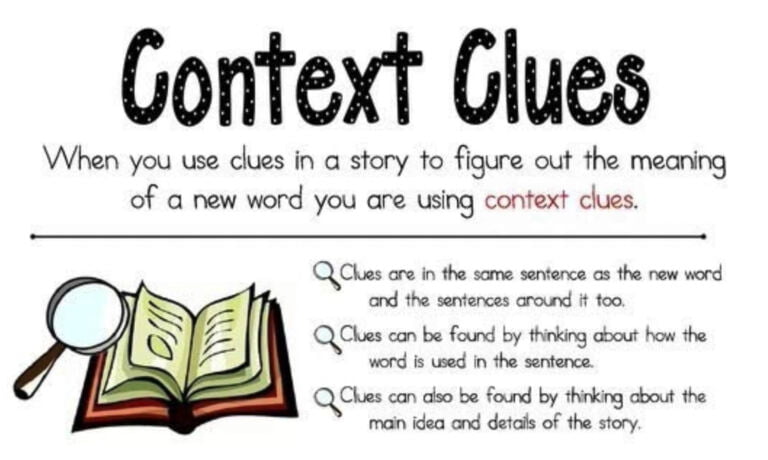
Context clues are integral to adequate reading comprehension, as they provide valuable hints and information that help readers decipher the meanings of unfamiliar words, phrases, or concepts within a text. These clues are present in the surrounding context of the word or phrase in question and offer several significant benefits:
1. Vocabulary Expansion
Context clues allow readers to infer the meanings of new words based on their familiarity with the rest of the text. This process contributes to expanding one’s vocabulary naturally without relying solely on dictionaries.
2. Enhanced Comprehension
Understanding the meaning of unknown words contributes to a deeper understanding of the text. It ensures readers don’t miss key details or messages due to stumbling over unfamiliar vocabulary.
3. Efficient Reading
Context clues enable readers to grasp the meaning of words without interrupting the reading flow to consult external resources. This enhances reading efficiency and maintains the reader’s engagement with the text.
4. Independent Learning
By using context clues to deduce meanings, readers develop the skill of self-sufficiency in Learning. They become less reliant on external assistance and can confidently tackle more complex texts.
5. Critical Thinking
Analyzing context clues requires readers to think critically and make informed judgments about the meaning of words. This mental exercise enhances cognitive skills and promotes active engagement with the material.
6. Cultural and Historical Understanding
Context clues often provide insights into a text’s cultural or historical background. By deciphering these clues, readers better understand the context in which the text was written.
7. Language Acquisition
For language learners, context clues are precious in building language proficiency. They aid in understanding nuances, idiomatic expressions, and word usage within real-world contexts.
8. Reading Enjoyment
Successfully using context clues to unlock the meanings of words can boost a reader’s confidence and Enjoyment. It makes the reading experience more rewarding and less daunting.
9. Versatile Application
Context clues are not limited to written texts. They are equally applicable to spoken language, aiding listeners in comprehending conversations, lectures, or presentations.
10. Life-Long Skill
The ability to decipher meanings from context is a skill that extends beyond academics. It’s relevant in professional, personal, and social contexts, contributing to effective communication.
IV. Examples of Context Clues
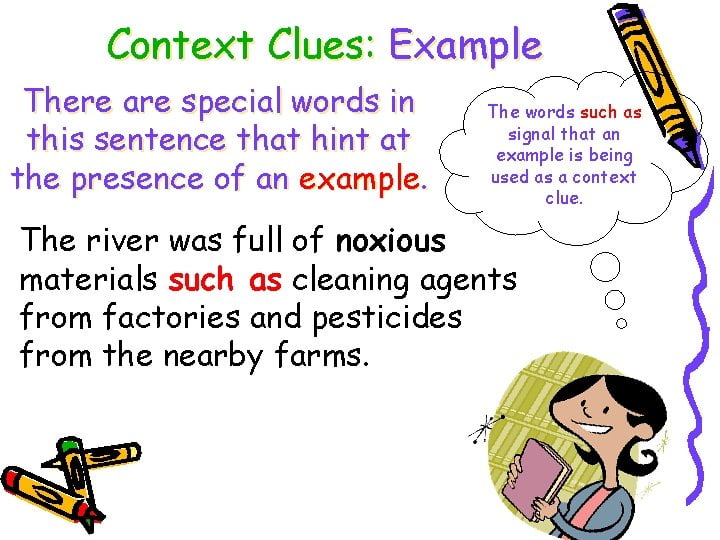
1. Definition Context Clue:
"The book was full of esoteric language that was difficult to understand."
In this sentence, the word "esoteric" is unfamiliar to many readers. However, the context clue is "difficult to understand," which provides the definition of "esoteric."
2. Synonym Context Clue:
"The chef was known for his culinary skills and could whip up a delicious meal in no time."
In this sentence, the unfamiliar word is "culinary," but the context clue is "could whip up a delicious meal," which provides a synonym for "culinary."
3. Antonym Context Clue:
"The athlete was very lethargic and lacked energy during the game."
In this sentence, the unfamiliar word is "lethargic," but the context clue is "lacked energy," which provides an antonym for "lethargic."
4. Inference Context Clue:
"The sky was dark and the air was thick with humidity. The forecast had called for rain all week."
In this sentence, the context clues suggest that a storm is coming, even though the word "storm" is not used explicitly.
V. How to Use Context Clues
Here are some steps to follow when using context clues to determine the meaning of an unfamiliar word:
- Read the sentence or passage carefully and identify the unfamiliar word.
- Look for any surrounding words or phrases that provide clues to the meaning of the word. These clues may include synonyms, antonyms, definitions, or inferences.
- Use your knowledge of the topic or subject matter to help you make an educated guess about the meaning of the word.
- Try to use the word in a sentence to see if your guess makes sense in the context of the sentence or passage.
- If you are still unsure of the meaning of the word, look it up in a dictionary or use an online resource to find its definition.
Remember, context clues are not always present or reliable, so it’s important to use them in conjunction with other strategies, such as looking up the word in a dictionary or asking someone for help. With practice, you can become better at using context clues to determine the meaning of unfamiliar words.
Conclusion
In conclusion, as we dive into the world of context clues, we embark on a journey of discovery. Through the power of context, we unveil the hidden meanings of words, unlocking a deeper understanding of texts. Let us embrace the challenge of deciphering word meanings, for within these linguistic puzzles lie treasures of knowledge and insight. So, as you navigate the vast landscapes of literature, trust in the power of context clues to illuminate the path, enriching your reading experience and broadening your horizons.