


Lesson 2 – Inference
Introduction
Are you often left puzzled by the hidden meanings and underlying messages in the texts you read? Do you need help grasping the subtle implications and drawing accurate conclusions from the information? Many individuals are challenged to make valid inferences while reading, hindering their understanding and critical thinking skills. In this lesson, we have the solution you’ve been seeking. We will delve into the art of inference, unravel its secrets, and provide you with practical strategies and techniques to master this essential skill.
I. Infer Intended Meaning
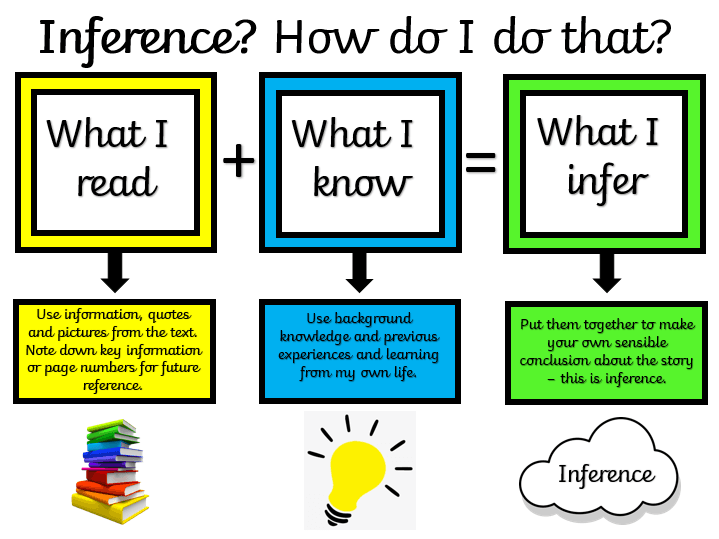
Inference, a robust cognitive process, allows us to draw logical conclusions based on observation and background knowledge. We engage in inference daily. For instance, when someone grimaces after tasting a new food, we infer they dislike it. Likewise, when a door slams, we assume the person behind it is upset. These simple examples demonstrate how inference operates in our daily lives.
In literature, the ability to make inferences is equally essential. It enables us to uncover the intended meaning that an author seeks to convey. This intended meaning encompasses the profound lessons and messages beneath the text’s surface.
Why is making inferences necessary? Authors intentionally leave gaps in their information, expecting readers to read between the lines and reach their conclusions. By making inferences, we go beyond the explicit text and unearth the subtle ideas and implications that the author hints at. This active engagement transforms us into discerning readers and critical thinkers, enhancing our understanding of the author’s message.
II. What are the forms of inference?
Inference is a cognitive process crucial in understanding information and making logical connections. It involves drawing conclusions or interpretations based on existing knowledge, evidence, and reasoning. Inference can take different forms, with inductive and deductive inference as primary approaches.
1. Inductive Inference:
Inductive inference involves deriving general principles from specific observations or instances. It‘s like piecing together a puzzle by examining individual parts. The following steps characterize this method:
Observation:
Collecting information from various sources and instances.
Pattern Recognition:
Identifying recurring patterns, trends, or relationships among the observed data.
Generalization:
Forming a broad conclusion or hypothesis that explains the observed practices.
Application:
Applying the generalized principle to new situations to predict outcomes or draw further conclusions.
Inductive inference encourages creative thinking, allowing for exploring new ideas and hypotheses. It’s often used in scientific research, where observations lead to the formulation of theories that can then be tested through experiments.
2. Deductive Inference:
Deductive inference, on the other hand, starts with a general theory or hypothesis and tests it against specific observations or evidence. It follows a more structured approach:
Starting Hypothesis:
Beginning with a premise, assumption, or general principle.
Evidence Examination:
Analyzing specific cases or instances to determine if they align with the starting hypothesis.
Conclusion:
Drawing a straightforward and logical conclusion based on the consistency between the theory and the evidence.
The deductive inference is often associated with formal logic and is used to validate or invalidate hypotheses. It’s commonly employed in mathematics, philosophy, and legal reasoning, where it aims to arrive at well-defined and definitive conclusions.
3. Educational Application:
In academic settings, inductive inference is often emphasized to help students develop critical thinking and analytical skills. By encouraging them to gather information, recognize patterns, and draw conclusions, educators enable students to approach complex problems with a creative mindset.
Inductive and deductive inference are valuable cognitive tools that contribute to adequate reading comprehension, problem-solving, and decision-making. By understanding the differences between these two approaches, individuals can enhance their ability to extract meaning from information and make informed judgments.
III. Types of Inferences
Here’s a table summarizing the main types of inferences, along with their descriptions and key considerations:
| Type of Inference | Description | Key Considerations |
|---|---|---|
|
Inference from Context |
Inferring meaning based on the surrounding context of a source, including time, location, and other influences. |
Setting (time and place) |
|
|
Situation the author is responding to (event, issue, problem) |
|
|
|
Type of publication (news, research, blog, novel) |
|
|
|
Author’s background (author’s identity and writing interests) |
|
|
Inference from Tone |
Inferring meaning by examining the author’s attitude or tone in writing. |
Descriptive words in the source (sarcastic, angry, impassioned) |
|
|
Inferring meaning by examining the author’s attitude or tone in writing. |
|
|
Inference from Examples |
Extracting meaning from the examples used by the author, which often convey implicit information |
Purpose behind the author’s choice of examples |
|
|
Emotional response elicited by the examples |
|
|
|
Implicit information and insights that can be derived from the examples |
These types of inferences provide readers with tools to analyze a text beyond its explicit content, unlocking deeper layers of meaning and enhancing comprehension.
IV. Examples of Inference
Here are a few more examples of inference using different types of clues:
1. Inference from Context:
Context:
A character is seen holding a bouquet of flowers and smiling while entering a restaurant.
Inference:
It can be inferred that the character is likely going on a date or celebrating a special occasion.
2. Inference from Tone:
Tone:
The author uses emotionally charged and passionate language while describing a social injustice.
Inference:
It can be inferred that the author is deeply concerned and advocating for change regarding the social issue.
3. Inference from Examples:
Example:
A character frequently mentions health-conscious habits, posts pictures of nutritious meals, and talks about their gym routine.
Inference:
It can be inferred that the character prioritizes their health and has a strong commitment to maintaining a healthy lifestyle.
4. Inference from Context:
Context:
A group of people is seen wearing party hats, holding balloons, and gathered around a cake with candles.
Inference:
It can be inferred that the group is celebrating someone's birthday.
5. Inference from Tone:
Tone:
The author uses a somber and melancholic tone while describing a character's mourning and loss.
Inference:
It can be inferred that the character is experiencing grief or bereavement.
V. How to Make Inferences
1. Understand the Source and Identify the Genre
Reading and analyzing the source to make accurate inferences is crucial. Take note of important features such as:
- Determine the genre of the text.
- Identify the purpose of the writing.
- Grasp the main idea conveyed.
- Consider the intended impact the author aims to have on the reader.
Genres, categorized by purpose and characteristics, help set the foundation for understanding. For instance, news reports provide factual information, while opinion editorials express subjective viewpoints.
2. Pose a Question
Craft a specific question that addresses what you seek to learn from the source. This question guides your inference process. If no particular question arises, begin with broader inquiries like:
- What are the goals of the head?
- What does the author's opinion suggest about a particular subject?
- What is the author attempting to imply about the topic?
- What does the author consider essential or irrelevant?
- Why does the author propose an inevitable occurrence?
3. Identify Clues
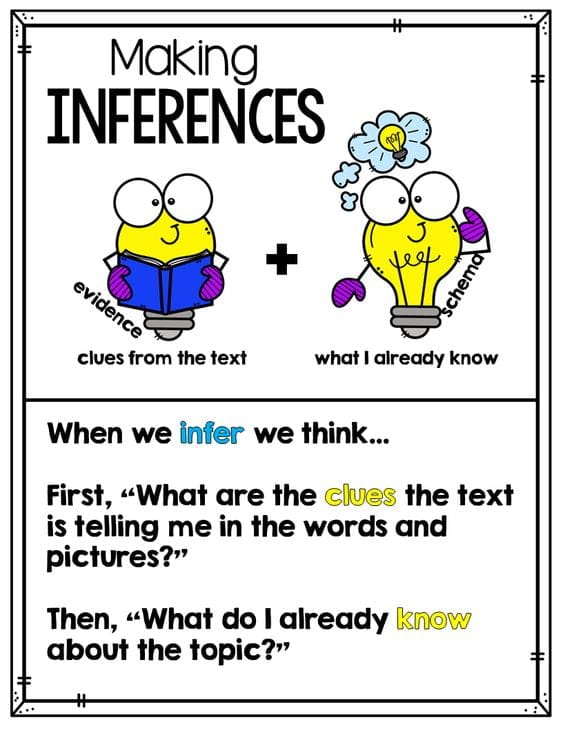
Put your detective hat on and carefully examine the source. Look for clues embedded within the author’s context, tone, and examples. These clues provide insights to answer your question. Jot down any valuable information you uncover, such as descriptive words that indicate the author’s tone.
Track the clues by highlighting, underlining, or taking notes directly on the source. If it’s an online resource, consider printing it out. For physical books, utilize sticky notes to mark important passages for future reference.
4. Make an Informed Assumption
Utilize the gathered clues to develop an educated guess in response to your question. Delve into your tentative answer by analyzing the evidence and insights from the clues you discovered.
5. Justify and Support Your Inferences
Explain your inference process and the pathway that led you to your answer. Strengthen your explanation by utilizing evidence from the source, including the clues you identified. In some cases, incorporating evidence from additional sources can provide valuable context to support your inferences.
For instance, include a direct quote from the source to illustrate the author’s tone and reinforce your conclusion.
Following these steps and honing your inference skills will unlock a deeper understanding of texts, enabling you to interpret and analyze information with greater clarity and precision.
Conclusion
In conclusion, improving reading comprehension is more than a skill; it’s a gateway to unlocking the boundless potential of knowledge and understanding. As you immerse yourself in the world of books, remember that every sentence can ignite your imagination and transform your perspective. Embrace the joy of reading, challenge your assumptions, and let the words on the page shape the person you become. The journey to enhanced comprehension is a lifelong pursuit, fueling intellectual growth and expanding your connection to the world.