


Lesson 11 – Realism in Ancient Egyptian Relief Carvings and Paintings
Introduction
Today, we are captivated by the dazzling treasures found in Tutankhamun’s tomb, such as his iconic golden mask, intricate jewelry, and richly decorated sarcophagus. These artifacts offer a glimpse into the wealth and craftsmanship of ancient Egypt during the 18th Dynasty of the New Kingdom. Additionally, the exquisite reliefs in tombs from this era, like those in the Valley of the Kings, depict scenes of daily life, religious rituals, and the journey to the afterlife with incredible detail and artistry. The peaceful beauty of statues from the Old Kingdom, such as the serene and lifelike statues of pharaohs and officials, further exemplifies the skill and dedication of ancient Egyptian artisans.
However, it is important to remember that most of these works were not meant to be seen by the living. Their primary purpose was to serve the deceased in the afterlife. The treasures in Tutankhamun’s tomb, for instance, were intended to accompany the young pharaoh on his journey through the underworld and to provide for him in the afterlife. The reliefs in New Kingdom tombs were designed to ensure the deceased’s safe passage and successful transition to the afterlife, depicting protective deities, spells, and offerings. Similarly, the statues from the Old Kingdom were created to house the ka, or spirit, of the deceased, providing a physical form for the soul to inhabit and receive offerings.
Now, let’s explore the specifics of these purposes and how they influenced the creation and placement of these remarkable works of art.
I. Function
Ancient Egyptian art, known for its symbolic and functional aspects, spans over three millennia and includes a variety of media such as statues, reliefs, paintings, and architectural structures. It often depicts figures in a highly stylized manner, with an emphasis on order and clarity. Despite this stylization, a form of realism is also present in the lifelike quality of statues and the detailed scenes carved in reliefs that portray daily activities, religious rituals, and significant events with meticulous attention to detail.
These images, whether statues or reliefs, were created to bring blessings to a god or a deceased person. Statues served as a physical representation where the recipient could participate in and receive the benefits of ritual activities. Divine cult statues were involved in daily rituals such as dressing, anointing, and perfuming with incense. They were also paraded during special festivals so that people could catch a glimpse of them, even though they were mostly covered. Despite being hidden, their presence would have been strongly felt, signifying the divine or spiritual presence they embodied and the continuous engagement in religious practices.
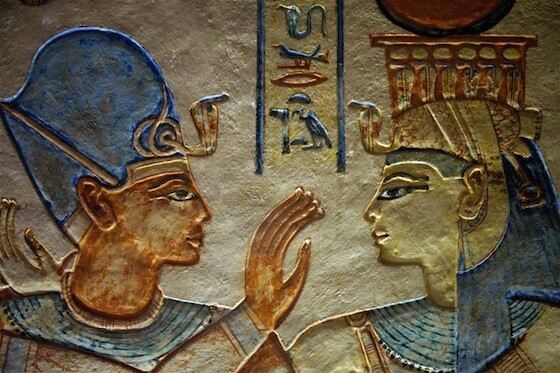
Painted sunk relief of the king being embraced by a goddess
II. Artwork
Two-dimensional art in ancient Egypt had a unique approach to representing the world. Instead of trying to recreate the real world, Egyptian artists focused on capturing the most representative aspects of each element in their scenes. They did this by rendering each object or element from its most recognizable angle and then grouping them together to create a complete image.
For example, when depicting people, their faces, waists, and limbs were shown in profile, while their eyes and shoulders were shown frontally. These scenes were complex composite images that provided comprehensive information about the various elements, rather than being designed from a single viewpoint. This approach allowed for a more detailed and informative representation of the world.
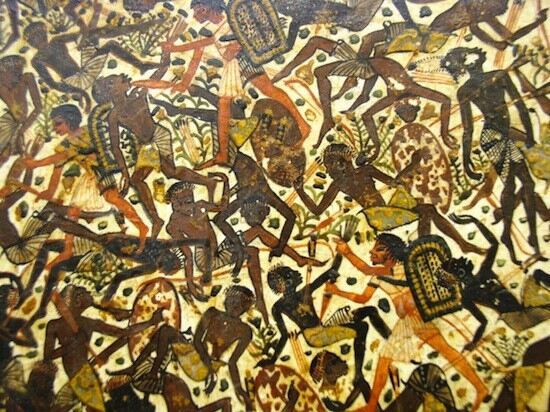
Chaotic fighting scene on a painted box from the tomb of Tutankhamun
Text is often found alongside images in various forms of art. In statues, the text is usually located on the back pillar or base, while relief art typically includes captions or longer texts that provide more information about the depicted scenes.
Hieroglyphs, although they may appear as small artistic works, do not always directly represent what they depict. Many of them are actually phonetic sounds. However, some hieroglyphs are logographic, meaning they represent specific objects or concepts.
The distinction between text and image can sometimes become blurred. For example, when a statue includes text referring to a person, it often omits the determinative at the end of the name.
The determinative is an unspoken sign that helps identify the word’s meaning. For instance, verbs of motion are followed by a pair of walking legs, names of men end with the image of a man, and names of gods end with the image of a seated god. In these cases, the representation of the figure itself serves the purpose of the determinative.
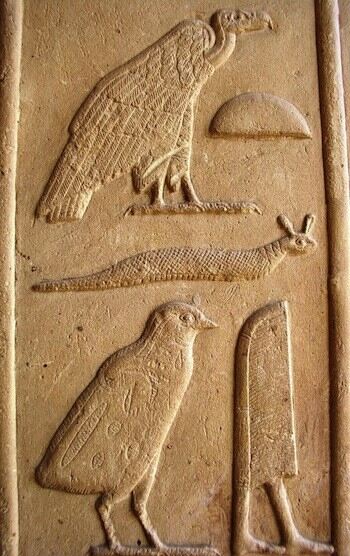
Highly detailed raised relief hieroglyphs on the White Chapel of Senusret I at Karnak
Conclusion
To truly appreciate ancient Egyptian art, it is important to consider it from the perspective of the ancient Egyptians themselves. The style of their artwork is often perceived as static, formal, abstract, and blocky, which has sometimes resulted in unfavorable comparisons to the more naturalistic art of the Greeks and Renaissance. However, it is crucial to understand that Egyptian art had a completely different purpose compared to these later cultures.