


Chapter 1, Lesson 10
In Progress
Lesson 10 – Question Marks
Chapter Progress
0% Complete
Introduction
Using the right punctuation is what will make your writing look impressive and also make it meaningful and understandable. The question mark is the only one used to demonstrate a question among the various punctuation marks. Through this lesson, students will get more about how and where question marks can be used in sentences. Check out the contents given below.
I. Question Mark – Definition
A question mark is a punctuation mark used to conclude question tags and interrogative statements. When a question mark is placed at the conclusion of a sentence or phrase, you can determine that the material being discussed is ambiguous and that the person asking the question is looking for an answer to the inquiry.
II. How to use a Question Mark?
As part of a technologically advanced era, you would constantly be exposed to the English language’s most prevalent usages. One of the many trends in internet messaging techniques is the use of several question marks to emphasize something (for example: What actually happened???) while sending personalized messages. However, this is not valid for writing carried out by professionals.
In formal writing, question marks tend to be utilized as follows:
– When asking someone a direct question or making an interrogative statement, you may wrap it up with a question mark.
– Sentences comprising question tags.
– Turning a regular statement into a question.
– A question mark should not be used if a previously asked question is reported in indirect speech.
III. Examples of Sentences Using a Question Mark
Let’s check out some cases to illustrate how the question mark might be employed in various contexts.
1. Use of a Question Mark at the End of a Direct Question
When will you reach?
What are your plans for tomorrow evening?
Who is that man?
When do you intend to tell your parents about this?
Why do you think it is taking this long?
2. Use of Question Mark at the End of Question Tags
He is coming home today, isn’t he?
They are working on different topics, are they?
Susan will not be attending the workshop, will she?
Suresh does not like sweets, does he?
You are an Indian, aren’t you?
3. Use of Question Marks in Direct Speech
My mom asked, “Has KRK been released on OTT?”
“When are you leaving for Bangalore?” asked Sheena.
Tharun asked, “Can you come with me to the clinic?”
Vishnu said, “They are all joining us for dinner, right?”
“Ashish is getting married?” asked Varsha.
IV. Rules for Correctly Using Question Marks
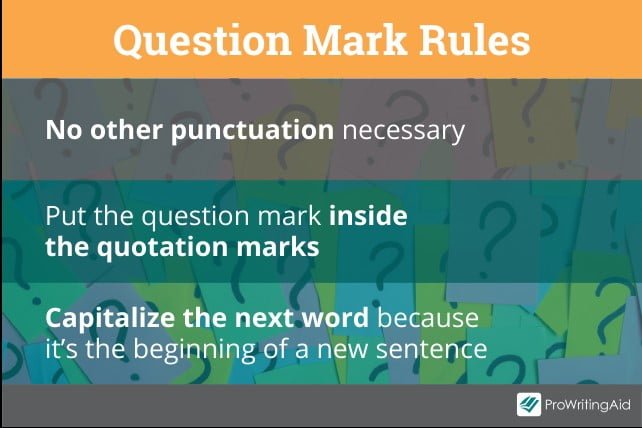
1. Rule #1: No Other Punctuation
You don’t need to use a question mark in conjunction with other ending punctuation, like a period or an exclamation point. The question mark replaces a period or exclamation point.
An exception to this rule is the interrobang, a pair of question marks and exclamation points. While a separate symbol exists, many times people type it with a question mark plus an exclamation point.
2. Rule #2: Capitalize the Next Word
You should always capitalize the first letter of the word directly after a question mark. A question mark denotes the end of a direct question. This means that the next word is the start of a new sentence, so a capital letter is necessary.
3. Rule #3: Question Marks in Quotes
If you’re writing a quoted question, you should put the question mark within the quotation marks. The direct question is the quote, so we need to attach our question mark to it.
Conclusion
The question mark is “the engine of debates and interrogations, of mysteries, solved and secrets to be revealed, of conversations between student and teacher, of anticipation and explanation,” adds Clark. If you handle it effectively, the question mark can help you engage your reader; it can help draw in your reader as a partner whose answers you seek and whose ideas issue.