


Lesson 1 – Species
Introduction
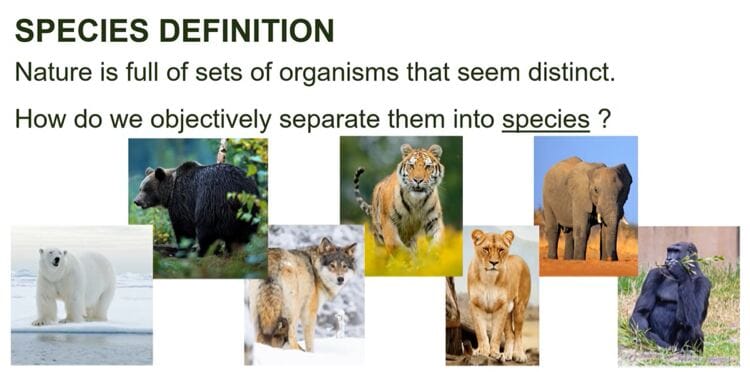
Defining the term “species” is challenging because different scientists have different perspectives and need for its definition. Typically, it is understood as a group of similar individuals living in the same area capable of interbreeding to produce fertile offspring. However, this definition falls short for asexual species not reproducing through interbreeding. To address these complexities, examining multiple species concepts and their limitations is essential to determine which ones are applicable in different situations.
I. Definition
1. Biological Species Concept (BSC)
The biological species concept, introduced by Ernst Mayr, is widely accepted and forms the basis for defining species. According to this concept, a species is a group of organisms capable of mating and producing offspring that can reproduce. In simpler terms, individuals belonging to the same species should be able to mate and have fertile offspring.
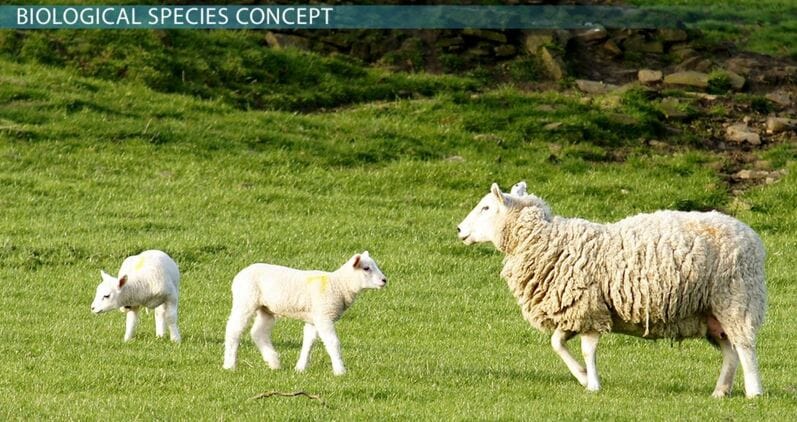
This concept highlights the significance of reproductive isolation within a species. Reproductive isolation ensures that individuals within a species can interbreed while remaining reproductively separate from other populations. Without reproductive isolation, the process of speciation, where new and independent species arise, cannot take place. For speciation to occur, populations must be separated for extended periods, physically through geographical barriers or reproductively through behaviors or other mechanisms that prevent interbreeding. This prolonged separation allows populations to diverge and eventually become distinct species. Reproductive isolation is a fundamental component of the biological species concept.
For instance, humans (Homo sapiens) are considered a unique biological species due to their distinctive cognitive abilities, complex language, and cultural traits. Despite variations in physical appearance and cultural practices among human populations, they can freely interbreed and produce fertile offspring. Similarly, lions (Panthera leo) in Africa exemplify the biological species concept as they constitute a group of individuals that can interbreed within their population, producing viable and fertile offspring.
2. Morphological Species Concept
The morphological species concept classifies species based on their physical characteristics like shape, size, and observable traits. When Carolus Linnaeus developed binomial nomenclature taxonomy, he primarily relied on the morphology of organisms to group them into species. This early understanding of “species” focused solely on their outward appearance. However, it didn’t take into account the role of genetics, DNA, and how they influence an individual’s physical features. Linnaeus was unaware of concepts such as chromosomes and other factors that contribute to variations among individuals who may look similar but belong to different species. These insights from genetics and microevolutionary processes have since expanded our understanding and classification of species beyond morphology.
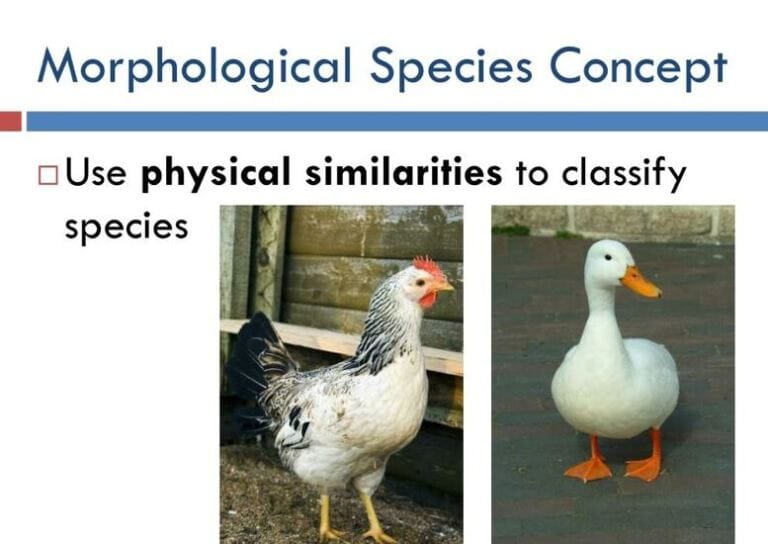
Domestic cats (Felis catus) are considered a morphological species because they share physical characteristics such as body shape, size, and facial features. Despite differences in coat color and pattern, domestic cats share a recognizable set of morphological traits that set them apart from other species. House mice (Mus musculus) are another example of a distinct morphological species. Their small size pointed snouts and large ears distinguish them. These physical characteristics distinguish them from other mouse species and contribute to their classification as a distinct morphological group.
3. Phylogenetic Species Concept
The phylogenetic species concept is a framework for defining species based on their evolutionary history and genetic relationships. It analyzes genetic data, such as DNA sequences, to determine distinct lineages and establish species boundaries. This concept emphasizes the importance of shared ancestry and unique genetic characteristics in identifying species.
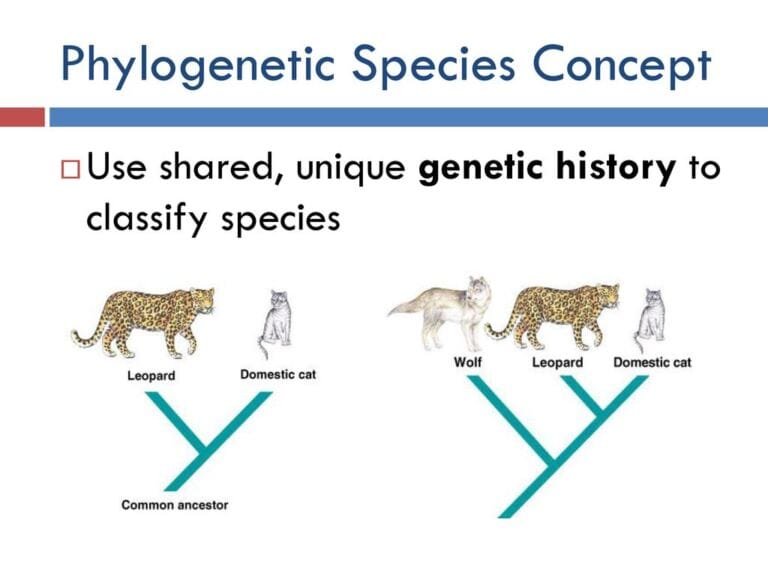
By constructing phylogenetic trees, which depict the evolutionary relationships among organisms and their common ancestors, researchers can discern separate branches or lineages that correspond to different species. The presence of distinct genetic traits sets these populations apart from others and establishes them as separate species.
Gray wolves (Canis lupus) are classified as a species based on their evolutionary history and genetic relationships, represented in phylogenetic trees by distinct lineages. Based on their phylogenetic relationships and genetic divergence from other dolphin species, bottlenose dolphins (Tursiops truncatus) are also recognized as distinct species.
II. Limitations
1. Biological Species Concept (BSC)
Fossil record:
Determining reproductive compatibility in extinct species is challenging due to the impossibility of direct interbreeding observations in the fossil record. Fossils are preserved through mineralization, cast and mold formation, amber entrapment, permineralization, and carbonization. However, inferring reproductive relationships in extinct species requires a comparative analysis of anatomical features and genetic data. The Biological Species Concept is valuable for living organisms but needs careful application to long-extinct species.
hybridization:
Hybridization occurs when individuals from different species interbreed, producing offspring that possess genetic material from both parent species. In some cases, these hybrids can be fertile or partially fertile. This challenges the clear separation between species as defined by the Biological Species Concept (BSC), which states that species are reproductively isolated from one another. Hybridization blurs the boundaries between species and suggests that genetic exchange can occur between closely related species. It highlights the dynamic nature of biodiversity and the potential for new genetic variations and evolutionary processes.
Geographically Isolated Populations:
Geographically isolated populations that have diverged genetically but can potentially interbreed if reunited are difficult to classify using the BSC.
2. Morphological Species Concept
Subjectivity:
Subjectivity in species identification arises from the interpretation and judgment of the observer when using morphological characteristics. These characteristics include physical features such as size, shape, color, and other anatomical traits of organisms. However, variations in these traits can exist within a species due to genetic diversity or environmental factors. As a result, deciding whether individuals belong to separate species or represent variations within a single species can be subjective. To enhance objectivity, scientists often use genetic analysis alongside morphological studies for species identification. Ongoing advancements in taxonomy aim to minimize subjectivity and improve the accuracy of species classification methods.
Variation within Species:
There can be significant variation within a species due to factors like sexual dimorphism or phenotypic plasticity. This can lead to difficulties in defining species solely based on morphology.
Pre-Clovis Archaeological Sites:
Archaeological sites discovered across North and South America have yielded artifacts that predate the Clovis culture. These artifacts show different styles and technologies that do not fit within the Clovis tradition, indicating the presence of earlier cultures.
Convergent Evolution:
Convergent evolution is a fascinating phenomenon where different species independently evolve similar physical characteristics in response to similar environmental challenges. This process occurs when unrelated organisms face similar selective pressures, leading to the development of analogous traits that serve similar functions. As a result, these species may exhibit striking similarities in their appearance or adaptations, even though they are not closely related.
The challenge with convergent evolution lies in differentiating these species based on morphology alone. Morphology refers to the study of an organism’s physical structure and characteristics. When species display convergent evolution, they may share similar traits that are adapted for the same ecological niche, but their underlying genetic and evolutionary histories are distinct.
Cryptic Species:
Cryptic species refer to a fascinating phenomenon where certain organisms may appear morphologically similar, making it difficult to distinguish them using traditional morphological characteristics alone. However, despite their similar appearance, these species may exhibit significant genetic and ecological differences that are not apparent through morphology.
Genetic Differences:
Cryptic species may have distinct genetic profiles, indicating that they have evolved along separate evolutionary paths. These genetic differences can be observed through techniques like DNA sequencing, which reveals variations in their DNA sequences and genetic markers. Despite their outward resemblance, cryptic species have accumulated genetic changes over time that set them apart from one another.
Ecological Differences:
Cryptic species may also occupy different ecological niches or habitats, leading to variations in their behavior, feeding preferences, and interactions with other organisms. While they may look alike, their ecological roles and adaptations can differ significantly. These differences can be essential for their survival and success within their respective ecosystems.
3. Phylogenetic Species Concept
Data Requirements:
Determining evolutionary relationships and genetic distinctiveness often requires extensive genetic data and analysis, which may not always be available or feasible.
Lack of Consensus:
The lack of consensus in phylogenetic analyses can pose significant challenges in establishing a universally agreed-upon species classification. Phylogenetic analyses involve the study of evolutionary relationships between organisms based on genetic data, and they play a crucial role in determining species relationships and classifications.
One of the challenges is that different researchers may use varying methods and datasets for their phylogenetic analyses, leading to different interpretations of the evolutionary history of the organisms under study. This can result in conflicting conclusions about species relationships and boundaries.
Additionally, the availability of genetic data from different sources and the choice of genes or genetic markers to include in the analysis can also influence the outcomes. Small differences in these factors can lead to contrasting conclusions, making it challenging to reach a consensus on species classification.
Furthermore, uncertainties in the evolutionary processes themselves can introduce complexities. Factors such as hybridization, incomplete lineage sorting, and horizontal gene transfer can blur species boundaries and create ambiguity in phylogenetic relationships.
The lack of a clear-cut definition of what constitutes a species can also contribute to disagreements among researchers. Various species concepts, such as the Biological Species Concept, Morphological Species Concept, and Phylogenetic Species Concept, may be applied differently by researchers, further complicating the classification process.
Hybridization and Introgression:
Genetic exchange between divergent lineages, such as hybridization and introgression, can complicate identifying and classifying species based on phylogenetic data alone..
Extinct Species:
Applying the phylogenetic species concept to extinct species is challenging, as genetic data may be limited or not accessible.
Conclusion
In conclusion, defining species is complex, and different concepts provide different perspectives. The biological species concept focuses on reproductive compatibility, the morphological image looks at physical traits, and the phylogenetic concept considers evolutionary relationships. Each picture has strengths and limitations. Using multiple ideas and considering various factors is important to understand species diversity. Advances in technology and interdisciplinary approaches continue to expand our knowledge. Overall, species definitions are evolving, and ongoing research enhances our understanding of the natural world.