


Lesson 1 – Informative Speaking
Introduction
A presentation or discourse with the primary objective of giving the audience factual, objective information about a specific topic, idea, concept, event, process, or subject is known as an informative speech. An informative speech’s primary goals are to inform, enlighten, and improve the audience’s comprehension of the topic.
An informative speech’s subject matter is objective and educational. It is based on facts, and frequently, visuals are used as supporting evidence to help the audience remember the information. This lesson gives you more knowledge about informative speech and goes deeper into the types of speech and its rules. Help you understand more about the concept of informative speech.
I. Definition
1. What is an informative speech?
A definition speech aims to explain what something means. The audience probably needs to familiarize themselves with the subject. Using synonyms or antonyms to define concepts is the simplest method. You could also define something by describing what it does or how it is used.

Using examples is another very effective way to deliver a definition-style informative speech. Examples aid in assimilating information into the audience’s brains for improved retention. Any informative speech should have education as its primary objective.
An informative speech is when you communicate a message to inform another person. Giving someone directions to your home is akin to giving a brief informative speech. Companies use informative speeches to present details about a new policy, outline procedures, and establish expectations.
2. Key properties of an informative speech
Clarity:
The speaker should avoid jargon or other complex language that could mislead the audience when presenting information.
Objectivity:
The speech ought to be factually accurate, unbiased, and supported by reliable sources. The speaker’s biases or opinions should not influence the presented information.
Structure:
A typical structure for an informative speech includes an introduction, four main points, three or four supporting details, and a conclusion. Each key idea should be logically structured and connected to the main idea.
Audience Relevance:
The speech’s content should be adjusted based on the audience’s knowledge and interest. The speaker should consider what the audience already knows and modify the level of complexity and detail as necessary.
Visual Aids:
Slides, diagrams, charts, and images are examples of visual aids that can improve audience comprehension and engagement. These tools should support the spoken information rather than distract from it.
Credibility:
The speaker should establish credibility by referencing reputable sources and providing evidence supporting the presented information.
Variety:
The speech can be more interesting and relatable by incorporating various data, statistics, examples, anecdotes, and real-life applications.
Time frame:
To keep the audience engaged and attentive, an informative speech should be delivered in a reasonable amount of time.
3. What are the rules for informative speech?
An informative speech is not, first and foremost, intended to persuade anyone of anything. Although it may happen, the aim of your informative speech isn’t to persuade listeners to change their minds about a particular subject. Giving information is the aim of informative speaking. The goal of persuasive speaking, which is frequently used in sales roles, is to persuade a listener to act in a certain way in response to information that has been shared with them.
You could give a presentation on solar panels and how using them in a home reduces utility costs. Your speech’s sole purpose is to describe the relationship between solar energy use and how that affects the resident’s monthly electricity bill. However, some audience members might leave the room and buy solar panels. Even though you succeeded in convincing that audience member to take a particular action as a result of your informative speech, this is the fact that your speech was informative. The key is intent.
II. Purpose of an informative speech
An informative speech aims to inform, educate, and enlighten the audience on a particular subject, idea, concept, or event. In contrast to persuasive or entertaining speeches, the main objective of an informative speech is to give the audience factual, impartial information to improve their understanding and knowledge of the subject.
There are many purposes of an informative speech. They must be accurate, give meaningful information, articulate the message clearly, and be engaging. Make it memorable and truthful in a way that people can easily understand
Educate:
An informative speech aims to inform the audience by providing current, reliable information. It aims to close knowledge gaps and deepen the audience’s comprehension of the subject.
Raise Awareness:
Informative speeches can increase audience awareness of significant issues, occasions, or ideas they may not be familiar with. The speaker can aid in promoting awareness and understanding by providing information on these subjects.
Enhance Understanding:
Informative speeches simplify complex topics into easily understood facts so the audience can better understand them. These speeches aid the audience in understanding complex ideas, procedures, or concepts that they might not have been able to comprehend independently.
Clarify Misconceptions:
Informative speeches can address typical misunderstandings or misconceptions about a subject. Speakers can dispel misconceptions and present a more accurate picture of the topic by providing accurate and fact-based information
Provide Context:
Informative speeches frequently give background information about history, culture, or context to help the audience comprehend the importance ofthe subject. Thanks to this context, the audience can make connections and understand information’s significance
Promote Critical Thinking:
By presenting the audience with information and evidence, they can analyze and evaluate well-structured informative speeches and encourage them to think critically. This enables a deeper comprehension of the subject.
Enhance Communication Skills:
Effective communication skills, such as clear articulation, a well-organized structure, and engaging delivery, are necessary when giving an informative speech. Speakers can improve their capacity for confidence and delivering information.
Establish Credibility:
When a speaker presents accurate and thoroughly researched information, the audience begins to trust them. This can promote mutual respect and trust between the speaker and the audience.
Encourage Further Learning:
An informative speech can pique the audience’s interest and motivate them to learn more about the subject. This may result in more independent study and in-depth comprehension of the material
Facilitate Decision-Making
Informative speeches may provide the audience with knowledge that will help them make sound judgements.
Example:
- (1) An explanation of the benefits and drawbacks of a particular technology could assist people in deciding whether to adopt it.
- (2) The history of a significant event, describing a particular culture's characteristics, summarizing scientific discovery, or enlightening the audience on a current social issue are a few examples of informative speech topics.
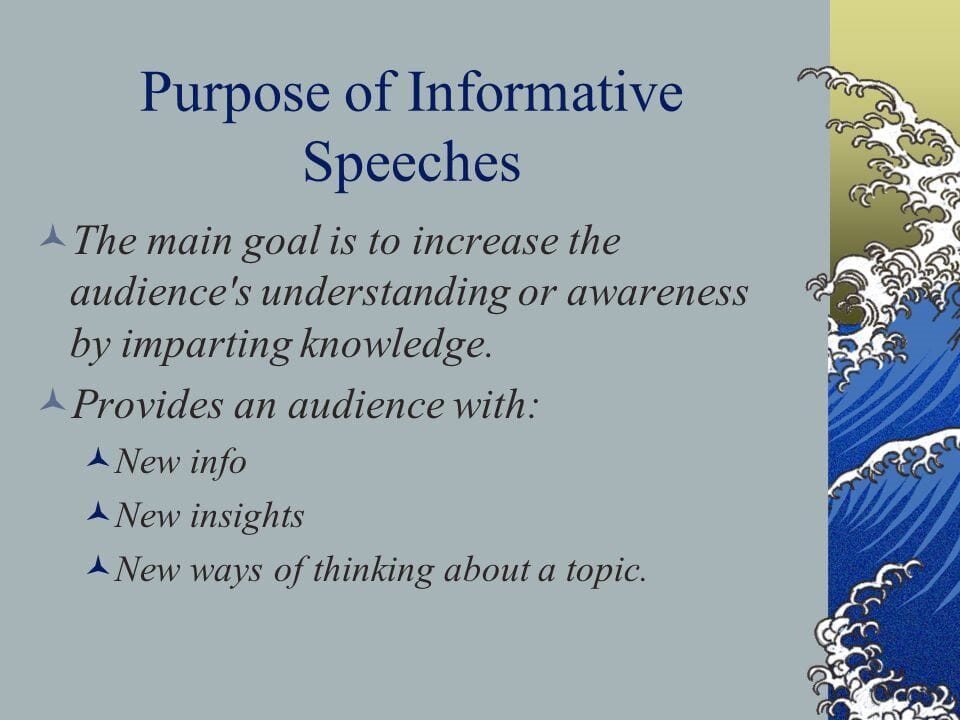
In summary, an informative speech aims to increase the audience’s knowledge, understanding, and awareness of a particular topic by giving them accurate, well-organized, and unbiased information.
III. Major Types of Informative Speeches
Depending on their subject matter and intended audience, informative speeches fall under one of several major types. These categories offer a useful system for classifying and rating informative speeches, helpful starting point for work on your speech, even though they are not absolute:
- Objects
- Processes
- Events
- Concept
1. Speeches about Objects
Speeches about objects, also known as object informative speeches, focus on things existing in the world. Objects include, among other things, people, places, animals, or products.
These speeches aim to enhance the audience’s understanding of the object’s characteristics, significance and uses. Here’s how you might structure a speech about an object:
Introduction
Body
- Description and Physical Characteristic
- Historical Background
- Significance and Purpose
- Cultural or Symbolic Meaning
- Innovation or Evolution
- Impact and Relevance
You cannot cover any topic in full because of the time constraints on your remarks. Instead, confine your speech to discussing one particular aspect of your subject.
Example:
- Central Intelligence Agency
- Tombstone
- Surgical lasers
- Franklin Delano Roosevelt, and efforts to conceal how he suffered from polio while in office.
2. Speeches about Processes
Speeches about processes focus on patterns of action. The demonstration speech is a sort of speech about processes that teaches individuals “how to” do a process by outlining a set of stages or a sequence of activities required to obtain a given outcome or complete a job. More frequently, however, you will use process speeches to explain a process in broader terms. The audience is more likely to comprehend the significance or context of the process in this manner.
These speeches are made to walk the audience through the steps and make sure they comprehend each one’s importance; the structure of a process speech is as follows:
Introduction
Body
- Process Overview
- Step-by-Step Explanation
- Materials and Tools
- Tips and Best Practices
- Visual Aids
- Safety Precautions
- Benefits and Applications
Conclusion
Example:
- A lecture on the pasteurization of milk would not instruct the audience on how to milk cows. Instead, by explicitly drawing connections between patterns of action (the pasteurization process) and outcomes (a safe milk supply), this speech could aid audience members in understanding the procedure.
- How the Internet works (not "how to use the Internet"), how to put together an effective informative speech, and how to conduct job market research.
As with any speech, keep discussing topics you can fully and concisely explain in the allotted time.
3. Speeches about Events
Speeches about events, called event informative speeches, concentrate on imparting knowledge and insights about particular incidents, significant historical moments, or noteworthy events. It focuses on things that happened, are happening, or will happen.
When discussing an event, remember to relate the subject to your audience and limit your focus to those aspects of an event that can be adequately addressed within the time limitations of your assignment. These speeches seek to inform the audience of the discussed event’s specifics, importance, and effects. Here is a structure of how to organize a speech about an occasion:
Introduction
Body
- Event Background
- Key Details and Chronology
- Significance and Impact
- Participants and Stakeholders
- Reactions and Responses
- Legacy and Lessons
- Cultural and Historical Context
Conclusion
Example: The 1963 Civil Rights March on Washington
Introduction:
Ladies and gentlemen, distinguished guests, and fellow advocates for justice, today we gather to revisit a pivotal moment in the fight for civil rights—the 1963 Civil Rights March on Washington. This historic event is a testament to the power of unity, resilience, and the unwavering commitment to equality.
Body:
Historical Context:
Cast your minds back to the early 1960s, a time marred by racial segregation and systemic discrimination. Dr. Martin Luther King Jr., alongside other civil rights leaders, envisioned a nation where individuals of all races could live together harmoniously. The march on Washington in 1963 culminated in their efforts to demand economic and civil rights for African Americans.
Key Moments of the March:
Picture the monumental scene on August 28, 1963, as over a quarter of a million people gathered at the Lincoln Memorial. Dr. Martin Luther King Jr. delivered his iconic “I Have a Dream” speech, articulating a vision of a nation free from racial injustice and inequality. The march was a poignant display of solidarity, determination, and the collective will for change.
Legacy and Impact:
The impact of the 1963 Civil Rights March on Washington reverberates throughout history. It catalyzed the Civil Rights Act of 1964 and the Voting Rights Act of 1965, ushering in a new era of legal and social change. The march laid the foundation for subsequent movements advocating for equality and justice.
Ongoing Struggles:
While progress has been made, it is essential to acknowledge that the struggle for civil rights persists. The principles championed during the 1963 march remain relevant today, inspiring us to continue working toward a society where everyone is afforded equal opportunities and rights.
Conclusion:
As we reflect on the 1963 Civil Rights March on Washington, let us honor the brave individuals who stood on the frontlines of change. Their courage and determination remind us that the pursuit of justice is an ongoing journey that requires our collective commitment to upholding the principles of equality and fairness for all.
4. Speeches about Concepts
Concept-related speeches, called concept-informing speeches, delineate abstract notions, theories, philosophies, or ideologies. While speeches about objects, processes, and events are fairly concrete, speeches about concepts are more abstract.
The purpose of these speeches is to help the audience better understand and relate to complex ideas. Here is an example of how to organize a speech about a concept:
Introduction
Body
- Definition and Explanation
- Origins and Development
- Core Principles and Characteristics
- Applications and Examples
- Relationships and Connections
- Impact and Relevance
- Critiques and Controversies
Conclusion
Be concise and understandable when writing and delivering a speech about a concept. When selecting a concept, remember you are crafting an informative speech. Concept-related speeches frequently adopt a persuasive tone. Focus your efforts on providing unbiased information and refrain from making arguments. Limit your speech to points that can be explained and understood within the time constraints because concepts can be hazy and complicated.
Example:
- Democracy
- Taoism
- Principles of feminis
- The philosophy of non - violent protest
- The Big Bang theory.
- The Butterfly effect
IV. FAQ about Informative Speaking
1. What is informative speaking?
In an informative speech, the speaker’s main objective is to give the audience factual, unbiased information regarding a given subject, idea, concept, event, process, or topic. The audience’s understanding is to be improved and educated.
2. What are the key characteristics of an informative speech?
Clarity, objectivity, logical structure, audience relevance, reliable sources, various supporting materials, and consideration for time are characteristics of informative speeches.
3. How does an informative speech differ from a persuasive speech?
A persuasive speech seeks to change the audience’s opinions or behaviors by advancing arguments and promoting a particular viewpoint, as opposed to an informative speech, which seeks to educate the audience by offering objective information
4. What are some tips for selecting an informative speech topic?
Pick a subject that appeals to both you and your audience, is timely and relevant, can be clearly explained within the allotted time, and is broad and narrow enough.
5. How should I structure an informative speech?
Usually, an informative speech follows an outline:
- Introduction: Capture attention, introduce the topic, and present the thesis.
- Body: Organize main points logically with supporting details, examples, and evidence.
- Conclusion: Summarize key points, restate the thesis, and provide a memorable closing statement.
6. What role do visual aids play in an informative speech?
By providing visual representations of complex information, visual aids like slides, diagrams, images, and videos can improve the audience’s comprehension and engagement. They should complement the spoken content.
7. How can I make sure my speech is credible?
Cite your sources correctly and with reliable sources. Keep your opinions and biases to yourself, and make sure your information is accurate by fact-checking it
8. How do I tailor an informative speech to your audience?
Consider the audience’s perspectives, interests, and level of knowledge. To fit their understanding, adjust your language, examples, and level of detail.
9. How do I keep my audience engaged during an informative speech?
Use stories, relatable examples, rhetorical questions, humor (if appropriate), and dynamic delivery to keep the audience’s interest and attention.
10. What is the purpose of delivering an informative speech?
An informative speech aims to increase the audience’s knowledge of a particular subject or idea by educating, informing, and enlightening them.
11. How can I ensure that my informative speech is well - received?
You should thoroughly prepare for your speech, edit it for clarity, deliver it confidently, and be ready to answer questions and offer more details if necessary.
12. What are some effective ways to conclude an informative speech?
Reiterate the thesis, restate the main points, make a memorable closing statement, and invite the audience to consider the significance of the information presented.
13. How long should an informative speech be?
An informative speech’s length is determined by the surroundings and instructions given. In general, it’s a good idea to stick to the allotted time and keep the audience’s interest throughout.
Conclusion
Informative speeches serve as valuable tools for expanding our understanding of the world around us. These speeches can educate audiences on various subjects, from historical events to scientific concepts, cultural practices to technological advancements, through clear explanations, factual information, and organized structures. An informative speech should encourage curiosity, critical thinking, and a deeper understanding of the complexity of our universe in addition to imparting knowledge. An informative speech aims to increase the audience’s knowledge and comprehension of a subject, giving them a clearer perspective and a better understanding. In an era of information overload, the significance of informative speeches must be considered. They offer a venue for knowledge exchange, debunking myths, and encouraging more research.