


Lesson 1 – How to Improve Reading Comprehension
Introduction
Are you tired of reading pages upon pages of text only to struggle to understand and retain the information? If so, you’re not alone. Many individuals face the challenge of poor reading comprehension, which can hinder their academic, professional, and personal growth. In this lesson, we have the solution you’ve been searching for. We’ll delve into practical strategies, proven techniques, and expert advice to help you enhance your reading comprehension skills and unlock a world of knowledge and understanding.
I. What is reading comprehension?
Reading comprehension is the art of understanding and making sense of written text. It encompasses an intentional and active process that occurs before, during, and after reading. Let’s consider an example: Picture yourself reading a thought-provoking article. As you engage with the text, you go beyond mere words and delve into its meaning, drawing connections and grasping the author’s message. By honing your reading comprehension skills, you can extract profound insights and fully appreciate the depth of any written work.
Reading comprehension comprises two fundamental components: text comprehension and vocabulary knowledge. Vocabulary knowledge ensures your understanding of the language employed, while text comprehension empowers you to decipher the underlying meaning of the written material.
II. Why Are Reading Comprehension Skills Important?
The importance of reading comprehension extends far and wide, offering many benefits that enhance both personal and professional realms. Compelling reading enriches your overall reading experience and fuels personal growth. For example, when you understand a technical manual, you acquire new skills and knowledge, enabling you to excel in a specific field.
Beyond personal growth, strong reading comprehension skills profoundly impact your professional life. They equip you to comprehend, analyze, and respond effectively to workplace documents and written communication. Additionally, these skills bolster your ability to communicate clearly and persuasively in written form.
Moreover, reading comprehension skills empower you to actively engage with current events through written media such as newspapers. By comprehending the news, you gain insights, broaden your perspectives, and become an informed and active societal participant.
Lastly, honing reading comprehension skills strengthens your capacity for focused reading over extended periods. This enhanced ability allows you to immerse yourself in complex texts, delve deeper into subjects of interest, and extract valuable information efficiently.
III. How to Improve Reading Comprehension
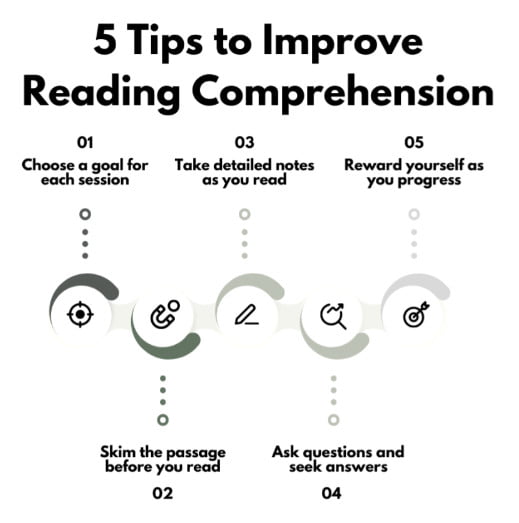
To enhance your reading comprehension skills, there are several strategies you can begin implementing right away. Your ability to understand and engage with what you read will improve significantly with practice. Here are seven simple strategies to help you work on your comprehension skills:
Expand your vocabulary
- Assess your current vocabulary level through online quizzes.
- Use flashcards to quiz yourself on unfamiliar words regularly.
- Incorporate newly learned words into your conversations and writing.
- Read extensively to enhance your ability to infer word meanings from context.
- Keep a list of unfamiliar words and look them up in the dictionary as you encounter them.
Pose questions about the text
- Asking questions while reading fosters engagement and deeper understanding.
- Explore themes, character relationships, and authorial choices.
- Frame specific questions to gain further insight into the text and its meaning.
Utilize context clues
- Context clues help you decipher unfamiliar words.
- Focus on key phrases or ideas in a sentence to deduce the main idea.
- Look for nearby words that are synonyms or antonyms of the unknown word.
Identify the main idea
- Recognize the central theme or purpose of paragraphs or articles.
- Understanding the significance of what you read enhances comprehension.
- Pause periodically to identify and articulate the main idea in your own words.
Summarize what you read
- Writing a summary helps solidify your understanding.
- Select essential information and express it in your own words.
- Summarizing tests your comprehension and aids long-term retention.
Break down the text into smaller sections
- For lengthy or complex texts, divide them into manageable portions.
- Read a couple of paragraphs at a time, then pause to summarize them mentally.
- Breaking the text into smaller chunks reduces overwhelm and enhances comprehension.
Maintain a suitable pace
- Set realistic reading goals to foster adequate comprehension.
- Particularly with challenging literature, establish manageable daily targets.
- Pace yourself by reading a few chapters per session, allowing time for reflection and processing.
IV. Tips to make the most of your reading comprehension practice
Reading plays an integral role in our daily lives, and by prioritizing comprehension, you can significantly enhance your reading abilities. To make the most of your reading practice, consider the following tips:
Reading comprehension comprises two fundamental components: text comprehension and vocabulary knowledge. Vocabulary knowledge ensures your understanding of the language employed, while text comprehension empowers you to decipher the underlying meaning of the written material.
1.
Minimize distractions:
- Eliminate any distractions that may hinder your focus while reading.
- Create a conducive environment to concentrate solely on the text.
- You can better assess your understanding of the material by maintaining undivided attention.
2.
Start with books below your reading level:
- Begin with readers that are comfortably within your comprehension level.
- This approach establishes a foundation and allows you to progress gradually.
- Online quizzes help determine your current reading level for appropriate selection.
3.
Revisit and re-read for comprehension:
- If you encounter a sentence or paragraph that perplexes you, take the time to re-read it.
- Read more slowly during the second attempt, focusing on understanding the message.
- Consult a dictionary to clarify the meaning of any unfamiliar words.
4.
Engage in oral reading:
- Reading aloud combines visual and auditory learning, enriching comprehension practice.
- Speaking the words forces you to slow down and facilitates deeper processing.
- Utilize this method to reinforce understanding and improve overall retention.
V. Practice
Here are some reading comprehension exercises to help you improve your skills:
Exercise 1: Short Passage Analysis
Read a short passage and then answer questions related to its main idea, supporting details, and key points. This exercise helps you practice extracting essential information from a text.
Exercise 2: Multiple Choice Questions
Read a passage and answer multiple-choice questions that require you to identify the correct inference, vocabulary usage, or main idea. This exercise sharpens your ability to comprehend and analyze written content.
Exercise 3: Summarization
Read a paragraph or short article, then write a concise summary of the main ideas and important details. This exercise encourages you to focus on the most crucial aspects of the text.
Exercise 4: Predictions and Inferences
Read a passage and make predictions about what might happen next. Afterward, read on to check if your predictions were accurate. This exercise strengthens your ability to draw logical inferences.
Exercise 5: Comparing and Contrasting
Read two passages on related topics and identify their similarities and differences. This exercise enhances your ability to analyze and synthesize information from different sources.
Exercise 6: Vocabulary in Context
Read a sentence with an unfamiliar word and try to infer its meaning based on the surrounding context. This exercise helps improve your vocabulary and context-clue skills.
Exercise 7: Sequencing
Read a passage with events in a specific order, then arrange those events in the correct sequence. This exercise hones your understanding of chronological organization.
Exercise 8: Main Idea Identification
Read a longer article and determine the main idea or central theme. This exercise requires you to grasp the overarching concept amidst various details.
Exercise 9: Cause and Effect Analysis
Read a passage and identify the cause-and-effect relationships presented. This exercise improves your ability to recognize how events are connected.
Exercise 10: Critical Reading
Read a persuasive or argumentative text and evaluate its strengths, weaknesses, and logical coherence. This exercise enhances your critical thinking and analytical skills.
Conclusion
In conclusion, improving reading comprehension goes beyond decoding words; it’s about immersing yourself in the author’s world, asking questions, and embracing diverse perspectives. It’s a journey of imagination, empathy, and critical thinking. So, let us not just master the skill but embrace the transformative power of reading. Every page turned is an opportunity for growth, enlightenment, and connection. Let the words on the page shape the person you become on this lifelong learning adventure.