


Lesson 1 – History of Native Americans
Introduction
Understanding the ancient migrations of humans holds profound significance, shedding light on the intricate tapestry of our shared history and ancestry. Since time immemorial, humans have been on the move, seeking better opportunities or adapting to changing environments. The question of the origins of the first people to arrive in the Americas is a subject of intense debate and discussion. This inquiry is intricately tied to the history of Native Americans, as unraveling these mysteries offers insights into their ancient roots and cultural evolution. Various theories have been proposed, each with its own set of supporting evidence, making the quest for definitive answers both challenging and captivating. The purpose of this lesson is to delve deeper into the origins of early people in the Americas.
I. Origins of Early People in the Americas
Different theories shed light on how the very first inhabitants could have arrived and settled in these vast lands.
1. The Bering Land Bridge Theory
The long-standing Bering Land Bridge theory, often referred to as Beringia, posits that during the last Ice Age, massive glaciers trapped vast amounts of water, causing sea levels to drop and revealing a large land stretch connecting Siberia and Alaska. This geographical change provided a migratory path for people from present-day Russia to Alaska. Evidence of this migration can be found in numerous archaeological sites across Alaska and Siberia, which display traces of ancient human activity. Additionally, genetic studies bolster this theory, showcasing a shared lineage between Native Americans and ancient northeastern Asian populations. Once these pioneering individuals made their way into Alaska, they embarked on a gradual southward journey, populating the vast and unexplored expanses of the Americas over millennia.
2. Other theories
Maritime Migration:
Some researchers believe that early inhabitants could have used boats to migrate down the Pacific Coast, instead of traversing overland. Supporting this claim are ancient sites discovered on islands off the west coast of Central and South America, suggesting that a sea-based migration route might have been plausible.
European Migration:
The contentious "Solutrean hypothesis" proposes that ancient Europeans may have been among the initial settlers in the Americas, journeying across the North Atlantic ice sheet. Advocates for this perspective highlight the resemblances between European Solutrean tools and artifacts from early American sites, even though the theory continues to be a subject of rigorous debate.
Australian Migration:
A speculative hypothesis proposes that early Australians, or possibly groups from Southeast Asia, might have navigated to the Americas via watercraft, traveling through the Pacific islands. Despite the allure of this idea, it's currently backed by sparse archaeological or genetic evidence.
II. The Emergence and Evolution of Native American Cultures
The emergence of Native American cultures traces back to ancient settlements, revealing a kaleidoscope of traditions, beliefs, and societal structures that have evolved over millennia. Archaeological finds and studies have uncovered the remnants of these ancient societies, offering insights into their ways of life, technological advancements, and the environments they inhabited.
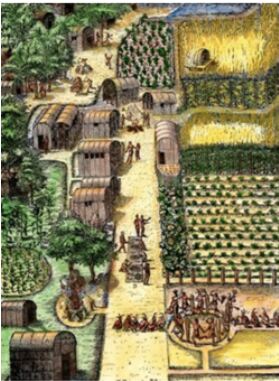
Figure 01: Powhatan village of Secoton
These ancient civilizations, despite the shared geography, developed diverse and unique cultures, each enriched by its distinct practices, artistic expressions, and spiritual beliefs. The geographic spread of these tribes across the Americas resulted in a myriad of cultural expressions, shaped and nurtured by the landscapes they inhabited, the resources they harvested, and the communities they forged.
The diversity in cultures is mirrored in their societal structures, ceremonial rituals, and folklore, each narrating the tales of their ancestors, their struggles, and their triumphs. The multitude of languages, art forms, and ceremonial practices across different tribes underline the rich tapestry of Native American heritage, a heritage deeply rooted in resilience, wisdom, and a profound connection to the land.
The exploration of these ancient settlements and the study of their diverse cultures enable a deeper appreciation for the complexity and richness of Native American societies, providing a window into their worldviews, their harmonious relationship with nature, and their enduring legacies that continue to influence and inspire generations.
III. Genetic Links and the Intricate Relationships Between Early Inhabitants and Today's Native Americans
Delving deep into the realm of genetics provides a fascinating perspective on the migratory patterns and settlement dynamics of ancient human groups. Sophisticated genetic analysis, especially through mitochondrial DNA and Y-chromosome studies, has been instrumental in mapping the intricate web of ancestry and descent.
Modern Native American communities, with their rich cultural tapestries, can be genetically traced back to the pioneering inhabitants who first called the Americas their home. Specific genetic markers, unique to these indigenous populations, serve as undeniable evidence of their longstanding connection to this land. Furthermore, the haplogroups identified in today’s Native American populations often match those of ancient skeletal remains unearthed from various archaeological sites across the continent.
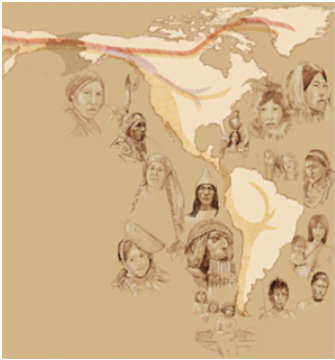
Figure 02: Native American populations descend from three key migrations
These genetic connections not only substantiate historical accounts and oral traditions but also fortify the bonds that contemporary Native American tribes share with their ancestors. Through the lens of genetics, we witness the enduring legacy of the first settlers and gain a deeper appreciation for the diverse yet interconnected heritage of the many tribes that grace the Americas today.
IV. FAQ
1. What is the main premise of the Bering Land Bridge Theory, and how does it explain the migration of early people to the Americas?
- The Bering Land Bridge Theory proposes that early humans migrated from Asia to the Americas by crossing a land bridge called Beringia during periods of lowered sea levels.
2. Can you provide examples of alternative theories to the Bering Land Bridge Theory, and what evidence supports these alternatives?
- Alternative theories include the Coastal Migration Theory, which suggests migration along the Pacific coast, and the Pre-Clovis Theory, which challenges the idea that the Clovis culture was the first in the Americas. Evidence for alternatives includes pre-Clovis archaeological sites and early human remains.
3. How do genetic studies contribute to our understanding of the migration patterns and settlement dynamics of early human groups in the Americas?
- Genetic studies, particularly of mitochondrial DNA and Y-chromosomes, help trace the genetic connections between ancient and modern Native American populations, supporting the Bering Land Bridge Theory but also revealing genetic diversity and potential contributions from other sources.
4. In what ways did diverse environments and landscapes shape the unique cultures of Native American tribes?
- Diverse environments and landscapes in the Americas shaped the unique cultures of Native American tribes by influencing their subsistence strategies, social structures, religious beliefs, artistic traditions, and languages. For example, tribes in different regions adapted to agriculture, hunting, fishing, or gathering based on the available resources.
5. How does genetic analysis, specifically mitochondrial DNA and Y-chromosome studies, help trace the genetic connections between ancient and modern Native American populations?
- Genetic analysis, particularly of mitochondrial DNA and Y-chromosomes, helps trace the genetic connections between ancient and modern Native American populations by examining specific genetic markers. Mitochondrial DNA is inherited from the mother and provides insights into maternal lineages, while the Y-chromosome is inherited from the father and reveals information about paternal lineages. Comparing these genetic markers between ancient and modern populations can identify shared ancestry and migration patterns.
Conclusion
Recognizing and understanding the history of Native Americans is not just an academic endeavor; it’s a journey of respect, acknowledgment, and appreciation. Their history, intertwined with the very fabric of the Americas, serves as a testament to resilience, innovation, and a deep spiritual connection to the land. Moreover, the rich tapestry of Native American cultures underscores the incredible diversity of traditions, beliefs, and practices that have flourished across the continent. Embracing this diversity is paramount, not just for historical accuracy but also to honor the profound contributions and the enduring spirit of Native American communities. It is a reminder that in diversity lies strength, and in understanding, lies unity. By valuing their history, we not only celebrate their past but also pave the way for a future of mutual respect and collaboration.