


Chapter 1, Lesson 1
In Progress
Lesson 1 – Alberti’s Basilica of Sant’Andrea in Mantua
Chapter Progress
0% Complete
Introduction
In this installment, we cast our gaze upon a marvel of architectural ingenuity – Alberti’s Basilica of Sant’Andrea in Mantua. A cornerstone of Renaissance architecture, this sacred edifice stands as a testament to the vision and mastery of Leon Battista Alberti, a polymath whose influence reverberates through the corridors of history.
In this lesson, we will unravel the layers of significance woven into the Basilica’s stones and arches, exploring not only its physical structure but the very essence of Renaissance thought embedded within its walls.
I. Leon Battista Alberti (1404-1472)
1. Brief Introduction to Alberti's Life and Contributions to Renaissance Architecture:
Leon Battista Alberti, born in 1404 in Genoa, Italy, was a true luminary of the Italian Renaissance. His multifaceted genius left an indelible mark on various fields, including architecture, literature, philosophy, and the arts. Alberti’s life unfolded against the backdrop of a transformative era, where the revival of classical learning and humanist ideals laid the foundation for a cultural renaissance.
Alberti’s architectural journey began with a deep appreciation for the classical past, particularly the works of Roman architects like Vitruvius. His profound understanding of ancient architecture, combined with his insatiable curiosity, propelled him to become one of the foremost architectural theorists and practitioners of his time.
Some of Alberti’s notable contributions to Renaissance architecture include his treatise “De Re Aedificatoria” (On the Art of Building), a seminal work that synthesized classical principles with contemporary insights. In this treatise, Alberti articulated principles of proportion, harmony, and symmetry, laying down a theoretical framework that would guide architects for centuries.
2. His Role as a Humanist, Architect, and Polymath:
Alberti’s brilliance extended beyond the realm of architecture. He embraced the humanist philosophy that characterized the Renaissance, emphasizing the dignity and potential of humanity. As a humanist, Alberti sought to revive classical learning, viewing it as a source of wisdom and inspiration.
In addition to his architectural pursuits, Alberti was a prolific writer, poet, and philosopher. His literary works, such as “De Pictura” (On Painting), explored the principles of painting and visual aesthetics. This polymathic approach, where one mind seamlessly navigated between diverse disciplines, exemplified the Renaissance ideal of the “universal man” or “Renaissance man.”
Alberti’s architectural legacy reflects not just technical expertise but a holistic worldview that synthesized humanist ideals with artistic expression. His designs were imbued with a profound understanding of proportion, beauty, and human experience, making him a luminary whose influence continues to resonate in the corridors of art and architecture.
II. Context of the Renaissance
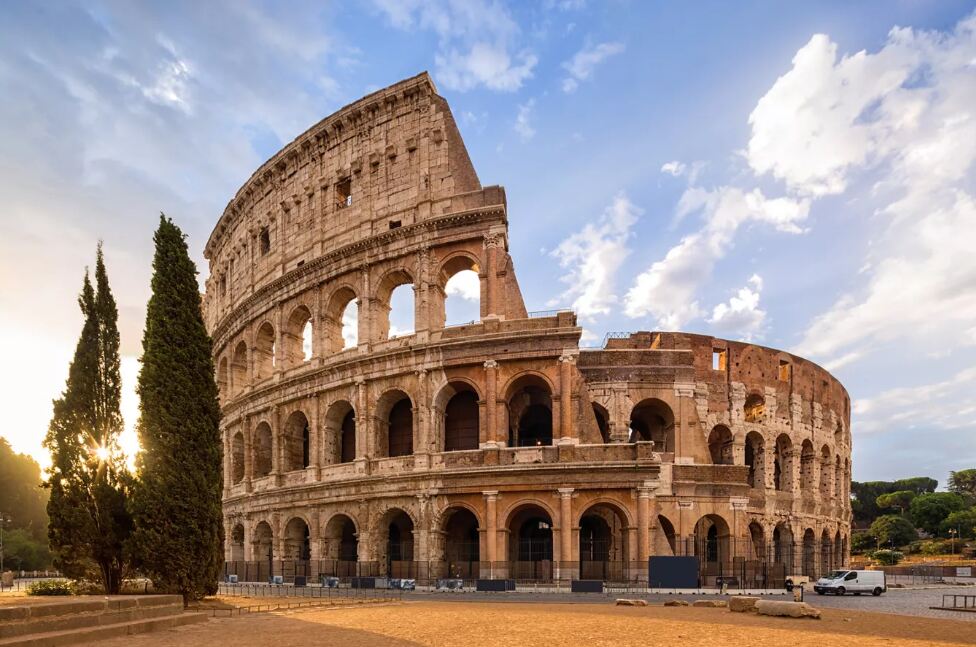
Colosseum
1. Historical and Cultural Context of the Italian Renaissance:
The Italian Renaissance, spanning roughly from the 14th to the 17th century, marked a pivotal period in European history characterized by a profound resurgence of interest in classical learning, arts, and sciences. This cultural revival was rooted in the aftermath of the Middle Ages, a time marked by feudalism and religious orthodoxy.
The city-states of Italy, including Florence, Venice, and Rome, became thriving centers of commerce, fostering an affluent and intellectually vibrant society. The rediscovery of ancient texts, particularly those of Greek and Roman philosophers, poets, and historians, ignited a fervor for knowledge. Scholars delved into the works of thinkers like Plato, Aristotle, and Cicero, seeking inspiration and wisdom from the classical past.
This intellectual awakening was complemented by a renewed interest in humanism, a philosophical movement that exalted the inherent value and potential of human beings. Humanists championed the idea that education, knowledge, and artistic expression were integral to a well-rounded individual. The fusion of classical wisdom and humanist ideals laid the groundwork for the Renaissance’s cultural explosion.
Artists, thinkers, and patrons of the arts became enthusiastic patrons of this cultural renaissance. The Medici family in Florence, for example, played a pivotal role in supporting artists and intellectuals, creating an environment conducive to creative exploration. The result was an unprecedented flourishing of the arts, literature, science, and, significantly, architecture.
2, Recognizing the Revival of Classical Ideas and the Emphasis on Symmetry, Proportion, and Harmony in Art and Architecture:
At the heart of the Renaissance was a profound admiration for the achievements of classical antiquity. Architects and artists sought inspiration from the architectural marvels of ancient Rome and Greece, aiming to emulate the grace, order, and beauty found in classical structures.
Symmetry, proportion, and harmony emerged as guiding principles in Renaissance art and architecture. Drawing from Vitruvius’ principles outlined in ancient Roman architecture, Renaissance architects like Alberti emphasized the importance of balance and proportion in creating aesthetically pleasing and harmonious designs. The human body, as a measure of proportion, became a central motif, with buildings designed to reflect the ideal proportions found in nature.
This emphasis on classical ideals extended beyond architecture to encompass painting, sculpture, and literature. The use of mathematical ratios, such as the golden ratio, became prevalent, reflecting a belief that beauty could be quantified and expressed through mathematical precision.
In architecture, the quest for harmony extended to the design of city spaces, where urban planning and civic architecture aimed to create a harmonious and orderly environment. The cityscape became a canvas upon which Renaissance ideals of symmetry and proportion were translated into built form.
III. Basilica of Sant'Andrea
1. Location, Purpose, and Historical Background:
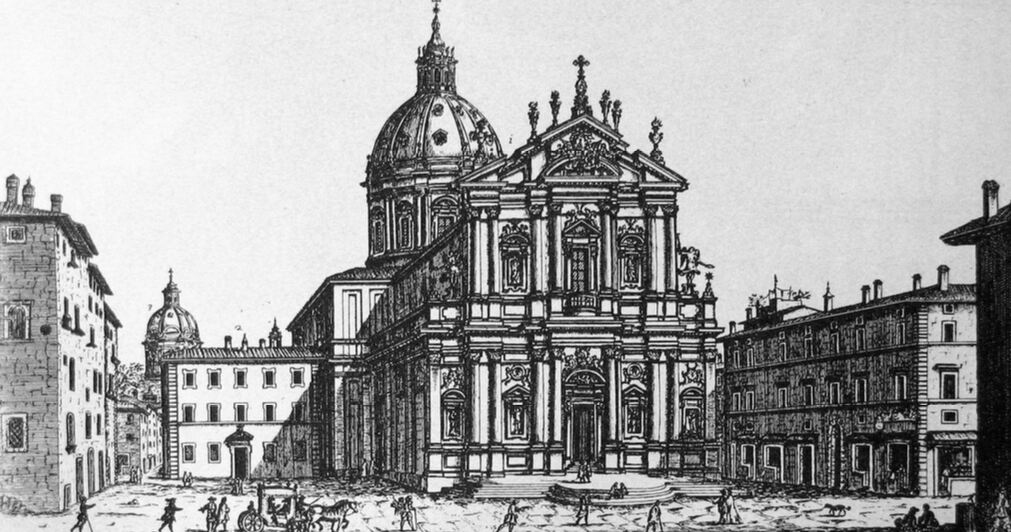
Giovanni Battista Falda in 1655
a. Location:
The Basilica of Sant’Andrea is situated in the charming city of Mantua, Italy. Nestled within the historic heart of the city, the basilica commands attention with its imposing presence, a testament to the significance it holds in both religious and architectural history.
b. Purpose:
Commissioned by Ludovico III Gonzaga, Marquis of Mantua, in the 15th century, the Basilica of Sant’Andrea served as a grand mausoleum for the Gonzaga family. The basilica was dedicated to St. Andrew, the patron saint of Mantua. Beyond its role as a sacred space, it was intended to showcase the power and prestige of the Gonzaga dynasty.
c. Historical Background:
Construction of the basilica commenced in 1462 under the guidance of the renowned architect Leon Battista Alberti. The project unfolded during a time when Mantua was flourishing culturally and economically under Gonzaga rule. The basilica’s construction, with its ambitious design and artistic embellishments, reflected the aspirations of the Gonzaga family to solidify their legacy in the annals of Italian nobility.
2. Façade:
a. Architectural Composition:
The façade of the Basilica of Sant’Andrea is a masterpiece of Renaissance architecture, reflecting Leon Battista Alberti’s commitment to classical ideals and harmonious design. Divided into three sections, the façade follows the traditional tripartite structure, reminiscent of ancient Roman triumphal arches. This division imparts a sense of grandeur and symmetry to the exterior.
b. Classical Orders:
Alberti employed a careful use of classical orders in the façade, showcasing a harmonious integration of architectural elements. The lower-level features robust Doric columns, conveying strength and solidity, while the upper level boasts elegant Corinthian columns, adding a touch of grace and sophistication. This classical vocabulary not only pays homage to ancient architectural traditions but also establishes a visual rhythm that captures the eye.
c. Pediment and Decorative Elements:
The façade is crowned with a triangular pediment, a hallmark of classical architecture. This architectural element, adorned with sculptural details and decorative friezes, adds a sense of completion to the structure. Sculptures and reliefs depicting religious and mythological themes adorn the façade, providing both aesthetic richness and narrative depth.
d. Symmetry and Proportion:
Symmetry is a central theme in the façade, with each element meticulously balanced to create a visually pleasing composition. The use of proportion, a key Renaissance principle, ensures that every architectural detail contributes to the overall harmony of the structure. The façade, therefore, becomes a testament to Alberti’s mastery in achieving a perfect balance between classical tradition and innovative design.
3. Interior:
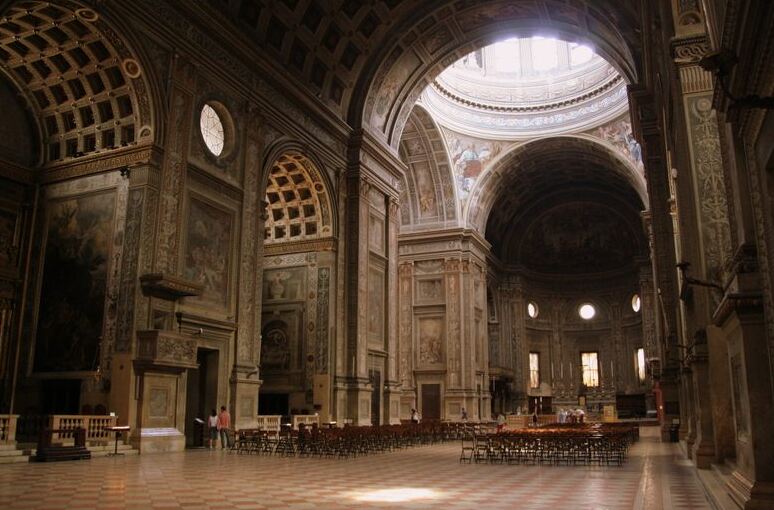
Interior of Basilica di Sant’Andrea
a. Nave and Columns:
Upon entering the Basilica, visitors are greeted by a spacious and luminous interior. The nave, flanked by towering Corinthian columns on either side, creates a sense of verticality and grandeur. The columns support arches that guide the eye along the length of the nave, contributing to the overall symmetry and rhythm of the interior space.
b. Dome
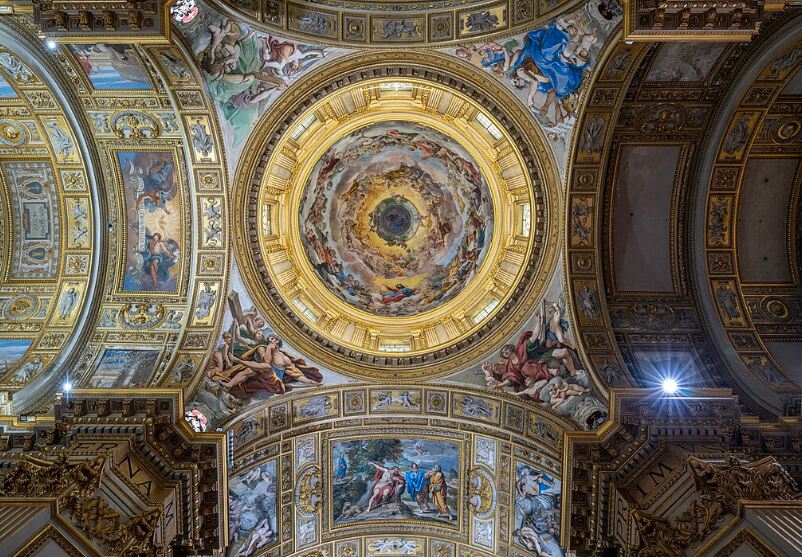
Dome of Basilica di Sant’Andrea
One of the most remarkable features of the interior is the centralized dome, inspired by the Pantheon in Rome. The dome, with its oculus allowing natural light to filter into the space, creates an ethereal atmosphere. The geometric patterns and decorative elements on the dome add to its visual appeal, serving as a focal point that draws the eye upward.
c. Transept and Apse:
The transept, intersecting the nave, provides additional space for religious rituals and is often adorned with frescoes and sculptures. Moving towards the apse, visitors encounter a semicircular space that typically houses the altar. The apse is often adorned with intricate artwork, creating a visually rich focal point within the basilica.
d. Frescoes and Artwork:
The interior walls and ceilings of Sant’Andrea are adorned with frescoes and artwork, showcasing the talents of renowned artists from the Renaissance period. These artistic embellishments contribute to the overall religious narrative, depicting scenes from the life of St. Andrew and other biblical themes.
IV. Symbolism and Meaning
The Basilica of Sant’Andrea is not only a marvel of Renaissance architecture but also a repository of symbolism and meaning, carefully woven into its design to convey religious, political, and cultural messages. As we explore the symbolic elements of the basilica, we uncover layers of significance that contribute to its rich narrative:
1
1
2
2
3
3
4
4
1
Religious Symbolism:
- Dedication to St. Andrew: The basilica is dedicated to St. Andrew, the patron saint of Mantua. St. Andrew, one of the twelve apostles, holds religious significance, and his presence in the dedication underscores the sacred purpose of the building.
- Altar and Apse: The altar located in the apse, often the focal point of religious ceremonies, symbolizes the sacred heart of the basilica. The apse, with its semicircular design, creates a sense of enclosure and emphasizes the importance of the religious rituals conducted within.
- Frescoes and Artwork: The frescoes and artwork within the basilica depict scenes from the life of St. Andrew and other biblical narratives. These visual representations serve as a form of religious education and contemplation for worshippers.
2
Political and Dynastic Significance:
- Patronage by the Gonzaga Family: Commissioned by Ludovico III Gonzaga, Marquis of Mantua, the basilica served as a grand mausoleum for the Gonzaga family. The architectural splendor and scale of the basilica reflect the Gonzaga dynasty's desire to showcase their wealth, power, and cultural refinement.
- Triumphal Arch Façade: The façade, reminiscent of a triumphal arch, evokes the architectural language of ancient Rome, symbolizing the glory and triumph of the Gonzaga family. It becomes a visual representation of their political and military achievements.
3
Architectural Symbolism:
- Centralized Dome: The centralized dome, inspired by the Pantheon, symbolizes the celestial realm and the divine. Its innovative design deviates from traditional cruciform plans, contributing to a sense of awe and transcendence.
- Classical Orders: The use of classical orders in the façade, including Doric and Corinthian columns, reflects a conscious effort to connect with the architectural traditions of ancient Greece and Rome. This choice symbolizes a revival of classical ideals during the Renaissance.
- Symmetry and Proportion: The emphasis on symmetry and proportion in architectural design reflects Renaissance principles of beauty and mathematical precision. It symbolizes an idealized and harmonious vision of the world.
4
Humanist Ideals:
- Integration of Arts and Sciences: The basilica embodies the humanist ideals of the Renaissance, where knowledge and appreciation of various disciplines, including art, architecture, literature, and philosophy, were celebrated. The integration of artistic embellishments and architectural innovation reflects this holistic approach.
- Universal Beauty: The pursuit of universal beauty, a core humanist concept, is evident in the basilica's design. The use of classical elements and a commitment to aesthetic harmony aim to evoke a sense of beauty that transcends cultural and temporal boundaries.
Conclusion
In concluding Lesson 1, our exploration of Alberti’s Basilica of Sant’Andrea in Mantua has unraveled the layers of artistry, symbolism, and historical significance that define this Renaissance masterpiece. From its commanding façade, adorned with classical orders and sculptural richness, to the celestial embrace of its centralized dome, the basilica stands as a testament to the genius of Leon Battista Alberti and the spirit of the Italian Renaissance
As we move forward in our Architectural History series, let the Basilica of Sant’Andrea remain a beacon, reminding us that behind every architectural marvel lies a story – a story of human creativity, cultural aspirations, and the enduring quest for beauty and meaning. May this lesson inspire a deeper appreciation for the treasures of the past and a heightened curiosity as we continue to unveil the wonders of architectural history.