


Chapter 1, Lesson 3
In Progress
Lesson 3 – Managerial Skills
Chapter Progress
0% Complete
Introduction
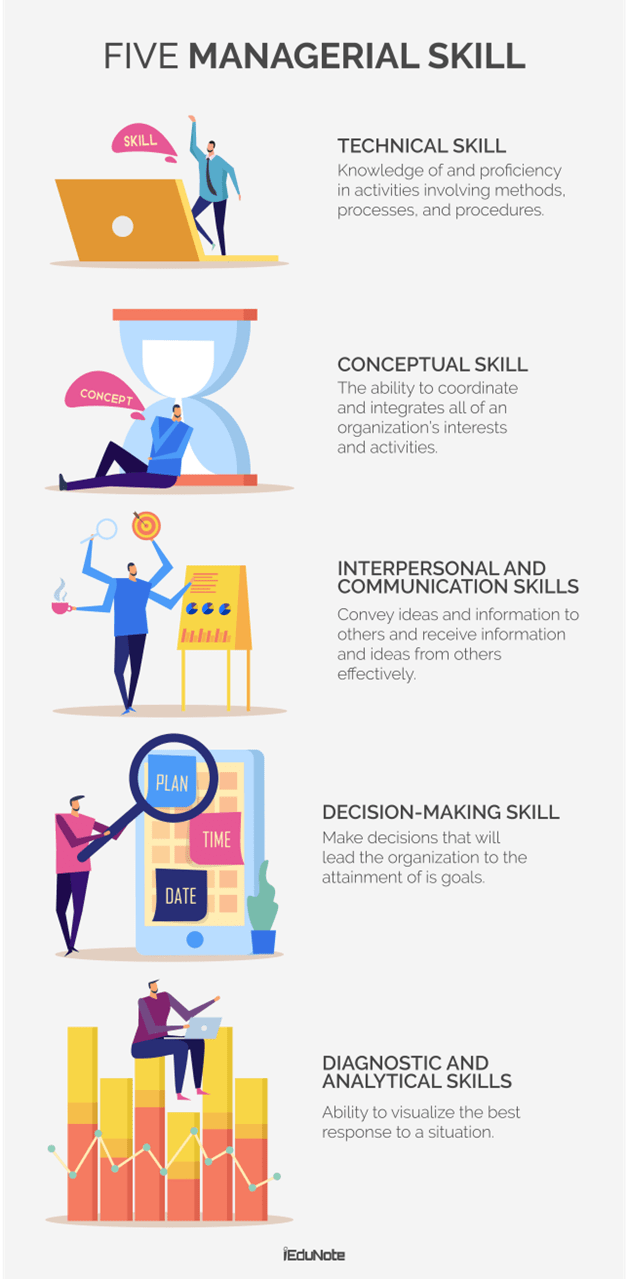
Managerial skills can be categorized into five main areas: technical skills, conceptual skills, interpersonal and communication skills, decision-making skills, and diagnostic and analytical skills.
I. Technical Skill
Technical skill refers to the knowledge and proficiency in activities that involve methods, processes, and procedures. It requires working with tools and specific techniques. In various professions such as accounting, engineering, and surgery, technical skills are essential for effective performance. Even managers, particularly at lower and middle levels, need technical skills to carry out their tasks efficiently.
For instance, mechanics use tools, and their supervisors should possess the ability to teach them how to use these tools. Similarly, accountants utilize specific techniques in their work. This skill is particularly valuable in a supervisory or first-level management position.
II. Conceptual Skill
Conceptual skill refers to the ability to have a broad understanding of a situation and recognize the important elements within it. It involves being able to see the connections and relationships between these elements.
In addition, conceptual skill involves coordinating and integrating all of an organization’s interests and activities. This means being able to visualize the organization as a whole and understand how its different functions work together. It also involves anticipating how changes in one part of the organization will impact the entire organization.
Having the ability to think abstractly and view the organization as a whole is crucial for managers. This skill allows them to make decisions on a larger scale, such as suggesting new product lines, implementing computer technology, or entering international markets.
Overall, conceptual skill is an important trait for managers to possess as it allows them to have a holistic understanding of the organization and make informed decisions that benefit the entire company.
III. Interpersonal and Communication Skills
Effective communication skills are essential for managers. They need to be able to effectively convey ideas and information to others, as well as receive information and ideas from others. A manager’s role involves controlling subordinates and providing high-level managers or administrators with updates on what is happening. Good communication skills enable a manager to perform these tasks effectively. A manager spends a significant amount of time interacting with people both inside and outside the organization. Interpersonal and communication skills are crucial for a manager’s ability to communicate with individuals and groups, as well as to control and motivate them. Therefore, a manager needs to possess effective interpersonal and communication skills to fulfill their responsibilities.
IV. Decision-Making Skill
In simple terms, a manager’s role is to make decisions that will help the organization achieve its goals. Decision-making skills are crucial for managers as they enable them to identify opportunities and threats and choose the most suitable course of action to address them effectively, benefiting the organization. It’s important to note that managers may not always make the best decisions. However, a good manager often makes sound decisions and learns from their mistakes. Decision-making skills improve with experience, but training and education can also be effective in developing these skills for managers.
V. Diagnostic and Analytical Skills
A competent manager possesses diagnostic and analytical skills. Diagnostic skill refers to the ability to determine the most effective response to a situation. Analytical skill, on the other hand, involves identifying the key factors in a situation. These skills enable a manager to identify potential approaches to a situation and envision the potential outcomes of these approaches. While this skill may seem similar to decision-making, it is the skill needed to make informed decisions.
Conclusion
In conclusion, a competent manager possesses a range of skills and knows how to apply them effectively to run an organization smoothly. There are five key managerial skills: technical skills, conceptual skills, interpersonal and communication skills, and decision-making skills. The various roles a manager fulfills within an organization necessitate the possession of these skills. These skills or qualities are sought after by organizations when selecting individuals for managerial positions.