


Chapter 1, Lesson 2
In Progress
Lesson 2 – Management in Organizations
Chapter Progress
0% Complete
Introduction
Management is necessary for any organized life and is crucial for running all types of organizations. A strong management system is the foundation of successful companies. Managing life means accomplishing life goals and maintaining a business. This involves working with and through others to achieve objectives.
In simpler terms, management is the organization and coordination of an industry’s activities to efficiently and effectively achieve specific goals.
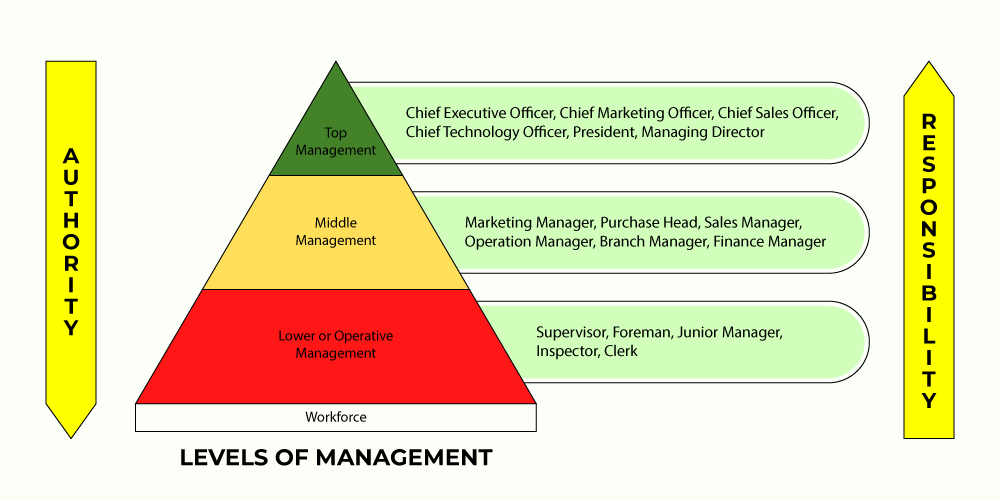
This essential structure establishes relationships between individuals as subordinates and superiors, creating distinct levels within an organization. There are three levels in the hierarchy of an organization:
- 1. Top-level management
- 2. Middle-level management
- 3. Lower-level management
I. Top Level Management
The top management of a company consists of the most senior executives, such as the Chairman, CEO, COO, President, and VP. This team includes managers from different operational levels who oversee areas like marketing and finance. For example, the CFO and VP of marketing are responsible for coordinating different units and aligning their actions with the company’s overall goals.
Top-level managers are responsible for the growth and sustainability of the organization. They analyze the business environment and its relationships to ensure the company’s survival. They establish the overall goals and strategies of the organization and are accountable for all its activities and their impact on society. Being a top manager is challenging and demanding, requiring long hours and a strong commitment to the company.
II. Middle-Level Management
Middle management serves as the link between top-level and lower-level managers. They are subordinate to top managers and supervise first-line managers. Division heads, such as Production Managers, typically hold middle management positions. The primary responsibility of middle management is to implement and oversee the strategies and plans developed by top management.
Additionally, they are accountable for the actions of first-line managers. Their main objective is to execute the plans established by top managers. To achieve this, they must:
- 1. Understand the procedures outlined by top management.
- 2. Ensure that their staff is adequately staffed.
- 3. Assign specific tasks and responsibilities to their staff and motivate them to achieve desired objectives.
- 4. Collaborate with other departments to ensure the smooth operation of the company.
Middle managers also report to top managers and are responsible for overseeing the actions of first-line managers.
III. Lower Level Management
Managers and supervisors are part of the lower level of management in a business hierarchy. Supervisors are responsible for directly managing the workforce. Their authority and capabilities are determined by the top management.
Supervisory management plays a crucial role in the system as they work closely with the actual workforce and communicate with middle management and employees. They are responsible for reporting the value of the output, minimizing waste, and ensuring safety measures are followed.
IV. FAQs
1. What is the role of top-level management?
The role of top-level management is to set the objectives and overall direction of the organization. They are responsible for making decisions that affect the entire organization.
2. What are the three levels of management?
The three levels of management are top-level management, middle-level management, and lower-level management. Top-level management is the highest level within the organization, followed by middle management and lower-level management.
3. What is the meaning of top management?
Top management refers to the leaders of an organization who hold the highest positions in the hierarchy. These positions are usually executive roles, such as CEO or COO.
Conclusion
In conclusion, management involves coordinating and administering tasks to achieve an organization’s goals. It is often described as the skill of effectively utilizing resources to make things happen.