


Chapter 1, Lesson 1
In Progress
Lesson 1 – The Four Functions of Management
Chapter Progress
0% Complete
Introduction
Functions of management refer to a systematic approach to accomplishing tasks. The management process emphasizes that all managers, regardless of their abilities or skills, engage in interconnected functions to achieve their desired objectives.
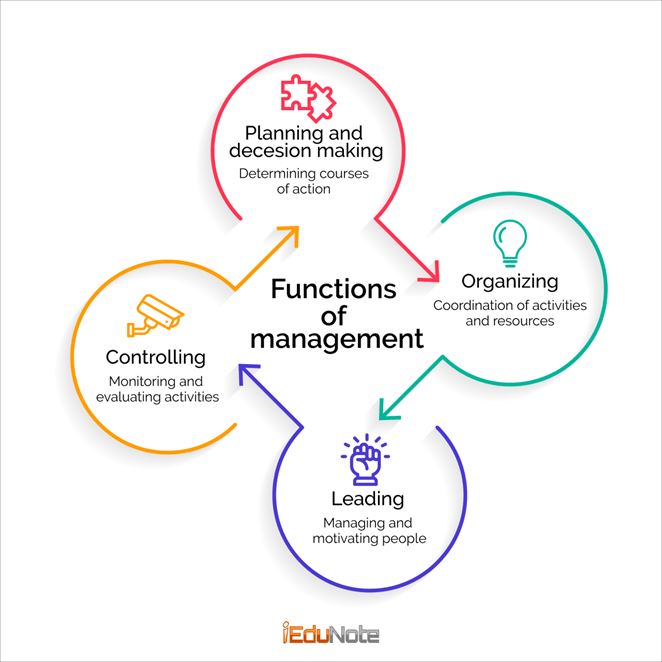
The management process consists of four fundamental activities:
- 1. Planning and Decision Making: This involves determining the best courses of action to take.
- 2. Organizing: This entails coordinating activities and resources effectively.
- 3. Leading: This involves managing, motivating, and directing individuals.
- 4. Controlling: This includes monitoring and evaluating activities to ensure they align with the desired outcomes.
I. Planning and Decision Making – Determining Courses of Action
The most important task for a manager is to look ahead and predict future trends or events that will impact on the work environment. Planning involves setting goals for the organization and determining the best way to achieve them. It is a process of making decisions about the goals and mapping out the future actions needed to reach them. Planning is crucial for maintaining managerial effectiveness as it serves as a guide for future activities. It involves selecting objectives and the necessary actions to achieve them, requiring decision-making and choosing the best course of action from available alternatives. In essence, planning is about determining the desired future position and situation of the organization and figuring out the most effective way to bring about that situation. By guiding future activities, planning helps managers maintain their effectiveness. To be successful in planning and decision-making, managers need to have the ability to anticipate, visualize, and purposefully look ahead.
II. Organizing – Coordinating Activities and Resources
Organizing is the process of moving established plans closer to realization. After a manager sets goals and develops plans, their next task is to organize the necessary human and other resources to achieve those goals. This involves determining how activities and resources will be coordinated and assembled.
An organization can be defined as a formalized structure of positions or roles for people to fill. It creates a structure of relationships within the organization, through which plans are pursued. Organizing is a crucial part of managing, as it establishes intentional roles for people in the organization, ensuring that tasks are assigned to those who can perform them best.
The purpose of an organizational structure is to create an environment that promotes optimal human performance. The structure must define the tasks to be done and establish rules that consider the abilities and motivations of the available workforce.
Staffing is closely related to organizing, as it involves filling and maintaining positions in the organizational structure. This includes determining the positions to be filled, identifying workforce requirements, filling vacancies, and providing training to ensure effective and efficient task completion.
The managerial functions of promotion, demotion, discharge, dismissal, and transfer are also part of staffing. Staffing ensures that the right person is placed in the right position.
Organizing also determines decision-making processes, job assignments, reporting relationships, and resource allocation.
III. Leading – Managing, Motivating, and Directing People

The third fundamental function of management is leading. Leading involves the skills of influencing people for a specific purpose. It is considered to be the most important and challenging activity for managers.
Leading is about influencing and encouraging members of the organization to work together in the best interest of the organization. It involves creating a positive attitude towards work and goals among the members. This is important because it helps improve effectiveness and efficiency by changing employee behavior.
Leading includes various processes and activities. Direction, motivation, communication, and coordination are all part of the leading process. Coordinating is also an essential aspect of leading, as it helps achieve harmony among individual efforts towards group targets.
Many authors do not consider coordinating as a separate function of management. Instead, they see it as the essence of managership for achieving harmony among individual efforts.
Motivating is a crucial quality for effective leadership. It involves influencing people’s behavior by understanding what motivates them and directing their actions toward a specific goal.
Efficient managers need to be effective leaders. Leadership involves motivating people and providing them with a means to satisfy their needs, hopes, and aspirations. This requires different leadership styles, approaches, and effective communication.
IV. Controlling – Monitoring and Evaluating Activities
Controlling is the process of monitoring and measuring the progress of an organization toward its goals. It is essential to ensure that organizational goals are achieved. Controlling involves activities such as measuring performance, comparing it to standards, identifying deviations, and making corrections.
Control activities are focused on measuring the results of actions taken to achieve the goal. Examples of control measures include budgeting for expenses, keeping inspection records, and tracking labor hours lost. These measures also help determine if plans are effective.
If deviations from the planned actions persist, corrective actions are necessary. This involves identifying the individuals responsible and taking steps to improve performance.
Controlling is crucial because it allows organizations to control outcomes by monitoring and managing people’s actions. It is the final and important function of management.
In conclusion, planning without control is ineffective. Controlling is necessary to ensure the successful implementation of plans.
Conclusion
To sum up, all the functions of management are interconnected and cannot be skipped. The management process creates and maintains a productive environment where employees work together in groups to achieve specific goals efficiently. In addition, all managers perform the main functions of management: planning, organizing, staffing, leading, and controlling. However, the amount of time and effort spent on each function may vary depending on their skills and position within the organization.