


Lesson 7 – Management Information Systems (MIS)
Introduction
Management Information Systems (MIS) play a pivotal role in modern organizations by facilitating the efficient collection, processing, storage, and dissemination of information. In Lesson 7, we delve into the fundamental concepts of MIS, exploring how these systems contribute to organizational decision-making, strategic planning, and overall business success.
I. Understanding Management Information Systems
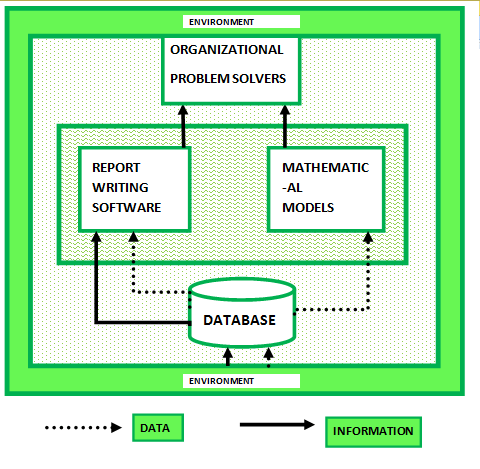
Management Information Systems refer to the integration of technology, people, and processes to support managerial decision-making and organizational processes. MIS provides a framework for collecting, processing, storing, and managing information from various sources within an organization.
II. Components of MIS
- Hardware: The physical components such as computers, servers, and networking devices that form the infrastructure of MIS.
- Software: Applications and programs designed to facilitate data processing, analysis, and reporting within the MIS.
- Data: Raw facts and figures that serve as the foundation for generating information. MIS transforms data into meaningful and actionable insights.
- Procedures: Standardized processes and methods governing the collection, processing, and dissemination of information within the MIS.
- People: The individuals responsible for managing, operating, and utilizing the MIS. Proper training and user engagement are crucial for effective MIS implementation.
III. Role of MIS in Decision-Making
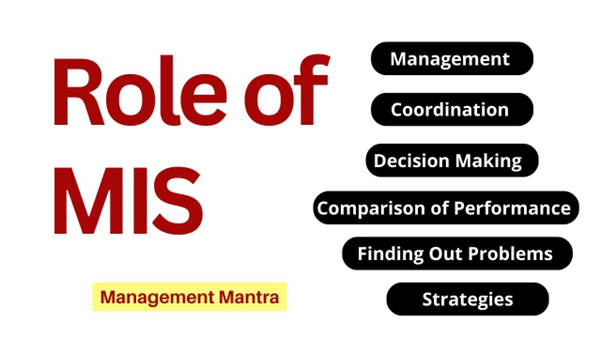
MIS contributes significantly to decision-making at various organizational levels:
IV. Benefits of MIS
Improved Decision-Making
MIS provides accurate, timely, and relevant information to support informed decision-making processes.
Increased Efficiency
Automation of routine tasks and streamlined processes result in operational efficiency.
Enhanced Communication
MIS facilitates communication and collaboration across different departments within an organization.
Strategic Advantage
Organizations can gain a competitive edge by utilizing MIS for strategic planning and market analysis.
V. Challenges in MIS Implementation
Integration Complexity
Integrating MIS with existing systems can be challenging and may require significant changes to current workflows.
Security Concerns
Protecting sensitive data within MIS from unauthorized access and cyber threats is a critical consideration.
Cost
Implementing and maintaining an effective MIS can be a substantial financial investment.
Resistance to Change
Employees may resist adopting new technologies, emphasizing the importance of comprehensive training and change management.
VI. Current Trends in MIS
Cloud-Based MIS
Leveraging cloud technology for increased accessibility, scalability, and cost-effectiveness.
Big Data Analytics
Utilizing advanced analytics to extract valuable insights from large datasets.
Mobile MIS
Supporting on-the-go decision-making through mobile-friendly MIS applications.
Integration with Artificial Intelligence (AI) and Machine Learning (ML)
Harnessing AI and ML to enhance data analysis and predictive capabilities.
VII. Manager Decision-Making Tools
In the fast-paced and intricate world of business, managers often find themselves at a crossroads where decisions can shape the destiny of an organization. To aid in this complex process, various decision-making tools have emerged, empowering managers to analyze, strategize, and make informed choices. Here, we explore some key decision-making tools that managers employ in their quest for effective and efficient decision-making.
Manager decision-making tools serve as compasses in the sea of complexity, guiding leaders through the intricate process of choosing the best course of action. Each tool brings its unique perspective and utility, empowering managers to make decisions that align with organizational goals and navigate the challenges of an ever-evolving business landscape. As technology advances, these tools continue to evolve, providing an arsenal for managers to tackle decision-making with precision and confidence.
1. SWOT Analysis (Strengths, Weaknesses, Opportunities, Threats)
SWOT analysis is a fundamental tool for assessing an organization’s internal strengths and weaknesses, along with external opportunities and threats. By identifying these factors, managers gain a comprehensive understanding of the business environment, aiding strategic decision-making.
2. Decision Trees
Decision trees are visual models that map out decisions and their potential consequences. This tool helps managers evaluate various options by considering the likely outcomes at each decision point. It is particularly useful for complex decisions with multiple variables.
3. Cost-Benefit Analysis
When faced with choices involving financial implications, managers often turn to cost-benefit analysis. This tool involves weighing the costs of a decision against the expected benefits, helping in the assessment of the economic feasibility and potential return on investment.
4. Pareto Analysis
The Pareto Principle, also known as the 80/20 rule, suggests that 80% of effects come from 20% of causes. Managers use Pareto analysis to identify and prioritize the most significant factors contributing to a problem. This assists in focusing efforts on the vital few rather than the trivial many.
5. Decision Matrix
A decision matrix is a systematic tool for evaluating and prioritizing various options against a set of criteria. This quantitative approach allows managers to assign weights to different factors, facilitating a more objective decision-making process.
6. Scenario Analysis
In an unpredictable business environment, managers utilize scenario analysis to assess the potential impact of different future scenarios on their organization. By considering various “what-if” situations, managers can develop strategies that are resilient to different possible futures.
7. Six Thinking Hats
Introduced by Edward de Bono, the Six Thinking Hats method encourages parallel thinking by assigning different perspectives to decision-makers. Each “hat” represents a particular viewpoint, such as emotions, facts, or creativity. This structured approach helps in considering a problem from multiple angles.
8. Balanced Scorecard
The balanced scorecard is a strategic planning and management tool that aligns an organization’s activities with its vision and strategy. It provides a comprehensive view by considering financial, customer, internal process, and learning and growth perspectives.
9. Decision Support Systems (DSS)
Decision Support Systems are computer-based tools that utilize data and models to assist managers in decision-making. These systems provide analytical support, simulations, and scenario analysis, enhancing the quality and speed of decision-making.
10. Risk Analysis and Management
Decision-making often involves inherent risks. Tools for risk analysis and management, such as risk matrices or Monte Carlo simulations, help managers quantify and assess potential risks, enabling them to make decisions that consider risk mitigation strategies.
Conclusion
This lesson has provided an insightful exploration into Management Information Systems, highlighting their integral role in organizational processes and decision-making. As technology continues to evolve, MIS remains a dynamic field, presenting both opportunities and challenges for organizations seeking to leverage information for strategic advantage. In our next lesson, we will delve into the evolving landscape of cybersecurity in contemporary business environments.