A pyramid is a three-dimensional structure that has a polygon as its base. You may have heard of the famous Great Pyramid of Giza, which is built in this shape. Each corner of the pyramid is connected to a single point at the top, giving it a unique appearance.
In this article, we will explore the concept of pyramid shapes, the various types of pyramids, and their formulas.
A pyramid is a three-dimensional shape with a polygonal base and flat triangular faces that meet at a point called the apex. It is formed by connecting the base to the apex. Each edge of the base is connected to the apex, creating triangular faces known as lateral faces. If a pyramid has a base with n sides, it will have n+1 faces, n+1 vertices, and 2n edges.
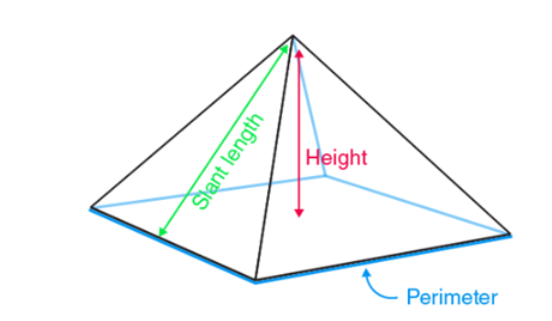
Pyramid shape
If the base of the pyramid is in a triangular shape (base with 3 sides), then the pyramid is called a triangular pyramid. As the triangle has 3 sides, then the triangular pyramid has the following properties:
No. of Faces = (3+1) = 4
No.of Vertices: (3+1) = 4
No. of Edges: 2(3) = 6
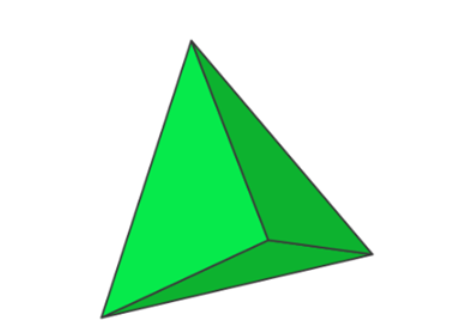
Triangular Pyramid
If the base of the pyramid is in the shape of a square (base with 4 sides), then it is called a square pyramid. As the square has 4 sides, then the square pyramid has the following properties:
No. of Faces: (4+1) = 5
No.of Vertices: (4+1)= 5
No. of Edges: 2(4) = 8
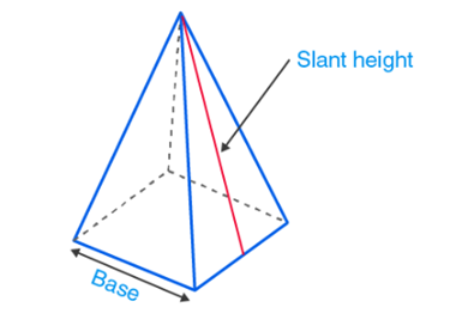
Square Pyramid
If the base of the pyramid is in the shape of a pentagon (base with 5 sides), then it is called a pentagonal pyramid. As the pentagon has 5 sides, then the pentagonal pyramid has the following properties:
No. of Faces: (5+1)=6
No.of Vertices: (5+1)=6
No. of Edges: 2(5)= 10
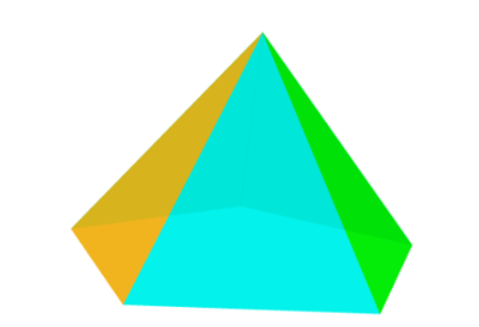
Pentagonal Pyramid
The standard formula to find the surface area and the volume of the pyramid are given as follows:
The total surface area of a pyramid is the sum of the base area and half the product of the base perimeter and the slant height.
Thus,
The Total Surface Area of Pyramid = (½)Pl +B square units
Where,
The general form to find the volume of the pyramid is one-third of the base area and the height of the pyramid.
Thus,
The volume of the pyramid = (⅓)×(Base Area)×(Height) Cubic units.
The great pyramids of Giza, the last remaining of the Seven Wonders of the ancient world, are widely known and have been extensively discussed throughout history. Their precise alignment and impressive construction have led to various theories about their origins, including unfounded claims of extraterrestrial involvement.
However, a closer look at the several hundred years leading up to their appearance on the Giza plateau reveals that these remarkable structures were the outcome of numerous experiments, with varying degrees of success, and represent the pinnacle of development for the royal mortuary complex.
There was a problem reporting this post.
Please confirm you want to block this member.
You will no longer be able to:
Please note: This action will also remove this member from your connections and send a report to the site admin. Please allow a few minutes for this process to complete.
Sign up for our fortnightly newsletter with the best travel inspirations.