


Lesson 5 – Amarna Period
Introduction
One pharaoh in ancient Egypt stood out among the rest. Akhenaten ruled for 17 years from 1353 to 1336 BCE and led a revolution in culture, religion, and art. This revolution shook the country, disregarding thousands of years of tradition and establishing a new order.
As a result, his name was removed from the king’s lists and his images were defaced and destroyed. Egyptologists have reconstructed his story and reign from the remaining fragments of evidence. It was a time of spiritual turmoil and experimentation unlike any other in Egyptian history.
I. History
The second son of Pharaoh Amenhotep III, Akhenaten (originally Amenhotep IV) was not supposed to become king. His older brother, Prince Thutmose, was the rightful heir, but after his unexpected death, young Amenhotep was forced into the political spotlight. After a short period of co-regency, Amenhotep III passed away in 1353 BCE, and Amenhotep IV took over the throne.
Accompanied by his Great Wife, Nefertiti, the new pharaoh initially seemed to have a typical reign. He built monuments for Amun, expanded the temple complex at Karnak, and even celebrated a Sed festival in his third year as ruler. However, Amenhotep IV’s rule was far from ordinary, and he soon revealed his true beliefs. The pharaoh was an extreme follower of Aten, a god that represented the physical form of the sun disk.
Unlike other Egyptian gods, Aten had no human characteristics and did not take on a human-like form. Under Amenhotep’s guidance, this fringe cult quickly became the largest religious group in Egypt.
II. Architecture
Shortly after assuming power, Akhenaten/Amenhotep IV ordered the construction of a new temple complex next to the one at Karnak. This new project, however, was completely separate from the temple to Amun, as it was located outside of Karnak’s perimeter. Named Gempaaten (The Aten is Found), Amenhotep’s new temple complex was unique compared to previous ones. Instead of private, enclosed sanctuaries, Gempaaten had open-air courtyards that allowed the sunlight of Aten to directly enter the complex.
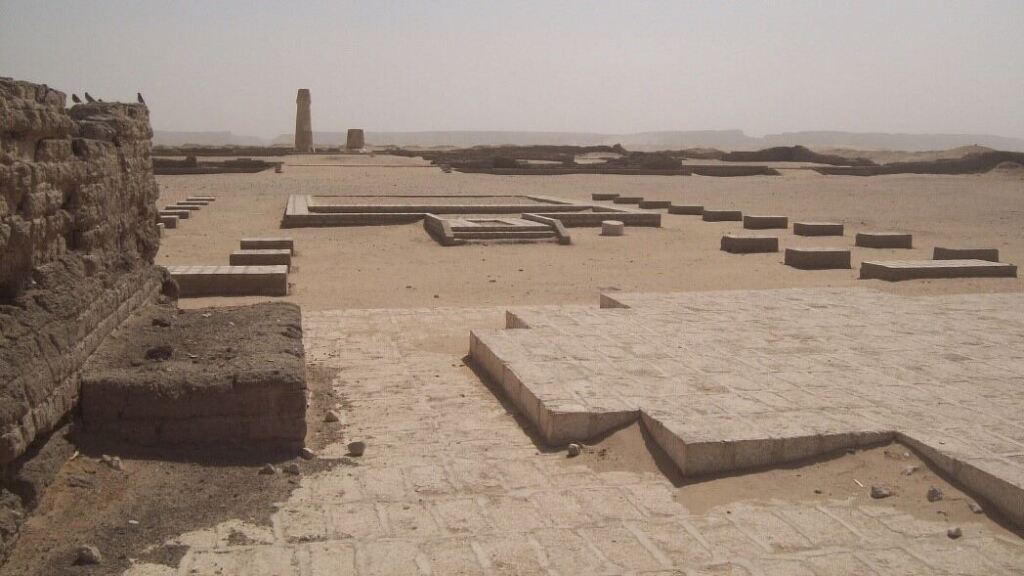
Smaller Aten Temple, Amarna
Following the example of Gempaaten, the Great Aten Temple in Amarna was another open-air temple. It was surrounded by a large enclosure wall and consisted of two main structures: the Sanctuary in the eastern section and the Long Temple in the western section. The temple’s east-west alignment symbolized the path of Aten across the sky each day.
Amarna’s multiple palaces were made of mudbrick and adorned with colorful, highly decorative scenes depicting plants, wildlife, and the royal family. These structures featured open courts, columned porticos, and large courtyards adorned with colossal stone statues of Akhenaten and Nefertiti.
III. Artwork
During the Amarna Period, one of the most touching and fascinating aspects of art was how Akhenaten and his family presented themselves. In traditional Egyptian artwork, the figures were usually depicted as stiff and composed, often shown participating in solemn religious ceremonies or political events. There are numerous stelae and carvings that show Akhenaten and Nefertiti doting on each other and holding hands. In one instance, the queen even sits on her husband’s lap.
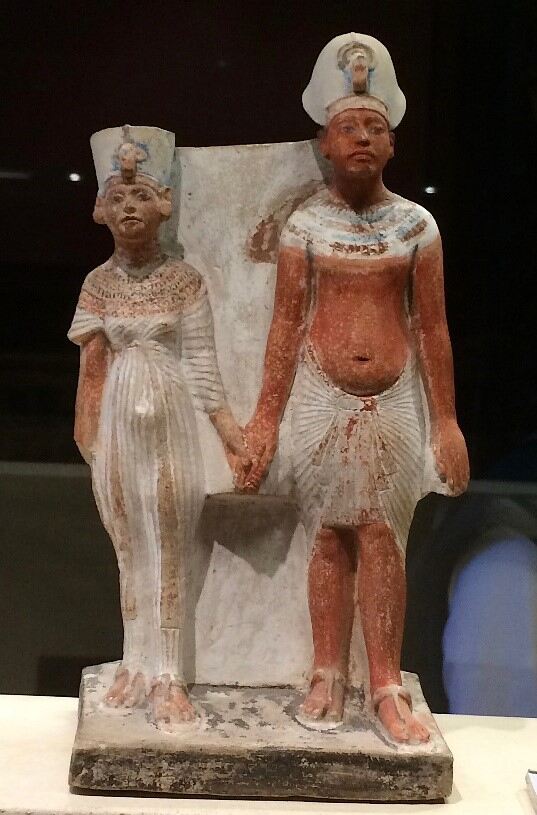
Akhenaten & Nefertiti (Elsie McLaughlin)
It was rare to see the royal family in a casual setting, spending time together in scenes from their daily life. However, during Akhenaten’s reign, this changed. The pharaoh was almost always accompanied by his daughters, and his great-wife Nefertiti was always by his side.
Conclusion
After Akhenaten’s reign, the Egyptian people quickly expressed their opposition to the radical religious reforms of the “heretic” king. Tutankhaten, favoring the stability of the old order, moved the capital back to Memphis and reinstated the worship of Egypt’s polytheistic pantheon.
Akhenaten and Nefertiti presented themselves as living gods by associating with Shu, the god of air, and Tefnut, the goddess of moisture. They believed that they, along with their children, were a sacred extension of the sun god Aten on earth. As a result, they expected to be worshipped and to serve as intermediaries between Aten and the common people.