


Lesson 4 – Expanding the Transcontinental Railroad
Introduction
The expansion of the Transcontinental Railroad in the late 1800s was a pivotal moment in American history. Linking the East and West coasts, it revolutionized travel, reducing journey times from months to mere days and facilitating the movement of people, goods, and ideas across the nation. Constructing the railroad was no small feat, with challenges ranging from harsh weather to difficult terrain and demanding labor. When completed in 1869, the Transcontinental Railroad brought far-reaching economic, social, and cultural changes. It spurred economic growth, encouraged Western settlement, and transformed various industries. However, this progress came at a cost, leading to the mistreatment of Native Americans, altering immigration patterns, and reshaping the labor landscape.
I. History of The Transcontinental Railroad
1. The Story
The Transcontinental Railroad transformed how people and goods moved across the United States. Before its construction, traveling from one coast to another was time-consuming and hazardous. The benefits of the railroad:
- Significantly cut down travel time
- Creating an efficient connection between the East and West Coasts
- Rapid transportation facilitates the movement of goods and people, encouraging settlements and economic development along its path
- Industries flourished as raw materials and products could be traded swiftly
- The railroad played a crucial role in uniting the nation, promoting cultural exchange, economic prosperity, and contributing significantly to the westward expansion.
The Transcontinental Railroad had a profound impact on the American economy. Prior to its completion in 1869, traveling across the nation was slow and laborious. With the railroad, travel time reduced drastically, enabling efficient transportation of goods and people. This revolutionized trade, enabling businesses to grow and exchange goods more conveniently. Industries flourished as raw materials, agricultural produce, and manufactured items could be swiftly and affordably transported across regions. Moreover, the construction and maintenance of the railroad created employment opportunities, spurring economic development in various sectors.
The Transcontinental Railroad was a groundbreaking achievement in American history that profoundly impacted the nation’s growth, economy, and society. This monumental undertaking aimed to connect the East and West coasts of the United States through a continuous railway, spanning approximately 1,907 miles of rugged terrain and diverse landscapes.
The idea for such a railway had been discussed for decades, but it wasn’t until the mid-19th century that it gained serious momentum. The Pacific Railway Acts of 1862 and 1864 provided federal support for the construction of the Transcontinental Railroad, offering land grants and financing to two major companies, the Union Pacific and the Central Pacific, tasked with building from opposite sides of the continent.
The Union Pacific, starting in Omaha, Nebraska, pushed westward across the plains and through the Rocky Mountains. Meanwhile, the Central Pacific, originating in Sacramento, California, headed eastward, tackling the formidable Sierra Nevada mountain range. The two railroads eventually converged at Promontory Summit, Utah, on May 10, 1869, marking the completion of the First Transcontinental Railroad.
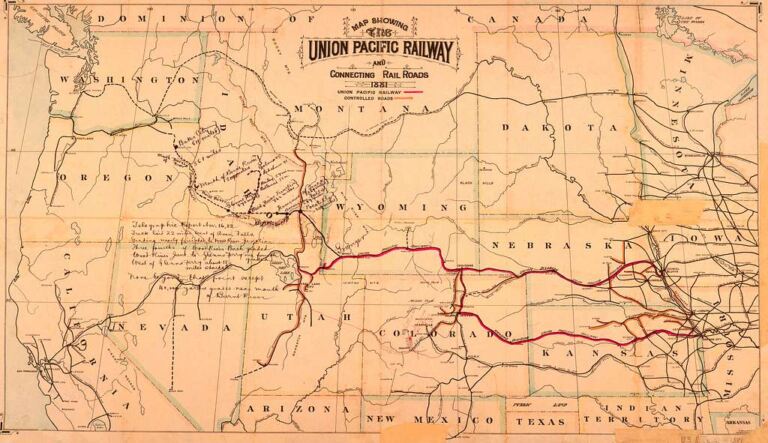
The Union Pacific Railway and Connection
The impact of the Transcontinental Railroad was profound and multifaceted.
- Dramatically reduce cross-country travel time from months to just over a week
- Making it easier for people, goods, and information to traverse the continent
- Revolutionize commerce, enabling the rapid movement of raw materials, agricultural products, and manufactured goods
- Spurre economic growth, as cities and towns sprang up along the rail lines, fostering trade, industry, and settlement in previously remote areas
The Transcontinental Railroad was not without its challenges and controversies, including:
- Labor disputes
- Financial struggles
- Environmental impacts
- The displacement of Native American communities
- The disruption of indigenous peoples traditional ways of life.
In conclusion, the Transcontinental Railroad was a monumental achievement that reshaped the American landscape, economy, and society. It stands as a testament to human ingenuity and determination, leaving an enduring legacy as a symbol of progress and connectivity in the United States.
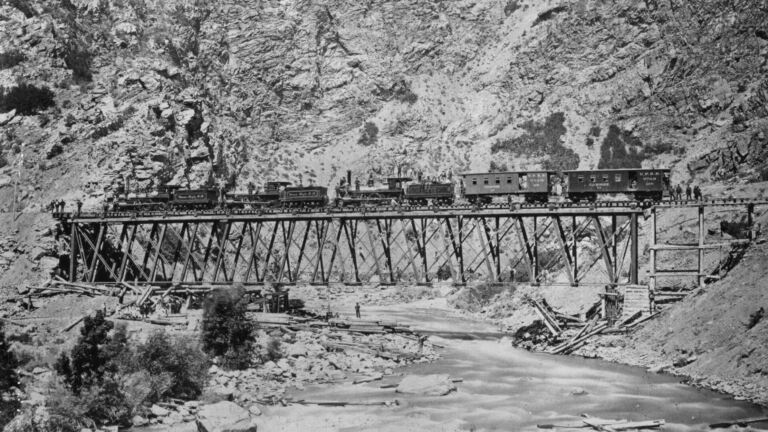
The Transcontinental Railroad
2. How to Build The Railroad?
To construct the railways, the leadership of both railroads established construction firms owned by their board members, who greatly enriched themselves by generously compensating themselves. The Union Pacific’s construction entity, known as Crédit Mobilier, became entangled in one of the most significant political scandals of the 19th century. Crédit Mobilier sought to influence numerous members of Congress by offering them company stock in exchange for favorable legislation and regulatory policies.
The Central Pacific initiated its construction efforts on January 8, 1863. Because California had limited manufacturing capabilities at the time, all the necessary rails, rolling stock, and heavy construction equipment had to be transported from East Coast ports, either by circumnavigating Cape Horn or via an overland route through Panama. The railway managed to recruit British and Canadian engineers with expertise in road and bridge construction. However, the recruitment of manual laborers posed a significant challenge since most Californians were either miners or farmers. Consequently, the Central Pacific turned to Chinese immigrant laborers, even recruiting them directly from China. These laborers were paid a monthly wage of $30, which was considered substantial during that era.
The Central Pacific Railroad initially confronted the most challenging segment of its 690-mile route, ascending from Sacramento at 40 feet above sea level to the Donner Pass summit at an altitude of 7,000 feet, covering approximately 90 miles. Remarkably, the incline exceeded a steep 2 percent gradient over just a three-mile section. Advance crews were dispatched to work on the intricate bridges and tunnels. Within the Sierra Nevada Mountains, there were a total of 11 tunnels, with seven of them concentrated in a mere three-mile stretch near the Donner summit. Engineers dug a 125-foot shaft down to the midpoint of the summit tunnel to enable concurrent work on four faces. To transport the excavated soil, an old locomotive steam engine was employed to lift it up the shaft.
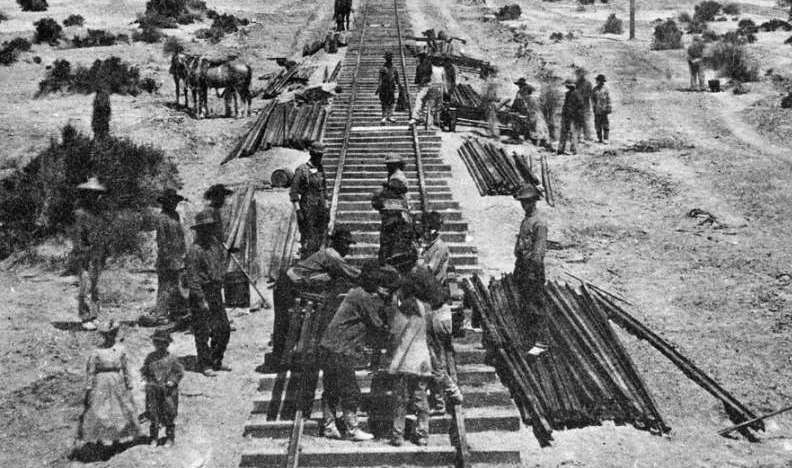
The 150th anniversary of the transcontinental railroad
II. The Impact of Transcontinental Railroad?
The completion of the Transcontinental Railroad marked a series of notable accomplishments and far-reaching impacts on the United States. Here, we summarize the key achievements:
National Connectivity
The railroad established the first uninterrupted rail link from the Eastern to the Western Coasts of the U.S., dramatically shortening cross-country travel time from months to mere days. Example: The completion of the Transcontinental Railroad in 1869 established a direct rail link from the Atlantic to the Pacific, reducing travel time significantly.
Economic Advancement
By facilitating the movement of people, goods, and resources across the nation, the railroad ignited economic growth, unlocking new markets and opportunities. Example: The railroad system facilitated efficient transportation of goods, fostering the growth of industries such as steel, manufacturing, and agriculture.
Population Movement
Encouraging westward migration, the railroad played a pivotal role in the settlement of the American West and the growth of cities along its path. Example: Pioneers and settlers were attracted to the western frontier, leading to the establishment of towns like Cheyenne, Wyoming, and Reno, Nevada. Example: Pioneers and settlers were attracted to the western frontier, leading to the establishment of towns like Cheyenne, Wyoming, and Reno, Nevada.
Technological Progress
The project accelerated advancements in engineering and construction techniques, setting a precedent for future large-scale infrastructure projects. Example: Agricultural products like wheat and livestock from the Midwest found new markets on both coasts, boosting trade and commerce.
Trade Expansion
It promoted trade and commerce by enabling the efficient transport of agricultural products, raw materials, and manufactured goods. Example: A multicultural workforce, comprising Chinese, Irish, and African American laborers, contributed to a diverse and vibrant social fabric along the railroad route.
Cultural Fusion
The diverse backgrounds and regions of those involved in westward expansion fostered cultural exchange and diversity. Example: Omaha, Nebraska, transformed into a bustling railroad hub, while Sacramento, California, thrived as a gateway to the West, attracting businesses and settlers.
Urban Development
Cities such as Omaha, Nebraska, and Sacramento, California, experienced rapid urbanization as they became vital railroad hubs.
Tourism Growth
The railroad fueled tourism as travelers flocked to witness the breathtaking landscapes along its route, including the Sierra Nevada and Great Plains. Example: Scenic routes, particularly through the Sierra Nevada Mountains, became popular tourist attractions, drawing visitors from around the world.
National Reunification
Symbolizing the reunion of the North and South following the Civil War, the railroad represented a unified nation. Example: The symbolic meeting of the Central Pacific and Union Pacific railroads in Promontory Summit, Utah, marked the reunification of a nation divided during the Civil War.
Military Mobility
The railroad enhanced military mobility and logistics, allowing the U.S. government to respond more effectively to regional challenges. Example: During the Spanish-American War, the railroad enabled the rapid movement of troops and supplies, showcasing its strategic importance in military operations.
Technological Advancement
The project pushed the boundaries of engineering and construction techniques, setting new standards for large-scale infrastructure endeavors. Example: During the Spanish-American War, the railroad enabled the rapid movement of troops and supplies, showcasing its strategic importance in military operations.
Environmental Effects
Construction had ecological impacts, including deforestation, land use changes, and alterations to wildlife habitats
These accomplishments highlight the profound and enduring influence of the Transcontinental Railroad on the United States, shaping its economy, society, and physical landscape in immeasurable ways.
III. FAQ
Why was the Transcontinental Railroad Important in American History?
The Transcontinental Railroad, finished in 1869, reshaped American travel by connecting the East and West Coasts efficiently. It significantly shortened travel time, linking distant regions and playing a crucial role in unifying the nation.
How Did the Transcontinental Railroad Contribute to Economic Growth?
This railroad revolutionized trade, connecting markets across the country and fueling economic growth. It created opportunities for industries, fostering trade and business expansion, and boosting the nation's overall economic development.
What Challenges Were Overcome During the Transcontinental Railroad's Construction?
Constructing the railroad posed significant challenges, including difficult terrains and cultural clashes among the diverse workforce. Despite these obstacles, the completion of the project showcased American determination, symbolizing the nation's resilience and innovation.
Conclusion
In conclusion, the Transcontinental Railroad stands as one of the most transformative developments in American history, leaving an indelible mark on the nation’s landscape, economy, and society. Its impact was profound and multifaceted.
The Transcontinental Railroad played a pivotal role in connecting the East and West Coasts, reducing travel time, and promoting national integration. It encouraged westward expansion, supporting agricultural development and the growth of towns and cities in the western frontier.