


Lesson 2 – Civilizations of Mesoamerica
Introduction
The civilizations of Mesoamerica have always held a sense of intrigue and wonder, showcasing the rich tapestry of ancient cultures and their profound influences on the region. Among these civilizations, the Olmecs stands out as one of the earliest and most influential. Originating from the tropical lowlands of what is now Mexico, the Olmecs laid the foundation for future Mesoamerican cultures with their advanced societal structures, distinctive art forms, and intricate belief systems. As we delve deeper into Mesoamerica’s rich history, the legacy of the Olmecs serves as a powerful starting point to understand the evolution of this region.
Exploring The Olmecs to Cortes, a journey through Mesoamerican history, encompassing the rise and fall of cultures, the exchange of ideas, and the transformative impact on Mesoamerica.
In this lesson, we will delve deeper into the Civilizations of Mesoamerica, focusing on the period from the Olmecs to Cortés.
I. The Olmecs
1. Who were the Olmec?
The Olmec, Mexico’s first major civilization, inhabited the tropical lowlands of the Gulf of Mexico. Their name, derived from the Aztec language, signifies “the rubber people,” possibly due to their innovation with the rubber tree latex. While little of their writing remains, the Olmec are famed for their monumental basalt stone heads and their influence on subsequent Mesoamerican societies like the Maya. They pioneered the Mesoamerican Ballgame using solid rubber balls and may have engaged in ritual bloodletting.
2. Olmec colossal heads
The Olmec civilization is known for its impressive Olmec colossal heads, seventeen monumental stone representations of human heads carved from large basalt boulders before 900 BCE. These heads depict mature men with distinct features like fleshy cheeks, flat noses, and slightly crossed eyes. Each head has a unique headdress, possibly representing specific individuals.
The Olmec transported these massive stone boulders from the Sierra de los Tuxtlas mountains of Veracruz, suggesting they may be portraits of powerful Olmec rulers, perhaps created to commemorate their deaths. While the heads were placed in lines or groups at major Olmec centers, the exact method and logistics of transporting these stones to the sites remain uncertain.
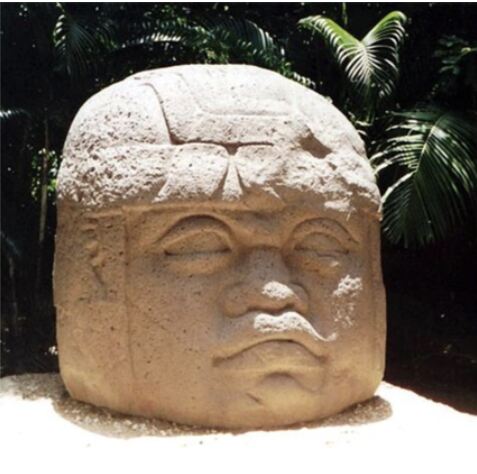
Figure 1: Photograph of an Olmec colossal head. There is a headdress carved onto the head and its eyes, nose and lips are prominent while its ears are not visible. The head is made of stone and is placed outdoors with palm fronds in the background.
3. The end of the Olmecs
The end of the Olmec civilization is generally dated around 400 BCE. While the Olmec culture flourished from approximately 1400 BCE to 400 BCE, the reasons for its decline remain subjects of research and debate among historians and archaeologists. Some theories suggest environmental changes, social upheavals, or external conflicts as potential reasons for the decline of the Olmec civilization. However, it’s worth noting that while the Olmec cities and ceremonial centers declined, their influence persisted in subsequent Mesoamerican cultures.
II. Cultural Succession - The Aztec Empire
After the collapse of the Olmecs, new civilizations emerged, including the Maya, Zapotec, and Mixtec. They inherited knowledge and techniques from the Olmecs and built upon this foundation.
1. Establishment and Political Structure
The Aztec Empire rose approximately 700 years after the Olmecs, in the 14th century, dominating the central and northern regions of Mexico. Tenochtitlan, the capital of the Aztec Empire, was a large and complex city.
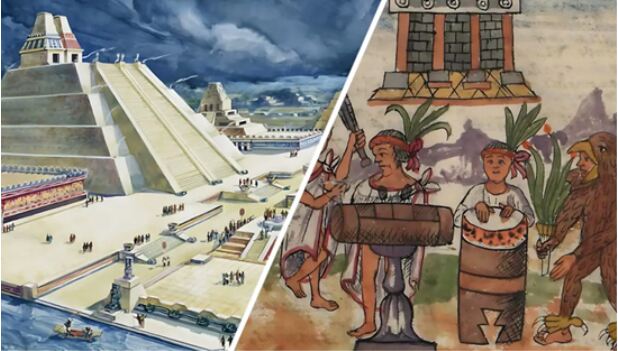
Figure 2: Illustrations of the Aztec civilization.
2. Society and Worship
Aztec society was organized under a centralized political system and a powerful military. The Aztec emperor held supreme authority, and they conducted ceremonies to honor deities, often incorporating human sacrifice.
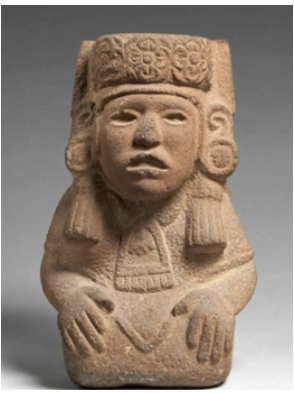
Figure 3: Seated Female Deity Stone Sculpture, ca 15th-early 16th century CE, via The Metropolitan Museum, New York.
3. Economy
The Aztec economy was based on agriculture, taxes collected from subject regions, and trade.
III. Hernán Cortés and the Conquest
1. Consequences of the Conquest
Hernán Cortés was a Spanish explorer, and in the year 1519, he led the conquest of the Aztec Empire, initially with the goal of seeking gold and valuable assets.
The interaction between Cortés and Moctezuma II, the Aztec emperor, began with an air of respect and fear. This conquest ultimately led to the downfall of the Aztec Empire in 1521.
2. Influence of the Olmec Civilization on Mesoamerica
Cortés’ conquest of the Aztec had significant consequences for Mesoamerica. It marked the end of an important historical era and ushered in a new age with the influence of Spain and European culture.
Other consequences included changes in religion, culture, and language in Mesoamerica. The fusion of indigenous elements with Spanish influences gave rise to the development of Mestizo culture, laying the foundation for modern-day Mexico.
3. Influence of the Olmec Civilization on Mesoamerica
The Olmec Civilization, a pioneering force in Mesoamerican history, left an enduring legacy that shaped the cultural landscape of the region. From their iconic colossal heads to advancements in agriculture and contributions to religious practices, the Olmecs’ influence resonates across various aspects of Mesoamerican civilizations.
Artistically, the Olmecs set a precedent with their monumental sculptures, influencing the visual expressions of subsequent cultures such as the Maya and Aztecs. The realistic portrayal of facial features and distinctive headdresses became hallmark elements of Mesoamerican art. Culturally, the Olmecs introduced the Mesoamerican Ballgame, a ritualistic sport that became integral to religious and social practices across Mesoamerica. The widespread adoption of this game highlights the lasting impact of Olmec cultural practices.
In agriculture, the Olmecs were trailblazers, implementing advanced techniques that influenced later civilizations, allowing for sustainable cultivation and supporting larger populations. Trade networks established by the Olmecs played a pivotal role in the exchange of goods, ideas, and cultural elements. These trade routes became the lifeblood of Mesoamerican civilizations, fostering connectivity and mutual influence. Religiously, the Olmecs left an indelible mark with symbols and deities that continued to hold significance in the beliefs of later cultures. Their potential involvement in ritual practices contributed to the spiritual continuity of Mesoamerican societies. Socially, the Olmecs’ hierarchical structure served as a blueprint for political organization in subsequent civilizations, influencing governance systems. Distinctive headdresses depicted on the Olmec colossal heads became symbols of authority, influencing the regalia of later Mesoamerican rulers. Mythologically, Olmec narratives likely persisted in oral traditions, enriching the mythological tapestry of Mesoamerican storytelling.
FAQs
1. Who were the Olmec, and what role did they play in shaping the foundations of Mesoamerican cultures?
The Olmec were an ancient civilization that flourished in Mesoamerica from around 1400 BCE to 400 BCE. They were one of the earliest complex societies in the region and are often considered the “mother culture” of Mesoamerica. The Olmec played a significant role in shaping the foundations of Mesoamerican cultures by establishing key elements such as monumental architecture, complex social and political systems, a distinct art style, and religious beliefs that influenced later civilizations like the Maya and Aztec.
2. What are the Olmec colossal heads, and what do they reveal about the Olmec civilization's cultural and artistic achievements?
The Olmec colossal heads are large stone sculptures depicting human heads, carved by the Olmec civilization. They are considered one of the most recognizable and remarkable artistic achievements of the Olmec culture. The colossal heads reveal the Olmec civilization’s advanced stone carving techniques and artistic skills. These sculptures also suggest a sophisticated understanding of portraiture and the depiction of individual characteristics. The colossal heads likely represented important Olmec rulers or deities and served as symbols of power and authority.
3. When and why did the Olmec civilization decline, and what theories exist regarding the reasons behind their downfall?
The decline of the Olmec civilization occurred around 400 BCE, and the reasons behind it are not fully understood. Various theories exist regarding their downfall, including environmental factors such as volcanic eruptions, earthquakes, or climate change that affected agriculture and trade routes. Internal social and political unrest, including power struggles or the exhaustion of resources, might have also played a role. The decline of the Olmec civilization paved the way for the rise of other Mesoamerican cultures, such as the Maya and Teotihuacan.
4. Describe the rise of the Aztec Empire, including the characteristics of their capital, Tenochtitlan, and the societal and economic structures they implemented.
The Aztec Empire, also known as the Mexica Empire, emerged in the 14th century in the Valley of Mexico. Their capital city was Tenochtitlan, located on an island in Lake Texcoco. The Aztecs were known for their militaristic society and expansionist policies. They established a complex societal structure with an emperor at the top, a noble class, and a vast slave population. The Aztecs practiced tribute and trade, with a centralized economy based on agriculture, including the cultivation of maize. They built impressive architectural structures, such as temples and palaces, in Tenochtitlan.
5. What were the consequences of Hernán Cortés' conquest of the Aztec Empire, and how did it influence the subsequent cultural and historical developments in Mesoamerica?
The consequences of Hernán Cortés’ conquest of the Aztec Empire were significant. The Spanish invasion, which culminated in the fall of Tenochtitlan in 1521, led to the collapse of the Aztec civilization. The conquest resulted in the loss of Aztec political sovereignty, the destruction of their religious and cultural institutions, and the imposition of Spanish colonial rule. The Aztec Empire’s downfall also brought about profound demographic changes, including the introduction of new diseases that decimated the native population.
Conclusion
From the Olmecs to Cortés, we’ve seen the story of Mesoamerican history and culture unfold. The Olmecs set the stage, later civilizations thrived, and Cortés brought change. Learning about this journey helps us better understand modern Mesoamerica’s rich diversity and heritage.