


Lesson 3 – Understanding Hypothesis, Theory and Law in Science
Introduction
Although many people have taken science classes throughout their education, people often have inaccurate or misleading ideas about some of the most basic and important principles in science. Most students have heard of hypotheses, theories and laws, but what do these terms really mean? Here’s a closer look at these important terms.
I. What is a Hypothesis?
"Hypothesis" is one of the most often used terms in science lectures. A hypothesis is a well-informed estimate that stems from observation. It is a cause-and-effect forecast. Generally, additional observation or experimentation can confirm or disprove a notion. Although a hypothesis can be refuted, its veracity cannot.
For example
You might assume that using a particular detergent has no bearing on cleaning efficacy if you observe no difference in the cleaning power of different detergents. If you see that some detergents remove stains while others do not, you can refute this theory.
However, the hypothesis cannot be proven. Even if you use 1,000 detergents and never notice a change in the cleanliness of your clothes, there may be one more that works differently that you haven’t tried.
II. What is a Theory?
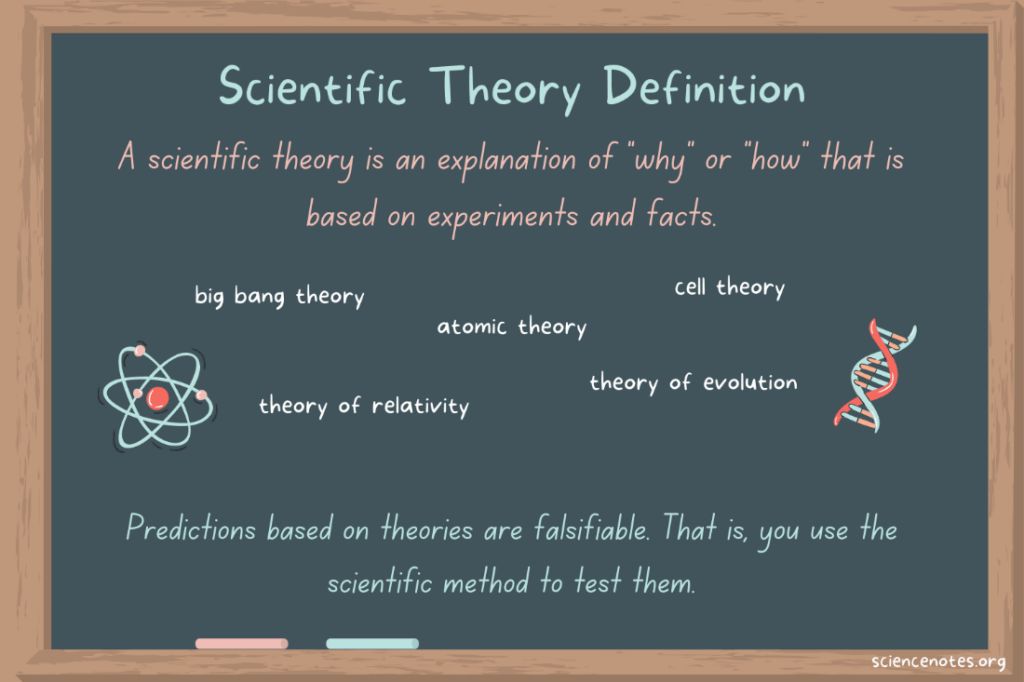
A scientific theory summarizes a hypothesis or group of hypotheses that has been supported by repeated testing. A theory is valid as long as there is no evidence to dispute it. So the theories can be disproven. Essentially, if evidence accumulates to support a hypothesis, that hypothesis can be accepted as a plausible explanation for a phenomenon. One definition of a theory is to say that it is an accepted hypothesis.
Theories are explanations of natural phenomena
They are not predictions (although we can use theory to make predictions). They are explanations of why we observe something.
Theories are hard to change
They have a lot of support and can explain satisfactorily many observations. Indeed, theories can be true. Theories may change, but it is a long and difficult process. For a theory to change, there must be many observations or evidence that the theory cannot explain.
Theories are not conjectures
The phrase “just a theory” has no place in science. Being a scientific theory carries a lot of weight; it's not just one person's idea about something.
For example
It is known that on June 30, 1908, in Tunguska, Siberia, there was an explosion equivalent to the explosive force of about 15 million tons of TNT. Many theories have been put forward about the cause of the explosion. There is a theory that the explosion was caused by an extraterrestrial natural phenomenon, not caused by humans.
Is this theory true? Are not. This event is a logged event. Is this theory, generally accepted as true, based on evidence to date? Correct. Can this theory be proven false and discarded? Correct.
III. What is a Law?
1. Law
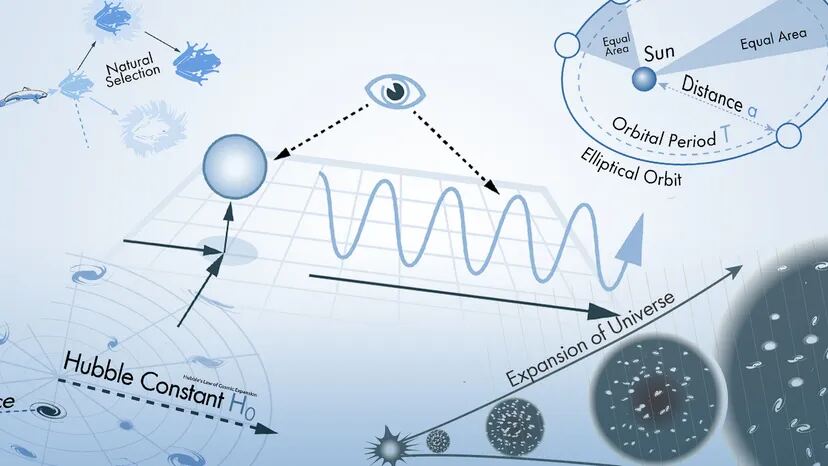
Scientific laws are similar to scientific theories in that they are principles that can be used to predict the behavior of the natural world. Both scientific laws and scientific theories are usually well supported by observations and/or experimental evidence. Usually scientific laws refer to rules about how nature will behave under certain conditions, often written in the form of equations. Scientific theories are broader explanations of how nature works and why it exhibits certain characteristics. By comparison, theories explain why we observe what we do, and laws describe what happens.
One way to distinguish a law from a theory is to ask whether the description gives you the means to explain “why.” The word “law” is used less and less in science, because many laws are true only in limited cases.
For example
Around 1800, Jacques Charles and other scientists were studying gases, among other things, to improve the design of airships. These scientists, after a lot of experimentation, discovered that certain patterns exist in observations of gas behavior. If the temperature of the gas increases, the volume of the gas increases. This is known as a law of nature. A rule is a relationship that exists between variables in a group of data. Laws describe patterns that we see in large amounts of data but do not describe why these patterns exist.
Or Consider Newton’s law of gravitation. Newton could use this law to predict the behavior of a dropped object, but he could not explain why it happened.
2. What’s the Difference Between a Scientific Law and Theory?
For example
If you see no difference in the cleaning power of different detergents, you might believe that employing a certain detergent has no effect on cleaning performance. You can disprove this notion if you see that certain detergents remove stains while others do not. But the hypothesis is not verifiable. There might be one more detergent that works differently that you haven't tried, even if you use 1,000 and your clothes never get any cleaner.
An activity is described by a law under specific situations. Evolution, for instance, is a law; it informs us that something occurs but does not explain how or why.
A theory explains the why and how of an event. One theory is evolution through natural selection. It offers a plethora of explanations for different mechanisms and explains how evolution operates.
Conclusion
You can see that science does not recognize “proof” or “truth” as absolute. Facts are the closest we can come; they are unquestionable observations. But take note: there is “proof” in science if you define it as drawing a logical conclusion from the data. Differently, some operate under the premise that something can never be incorrect if it is proven. The definitions of proof for the phrases hypothesis, theory, and law can differ slightly depending on the scientific discipline, so bear that in mind if you are asked to define them. Understanding that they are not interchangeable and have different meanings is crucial.