


Lesson 4 – How to Use Context Clues, Prior Knowledge, and Word Structure to Construct Meaning
Introduction
Have you ever encountered a challenging text that left you feeling lost and perplexed? Are unfamiliar words and complex sentence structures standing in the way of your comprehension? Fear not, for there is a powerful trio of tools: context clues, prior knowledge, and word structure. In this lesson, we will unravel the mystery of constructing meaning by harnessing these tools.
I. Context Clues Meaning
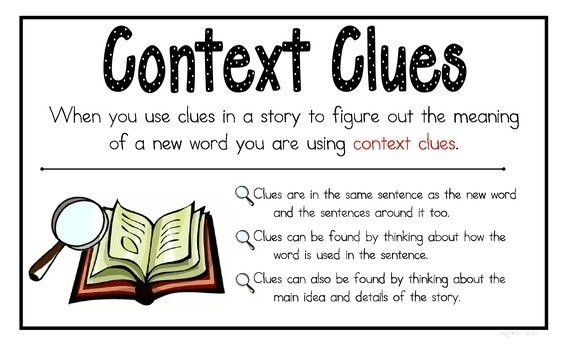
Context clues are tools that can help you decipher the meaning of words or sentences. These clues can come from a variety of sources, such as the sentence’s grammar and spelling, or the surrounding text and images. Developing the ability to use context clues is crucial for children learning English, and it’s best to start practicing this skill at a young age. There are four main types of context clues, and it’s important to teach children how to use each one effectively. Context clues are especially helpful for young children who may not have a large vocabulary and can easily misunderstand words or become distracted.
II. Why Utilizing Context Clues to Comprehend Word Meanings is Crucial
Many children need help grasping words‘ meaning within a given context, which can hinder their overall understanding of a text. Whether due to limited exposure or difficulties in learning, these challenges can be overcome with the proper support. At PlanetSpark, we specialize in cognitive training designed to enhance decoding skills and contextual knowledge in children. By incorporating context clues, such as sentence prompts or visual aids, we empower children to focus and actively engage in tasks. Through our program, children explore various context clues, enabling them to improve their comprehension abilities. Enroll your child in PlanetSpark today!
III. Types of Context Clues
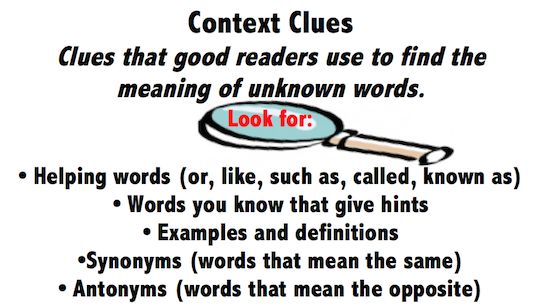
Context clues are elements within a text that assist us in comprehending the meaning of words. Various clues can aid our understanding, including prefixes and suffixes, synonyms and antonyms, word order, root words and affixes, logic, grammar, definition, illustration, and digital context clues. When teaching your child, it is beneficial to begin with the four fundamental types of context clues. Let’s explore these different types to enhance your child’s understanding of word meanings and content comprehension.
1. Word Meaning Context Clues
Pay attention to what the word is telling you. For instance, when a child sees the word “footprints” while reading about someone lost in the woods, they understand that it refers to evidence left behind by someone.
2. Word Order Context Clues
Consider the meaning of the word in its specific order. When children are instructed to put on their new dress before their shoes, they learn that word order impacts the understanding of a sentence’s meaning.
3. Root Word and Affix Context Clues
Examine the components of a word, such as the root and affixes. By understanding how affixes are added to root words, like –ing or –ed, your child can easily grasp word meanings using context clues.
4. Logic Context Clues
Pay attention to the logical connections within a sentence or passage. By understanding the reasoning behind statements, such as why deer are always watchful for lions, your child can grasp the complete meaning of the text.
IV. Examples of Context Clues with Explanations
Context clues are vital in deciphering word meanings and enhancing language comprehension. Let’s explore a few examples of context clues with explanations:
"The aroma of freshly baked cookies wafted through the kitchen, enticing everyone to indulge."
Here, the context clue is the mention of the enticing aroma, which suggests that the cookies are tempting and desirable.
"The professor's erudite lecture on astrophysics left the students in awe."
In this sentence, the context clue is the use of the word "erudite," indicating that the professor's lecture was intellectual and scholarly, leaving the students impressed.
"The dark clouds gathered ominously overhead, foretelling an impending storm."
Here, the context clue is the description of the dark clouds as "ominous," implying that a storm is approaching and potentially bringing unfavorable conditions.
V. How To Make Your Children Understand Context Clues?
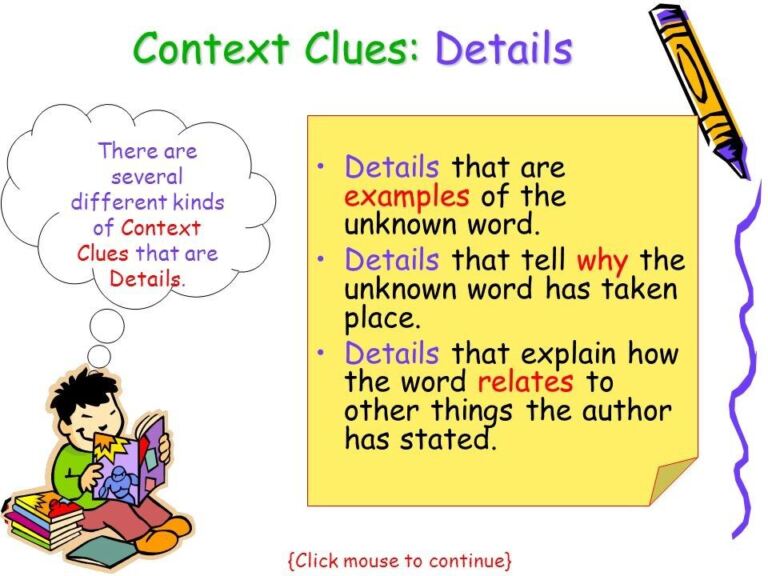
Understanding context clues is crucial for your children to comprehend the meaning of what they read. For instance, consider the sentence, “The cat was purring.” With context, it may be easier for children to grasp the situation. However, by providing additional information, such as, “The cat was purring because it was happy and content,” the meaning becomes more apparent. By teaching your children to recognize and use context clues, they can unlock the meaning and essence of the content effortlessly.
Here are effective strategies to help your children understand different types of context clues:
Encourage active engagement by asking children to explain the meaning of a word or phrase based on the surrounding context.
For example, if they come across the word "stroll" in a sentence like, "They took a stroll in the park," prompt them to infer the meaning based on the relaxed context.
Teach children to identify synonyms and antonyms within the text.
By recognizing words with similar or opposite meanings, they can infer the meaning of unfamiliar words. For instance, if they encounter the word "enormous" and notice the sentence mentions "huge" or "gigantic," they can conclude that "enormous" means very large.
Encourage children to pay attention to descriptive language and details that provide context.
Help them recognize adjectives, adverbs, and vivid descriptions contributing to the overall meaning. For example, if they encounter the sentence "The sun blazed fiercely overhead," they can infer that "fiercely" suggests intense heat.
By implementing these strategies, you can effectively empower your children to use context clues and enhance their reading comprehension skills. With practice and guidance, they will become adept at deciphering the meaning behind the words.
VI. Prior Knowledge and Word Structure to Construct Meaning
Here’s a table summarizing the different strategies for understanding and analyzing the structure of a text:
| Strategy | Description | Examples |
|---|---|---|
|
Activating Prior Knowledge |
Reflecting on existing knowledge and experiences related to the topic to establish a foundation. |
If reading a book about gardening, activating prior knowledge would involve recalling personal experiences with gardening or previous knowledge about plants and soil. |
|
Word Structure Analysis |
Analyzing the components of words, such as prefixes, suffixes, and root words, to derive meaning. |
Understanding that the prefix “un-” means not, and the word “happy” means joyful, enables readers to infer that “unhappy” means not joyful. |
By applying these strategies, readers can tap into their prior knowledge and use word structure analysis to gain a deeper understanding of the text they are reading.
Conclusion
In conclusion, as we navigate the realms of text interpretation, let us remember that constructing meaning is an intricate dance between the reader and the written word. Context clues, prior knowledge, and word structure serve as our guiding lights, illuminating the path to comprehension. Embrace the power of these tools and embark on a journey of discovery, where every text becomes a puzzle waiting to be solved. So, with an open mind and a thirst for knowledge, let us unravel the layers of meaning, forging connections and expanding our understanding of the world through the art of constructing meaning.