


Chapter 1, Lesson 3
In Progress
Lesson 3 – Common Usage of Commas
Chapter Progress
0% Complete
Introduction
Commas, those seemingly innocuous punctuation marks, often leave even the most seasoned writers scratching their heads. Their usage can be a baffling problem, leading to confusion and uncertainty. How often have you pondered whether to place a comma here or there, only to second-guess your decision moments later? Fear not, for within the realm of grammatical mysteries lies a solution. In this lesson, we will delve into the common usage of commas, unraveling their enigmatic nature and providing you with a clear understanding of where and how to employ them effectively. By the time you reach the end, you’ll be armed with the knowledge needed to conquer the comma problem once and for all.
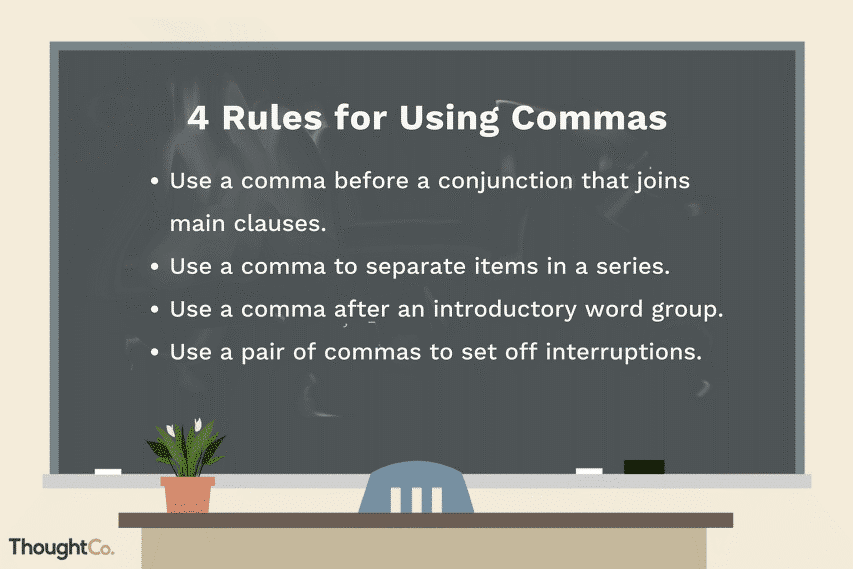
I. Rules for commas:
1. Rule 1.
In an easy-to-understand arrangement involving three or more items, use commas to distinguish between words and word categories.
Example: My estate goes to my husband, son, daughter-in-law, and nephew.
Note: The Oxford comma is utilized as the last comma in a series when it appears before and or (after daughter-in-law in the example above). In an apparent series, most newspapers and magazines omit the Oxford comma because they ostensibly believe it is superfluous. Nevertheless, missing the Oxford comma can occasionally result in misunderstandings.
Example:
We had coffee, cheese and crackers and grapes.
Adding a comma makes it obvious that cheese and crackers are one dish.
The Oxford comma is vital for transparency in situations like these.
We had coffee, cheese and crackers, and grapes.
2. Rule 2
To differentiate between two non-interchangeable adjectives, a comma is used for separation.
Example: She wore a beautiful, flowing gown.
Here the comma emphasizes that the gown is both beautiful and flowing. However, in the phrase “a red velvet cake,” no comma is needed because “red” and “velvet” jointly describe the type of cake. A helpful trick to determine if a comma is appropriate is mentally inserting “and” between the adjectives.
Example: a beautiful and flowing gown.
It makes sense, while “a red and velvet cake” does not.
3. Rule 3a.
Many novice authors link two independent clauses with a comma rather than a period. This results in a comma splice, which is specifically known as a run-on sentence.
Incorrect: He walked all the way home, he shut the door.
Here are several simple treatments:
Correct: He walked all the way home. He shut the door.
Correct: After he walked all the way home, he shut the door.
Correct: He walked all the way home, and he shut the door.
4. Rule 3b.
Use a comma before a coordinating conjunction (and, but, yet, so, or nor, for) when it joins two complete ideas (independent clauses).
Incorrect: He walked all the way home and he shut the door.
Correct: He walked all the way home, and he shut the door.
Incorrect: Did he walk all the way home or did he take a bus?
Correct: Did he walk all the way home, or did he take a bus?
5. Rule 3c
Without the appearance of the subject in front of the second verb, a comma is usually unnecessary.
Example: Morty thought quickly but still did not answer correctly.
But sometimes a comma in this situation is necessary to avoid confusion. Confusing: I saw that she was busy and prepared to leave. Clearer with comma: I saw that she was busy, and prepared to leave. Without a comma, the reader is liable to think that “she” was the one who was prepared to leave.
6. Rule 3d.
A comma is set before the word only if needed for apparent.
Example: The twins attended Tulane because their parents went there.
This sentence clearly conveys that the main reason the twins went to Tulane was because their parents attended Tulane.
The twins didn’t attend Tulane because their parents went there.
This sentence is ambiguous. We’re not sure whether they didn’t go to Tulane because they wanted to go somewhere other than where their parents went to college, or whether the twins did go to Tulane but for reasons other than that their parents went there.
The twins didn’t attend Tulane, because their parents went there.
With the comma before because, the sentence more clearly conveys that the twins desired a college other than the one their parents attended.
7. Rule 4a.
If a sentence begins with a dependent clause, use a comma after it.
Example: If you are not sure about this, let me know now.
Follow the same policy with introductory phrases.
Example: Having finally arrived in town, we went shopping.
However, with the obvious and short introductory phrase (three or four words), the comma is optional.
Example: When in town we go shopping.
But always add a comma if it would avoid confusion.
Example: Last Sunday, evening classes were canceled. (The comma prevents a misreading.)
When an introductory phrase begins with a preposition, a comma may not be obligatory even if the phrase contains more than three or four words.
Example: Into the sparkling crystal ball he gazed.
If such a phrase includes more than one preposition, a comma may be used unless a verb immediately precedes the phrase.
Example:
Between your house on Main Street and my house on Grand Avenue, the mayor’s mansion stands proudly.
Between your house on Main Street and my house on Grand Avenue is the mayor’s mansion.
8. Rule 4b
But often a comma is optional when the sentence starts with an independent clause followed by a dependent clause.
Example: Let me know now if you are not sure about this.
9. Rule 5a
Use commas to set off nonessential words, clauses, and phrases (see Who, That, Which, Rule 2b).
Incorrect: Jill who is my sister shut the door.
Correct: Jill, who is my sister, shut the door.
Incorrect: The actor knowing it was late hurried home.
Correct: The actor, knowing it was late, hurried home.
10. Rule 5b
The description that follows is regarded as accessible and should be separated by commas if something or someone has been appropriately characterized.
Examples:
Freddy, who has a limp, was in an auto accident.
If we already know which Freddy is meant, the description is not essential.
The boy who has a limp was in an auto accident.
We do not know which boy is meant without further description; therefore, no commas are used.
11. Rule 6a
Use a comma after certain words that introduce a sentence, such as well, yes, why, hello, hey, etc.
Examples:
Why, I can’t believe this!
No, you can’t have a dollar.
12. Rule 6b
Use commas to trigger expressions that disturb the sentence flow (nevertheless, after all, by the way, on the other hand, however, etc.).
Example: I am, by the way, very nervous about this.
13. Rule 6c
In general, use commas to set off the word too mid-sentence. However, it is usually not necessary to precede too with a comma at the end of a sentence.
Examples:
My sister, too, loves artichokes.
My sister loves artichokes too.
14. Rule 7
Use commas to set off the name, nickname, term of endearment, or title of a person directly addressed.
Examples:
Will you, Aisha, do that assignment for me?
Yes, old friend, I will.
Good day, Captain.
15. Rule 8
Use a comma to separate the day of the month from the year, and—what most people forget!—always put one after the year, also.
Example: It was in the Sun’s June 5, 2019, edition.
No comma is necessary for just the month and year.
Example: It was in a June 2019 article.
A comma may be advisable with other incomplete dates.
Examples:
Our planning meetings will take place on Friday, November 13 and Thursday, December 10.
Our planning meetings will take place on November 13 and December 10.
16. Rule 9
Use a comma to separate a city from its state, and remember to put one after the state, also.
Example: I’m from the Akron, Ohio, area.
17. Rule 10
Traditionally, if a person’s name is followed by Sr. or Jr., a comma follows the last name: Martin Luther King, Jr. This comma is no longer considered mandatory. However, if a comma does precede Sr. or Jr., another comma must follow the entire name when it appears mid-sentence.
Correct: Al Mooney Sr. is here.
Correct: Al Mooney, Sr., is here.
Incorrect: Al Mooney, Sr. is here.
18. Rule 11
Similarly, use commas to enclose degrees or titles used with names.
Example: Al Mooney, M.D., is here.
19. Rule 12a
Use commas to initiate or interrupt direct quotations of dialogue or text.
Examples:
He said, “I don’t care.”
“Why,” I asked, “don’t you care?”
If a quotation is preceded by introductory words such as that, whether, if, a comma is normally not needed.
Example: Was it James Baldwin who wrote that “nothing can be changed until it is faced”?
20. Rule 12b
If the quotation comes before he said, she wrote, they reported, Dana insisted, or a similar attribution, end the quoted material with a comma, even if it is only one word.
Examples:
“I don’t care,” he said.
“Stop,” he said.
21. Rule 13
Use a comma to separate a statement from a question.
Example: I can go, can’t I?
22. Rule 14
Use a comma to separate contrasting parts of a sentence.
Example: That is my money, not yours.
23. Rule 15a
Use a comma before and after certain introductory words or terms, such as namely, that is, i.e., e.g., including, and for instance, when they are followed by a series of items.
Example: You may be required to bring many items, e.g., sleeping bags, pans, and warm clothing.
24. Rule 15b
Commas should precede the term etc. and enclose it if it is located mid-sentence.
Example: Sleeping bags, pans, warm clothing, etc., are in the tent.
Conclusion
As we bid farewell to the comma problem, let’s reflect on the power of this seemingly humble punctuation mark. Beyond its grammatical rules and syntactical functions, the comma holds a more profound significance in our written communication. It represents the pauses, the rhythm, and the cadence of our words, breathing life into our sentences. It is a tool that allows us to shape our thoughts, guide our readers, and evoke emotions. So, as you venture forth in your writing journey, remember that the comma is not just a technicality but a creative instrument that empowers you to craft meaningful and impactful prose.