


Lesson 1 – Punctuation
Introduction
Punctuation is an essential skill for students. Using commas, periods, or question marks can completely change the meaning. Punctuation is covered in the English Grammar curriculum for Class 8, but the student needs to practice with additional resources to learn the subject. Punctuation should be your closest friend if you would like to convey your thoughts, compose creatively, and express yourself coherently!
I. Definition of the punctuation mark
A punctuation mark is a symbol used to assist in rendering a statement more comprehensible. Punctuation is the use of punctuation marks to divide words and phrases. English has 14 fundamental punctuation symbols that are employed. A period or full stop, a question mark, an exclamation point, a hyphen, an en dash, an em dash, a comma, a semicolon, a colon, quotation marks, ellipses, parentheses, an apostrophe, and a slash are examples of punctuation marks.
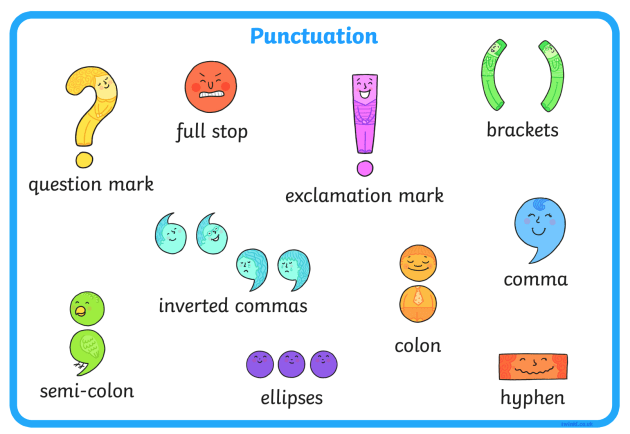
This session will explore three commonly used punctuation marks: colons, semicolons, and periods.
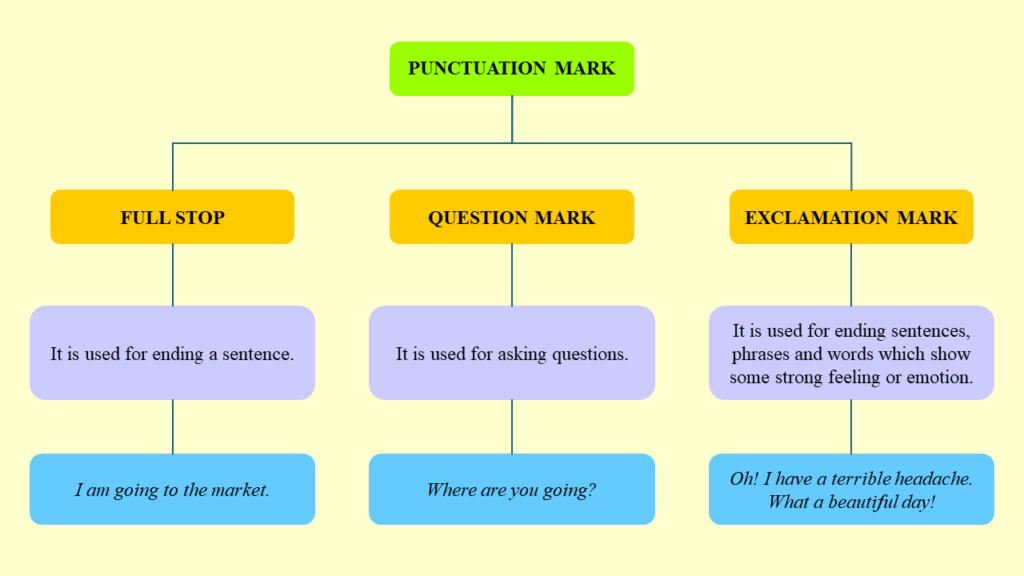
1. Colons:
A colon is used in sentences to signal that a reference, an example, or a list will come after it. Additionally, they can be employed to add more information to a sentence that explains or expands the clause that appears before the colon. For example, three things you can do to stay healthy are: exercise regularly, have a balanced diet, and sleep on time.
A colon looks like two full stops, one above the other. You can remember colons easily thanks to these two full stops; they can only be used at the end of an independent clause. Compared with their cousin, the semicolon, colons have a similar function but with one key difference: the lower dot on a semicolon looks more like a comma than a complete stop.
Colons can be used in grammatical and non-grammatical ways. Let’s start by looking at how colons are used in grammar. There are grammatical and non-grammatical ways to use colons. Let’s start by looking at how colons are used in grammar.
Expanding a Sentence:
- She wanted just one thing: happiness.
- The dog liked to sleep in two rooms: the bedroom and the living room.
- Only one piece of fruit left in the bowl: an orange.
In these above examples, the second clause explains and supports the first clause.
QUOTATIONS:
Using a colon before a quotation brings effective when the introduction is an independent clause. For example:
- He offered the following advice: 'Eat five fruits and vegetables daily.'
- From over the fence, Tom shouted: 'It's hot today, isn't it?
LISTS:
You may see a colon in a statement to demonstrate the start of a list.
Let’s take a look at some examples:
- The pot held stationery: pencils, rubbers and elastic band
- The drink contains milk, strawberries, and ice cream.
- The children can choose from a range of activities: tennis, orienteering or swimming.
However, they’re not always needed using colons to introduce a list. Another common mistake is using a colon in a sentence to start a list after the word ‘including.’ When describing a list that comes after the word ‘including,’ you never use a colon. For example, many treats were in the cupboard, including cupcakes and cookies.
Emphasis:
To make it more interesting for readers, authors will use colons to illustrate a phrase or single word at the end of a statement. For example, this was the trip of a lifetime, five continents, three dozen countries, and over a hundred cities.
2. Semicolons:
Contrary to colons, Semicolons are commonly used to combine two clauses that could function as sentences. Here are the following ways to use semicolons:
- Use the semicolon if you have two self-reliant clauses connected without a coincidence
Example: I have painted the house; I still need to sand the floors.
- When you already have commas within a sentence for smaller separations, you need the semicolon to increase more extensive separations.
Example: We had a reunion with family from Salt Lake City, Utah; Los Angeles, California; and Albany, New York.
3. Periods:
It shows the ending of a declarative sentence or statement.
- "I love going for long walks in the park."
- "Please turn off the lights."
- "What a beautiful sunset!"
- "Mr." for Mister
- "Dr." for Doctor
- o "e.g.," for exempli gratia (meaning "for example")
- "etc." for et cetera (meaning "and so on")
- "3.14" for the mathematical constant pi
- "2.5" for two and a half
Conclusion
Check out the Planet Spark courses to learn more about punctuation for class 8. Children may practice with entertaining examples and exercises in our high-quality study resources. You will also gestate amusing ways for your child to work on punctuation in Class 8 English Grammar with us.