


Lesson 3 – Angles, Line and Point
Introduction
This lesson will explore fundamental geometry concepts and the properties and relationships of angles, lines, and points. Geometry is the study of shapes, sizes, and spatial relationships, and understanding angles, lines, and points is essential to navigate and analyze the world around us. We will learn about the basic definitions and characteristics of angles, lines, and points and how they interact. By the end of this lesson, you will have a solid foundation in geometry, enabling you to identify, measure, and analyze angles, lines, and points and apply this knowledge to solve problems and explore more advanced geometric concepts. So let’s embark on this journey into the fascinating world of angles, lines, and points!
I. Definition
1. What is the point?
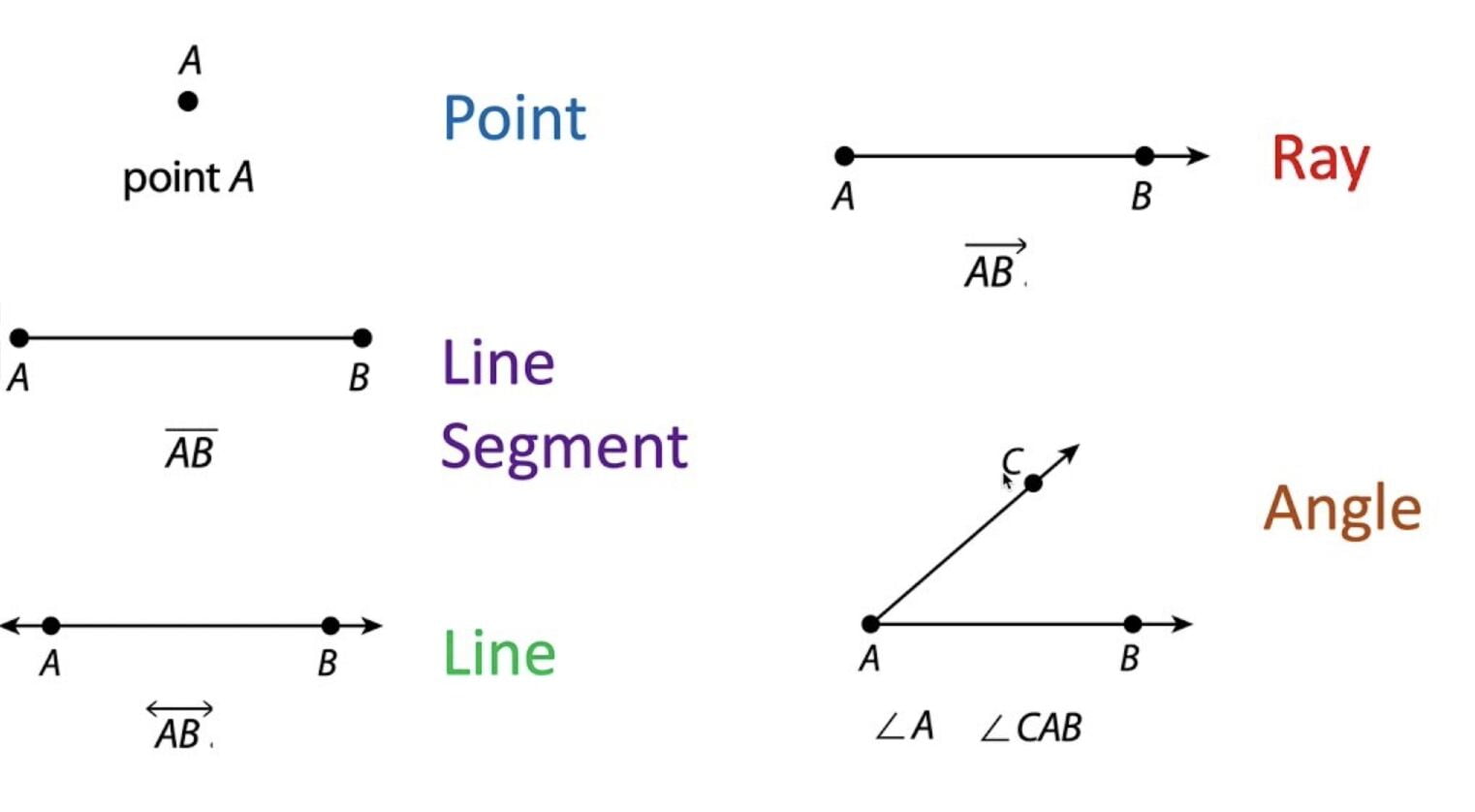
A point is a dot on paper or in a plane. There are no lengths, widths, or heights at an end. It is represented by a dot, named with a capital letter, and establishes a plane’s position or location.
To make a point, mark a dot on a paper with an A or another capital letter. Now, if you want to demonstrate three distinct points, place three dots on a piece of paper and label them X, Y, and Z., These points can be interpreted as X, Y, and Z.
We can quickly come across the image of the point in our daily life. In a classroom, can each student be considered a point, or can each picture on the wall be considered a point?
2. What is the line?
A line is a simple, one-dimensional object that extends indefinitely in opposing directions. Either a horizontal or vertical line exists. It can be drawn in either a top-down or left-to-right order.
A line is a set of infinitely many points. We can name a line from 2 points by concatenating those 2 points. Suppose we have points A and B; we can create a straight line AB from these two points.
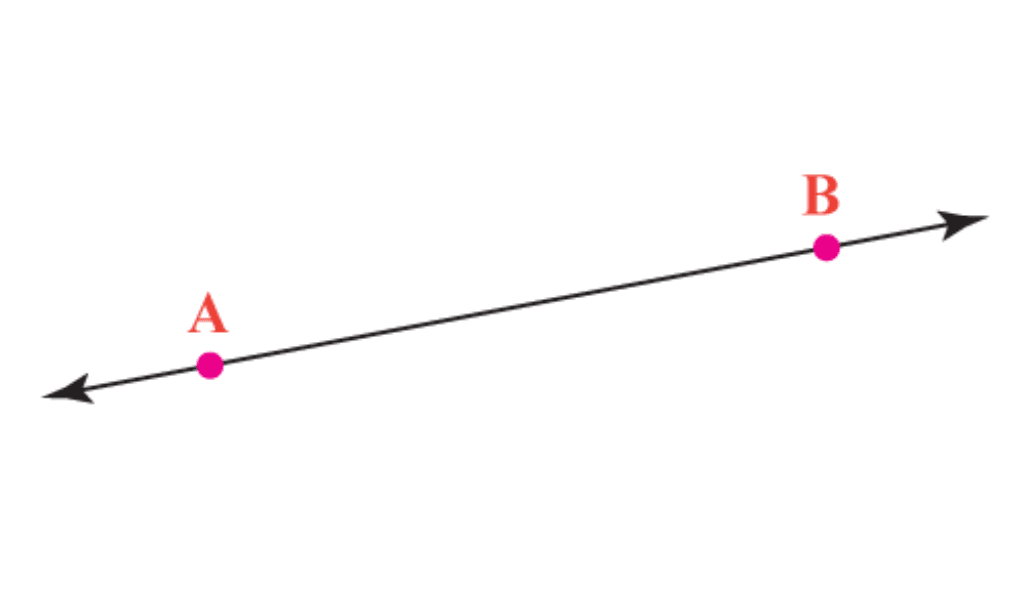
A line
3. What is the angle?
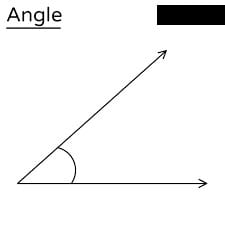
Angle is the shape created when the endpoints of 2 rays meet at a single point (co-identical). The unit of measure for an angle is degrees (°), denoted by ‘∠. ‘ One complete rotation equals an angle of 360 degrees. The two rays forming the angle are called the sides of the angle.
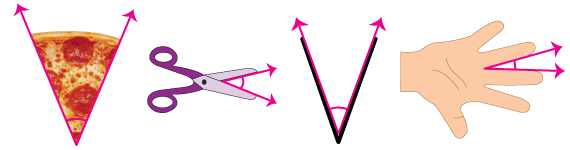
Most puzzles have corners; houses have corners; phones have four corners, etc.
II. Explanation:
1. Properties of point types
There are four types of points in geometry: collinear points, non-collinear points, coplanar points, and noncoplanar points (paragraph)
Collinear points:
- Collinear points are points lying on the same line
- Of the three collinear points, there is one, and only one is between the other 2 points.

- A and B are on the same side as C
- B and C are on the same side of A
- A and C are on the opposite side of B
- Point B lies between two points, A and C
Non-collinear points:
- Noncollinear points are points that are not on the same line
- From non-collinear points, only curved lines can be generated
Coplanar points:
- Coplanar points are points lying on the same plane
Non-coplanar points
- Noncoplanar points are points that do not lie on the same plane
2. Properties of line types
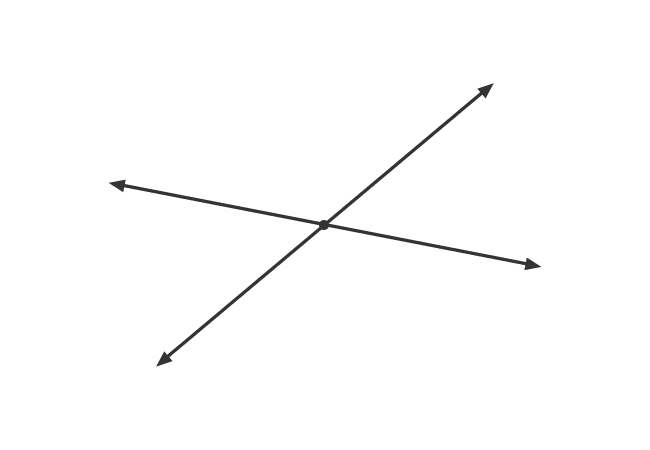
The intersecting lines
- Intersecting lines are lines having a common point
- Straight lines cannot intersect at more than one place.
- Lines that intersect at several points are not straight. There is at least one curve among them.
- Two intersecting lines form any angle
Parallel lines
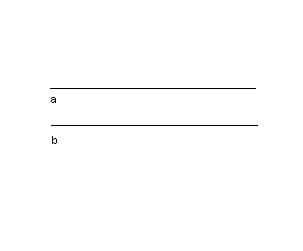
- Parallel lines are lines that do not intersect and have no common point
- Parallel lines must lie on the same plane
3. Properties of angle types
Acute angle:
An acute angle is an angle whose measure is greater than 0 degrees and less than 90 degrees.
Right angle:
A right angle is an angle whose measure is precisely 90 degrees.
Obtuse angle:
An obtuse angle is an angle whose measure is greater than 90 degrees and less than 180 degrees.
Flat curve:
A flat angle is an angle whose measure is precisely 180 degrees.
III. Practice exercise
Given: ∠ABC is a right angle, and ∠CBD = 35° . Find: Measure of ∠ABD
Solution:
Since ∠ABC is a right angle, it measures 90°.
∠CBD is given as 35°.
To find ∠ABD, we can subtract the measure of ∠CBD from 90°.
∠ABD = 90° – 35°
∠ABD = 55°
Therefore, the measure of ∠ABD is 55°.
IV. FAQs:
1. How do you define a point?
In geometry, a point is defined as a specific space location with no size, shape, or dimension. It is represented by a dot and is used as a fundamental building block in geometric constructions and measurements. A point is typically labeled with a capital letter. In mathematical terms, a point is considered a precise position with no length, width, or depth. It serves as a reference for defining other geometric objects such as lines, line segments, angles, and shapes. Points are fundamental elements in geometry and play a crucial role in describing and analyzing the relationships and properties of geometric figures.
2. What is the difference between a line and a point?
A point represents a specific position, while a line represents an infinite path or direction. An issue has no size or shape, while a line has length but no width or thickness. Points are used to define and locate objects, while lines provide a reference for direction, connectivity, and the basis for constructing geometric figures.
Conclusion
Points, lines, and angles are the most basic geometries in mathematics to construct different geometry types. These types also appear in all aspects of life, from close objects such as books, desks, phones, etc., to science and industry such as design, construction, and painting. The above article has covered essential information about points, lines, and angles.