Intersecting lines play a fundamental role in geometry and mathematics, serving as a key concept for understanding relationships between points, angles, and shapes. When two lines cross at a single point, they create an intersection that holds important properties and implications for various mathematical and real-world scenarios. Exploring intersecting lines provides insights into angle relationships, coordinate geometry, and the foundation of geometric proofs. In this lesson, we will delve into the characteristics, properties, and applications of intersecting lines, uncovering the mathematical principles that govern their interactions and pave the way for deeper exploration in the field of geometry.
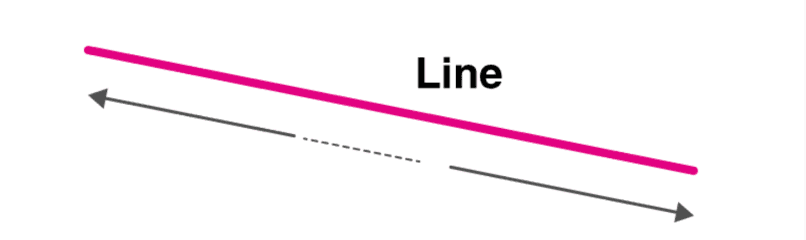
A line is a one-dimensional figure. It is described as a straight, long, and continuous path that is shown with arrowheads pointing in both directions. It stretches out in both directions.
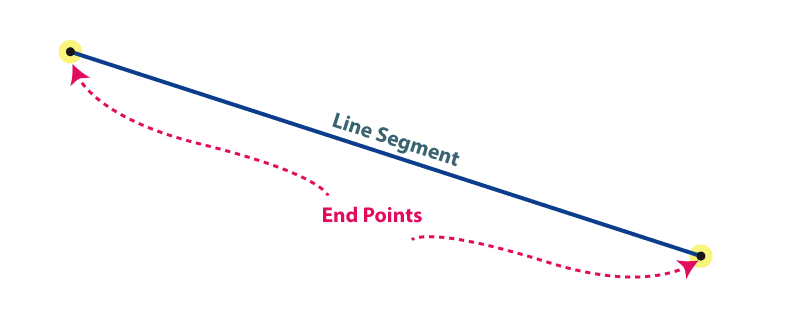
A line segment is straight and stretches between two endpoints. A line segment has a definite length. The shortest distance between two points can be measured with the help of a ruler. It has size, but it does not have width or depth.
Let’s think about two or more lines passing through a single point. In such conditions, the point they pass is known as the intersecting point, and all the lines are known as intersecting lines. Therefore, we can define intersecting lines as two or more lines that share the same point. This common point, which exists on all of these lines, is known as the intersection.
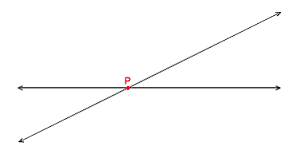
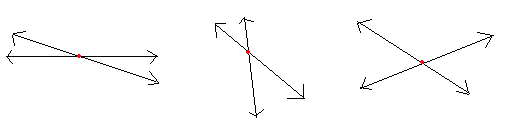
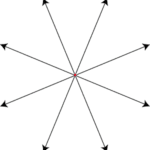
In the above pictures, lines share a common point of intersection (the red point in the figure). Hence, they are called intersecting lines.

Crossroads are created when two straight-lined roadways come together at one spot.
The scissors’ two arms create intersecting lines.
However, all lines can intersect each other, NOT be called intersecting lines. We must remember the following points to understand the properties of intersecting lines.
Point of intersection means the point at which two lines intersect. To find the intersection of two lines, we need the general form of the two equations, which is written as:
a1x + b1y + c1 = 0 and a2x + b2y + c2 = 0
We can determine the answer for the location of the intersection of two lines by resolving the two equations. The below figure illustrates the point of intersection of two lines.
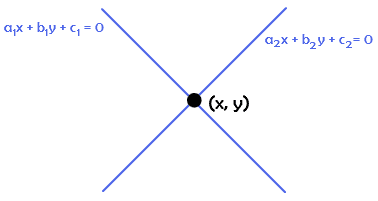
The formula of the point of Intersection of two lines is:
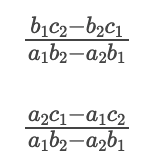
Because not all lines can be referred to as intersecting lines, understanding the properties of intersecting lines is crucial. We must know the distinction between intersecting and non-intersecting lines. The properties of intersecting lines are listed in the paragraph below to make it simple for us to identify them.
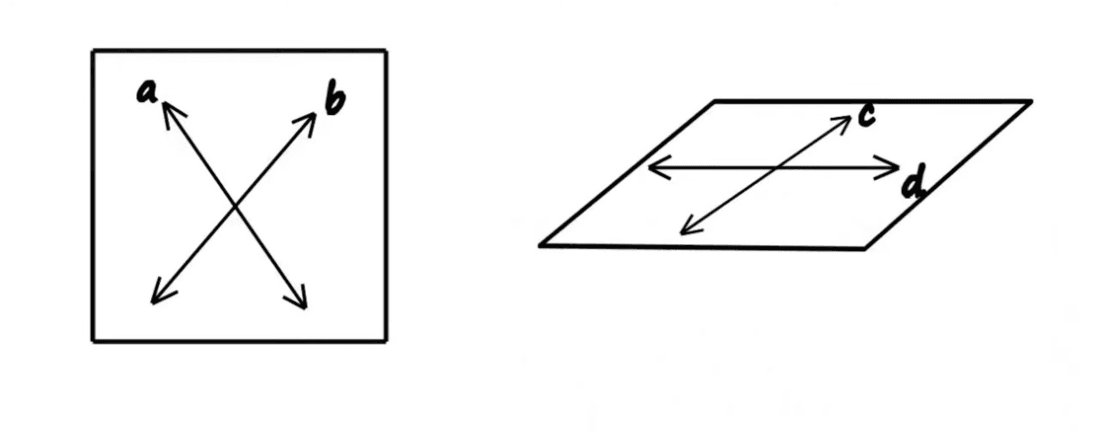
Consider two lines in a coordinate plane. Determine if the lines are intersecting or not based on their equations:
Line 1: y = 2x + 3
Line 2: y = -3x + 5
Solution:
2x + 3 = -3x + 5
5x = 2
x = 2/5
y = 2(2/5) + 3
y = 4/5 + 3
y = 19/5
⟹ Therefore, the lines intersect at the point (2/5, 19/5).
The “Intersecting Lines” lesson covers the properties and characteristics of lines that cross or meet at a point. We’ve learned about their definition, identification, and graphical representation. When lines intersect, they create vertical angles, alternate angles, corresponding angles, and linear pairs. These properties help us analyze and solve problems involving intersecting lines, such as finding missing tips or proving geometric relationships. Understanding intersecting cues is crucial in geometry and builds essential skills like critical thinking and problem-solving. Let’s keep exploring and applying our knowledge to deepen our understanding of geometry and its practical uses.
There was a problem reporting this post.
Please confirm you want to block this member.
You will no longer be able to:
Please note: This action will also remove this member from your connections and send a report to the site admin. Please allow a few minutes for this process to complete.
Sign up for our fortnightly newsletter with the best travel inspirations.