


Lesson 9 – Transitive Property
Introduction
Welcome to today’s lesson on transitive property! This is an essential concept in mathematics that tells us that if two things are equal to a third thing, they are equal to each other. The transitive property is frequently used in algebra and geometry proofs to simplify equations and make them easier to solve.
Understanding the transitive property is essential for success in higher-level math courses, so let’s dive in and explore this concept in detail!
I. Definition
1. What is transitive property?
If x, y, and z are the three quantities, and if x is connected to y by some rule, and y is related to z by the same rule, then we may say x is related to z by the same rule.
If there are three or more quantities, the transitive property can be utilized to relate them. When some rule associates the quantities, the transitive property applies to algebraic expressions, integers, and many geometrical notions.
2. Definition of transitive property?
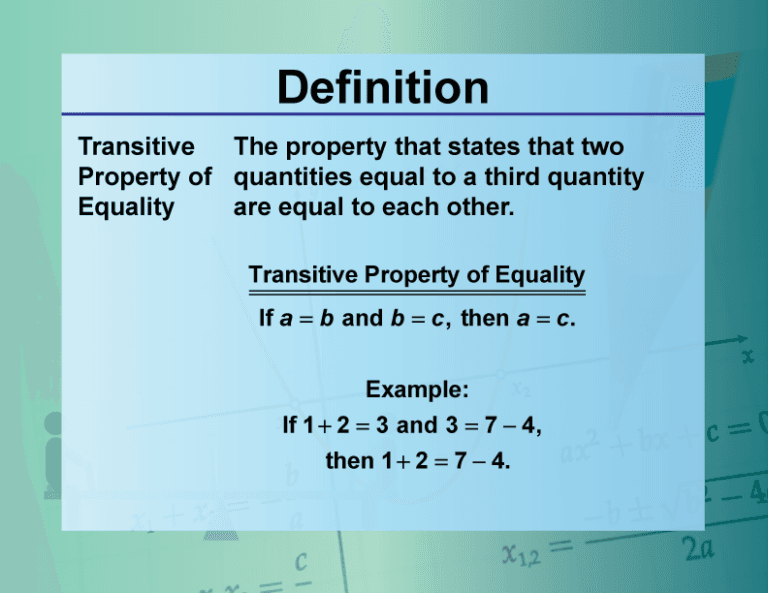
The transitive property is a fundamental concept in mathematics that states that they are equal if two quantities are equal to a third quantity. This property is used to compare and solve equations in various mathematical fields.
1. Explaination
Let’s consider an example to understand the transitive property better.
Suppose we have three quantities A, B, and C.
If A=B and B=C, then we can say that A=C.
This is because if A = B and B = C, then A = C.
The transitive property applies to mathematical concepts such as algebraic expressions, numerical values, and geometrical figures like congruent triangles, circles, and angles.
For example, in algebra, if we have an equation like a+b=c and b+d=e
Then we can use the transitive property to say that a+b+d=c+e.
This helps in simplifying complex equations and finding solutions easily.
2. Example
Here’s an example of the transitive property of equality:
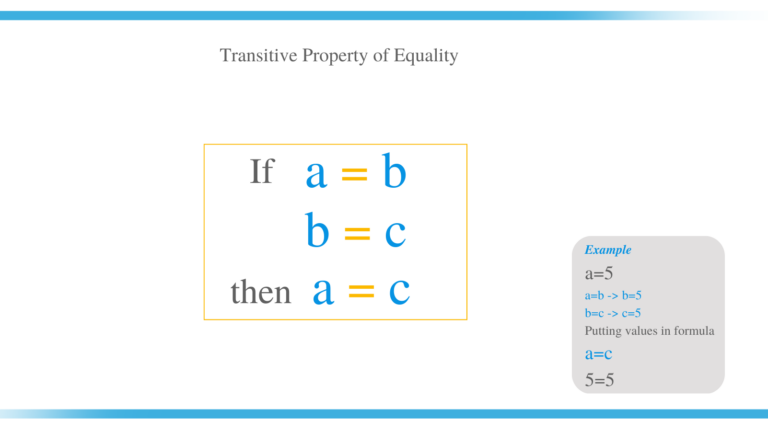
If a = b and b = c, then a = c.
Let’s say a = 2, b = 4, and c = 6. We can use the transitive property of equality to show that a = c: a = 2 b = 4 c = 6
Since a = b and b = c, we can conclude that a = c: a = b = c 2 = 4 = 6
Therefore, using the transitive property, we can say that 2 = 6.
3. The general formula for the transitive property of equality
The general formula for the transitive property of equality is:
IF A = B AND B = C, THEN A = C.
Where a, b, and c are three quantities of the same kind.
This formula can be applied to any variables or numbers and is used to simplify equations and find solutions.
4. How to use transitive property
To apply the transitive property of equality, having three or more quantities to relate is necessary. This property can also be extended to other mathematical concepts, such as angles’ transitive property and inequalities’ transitive property.
5. Transitive Property of Angles
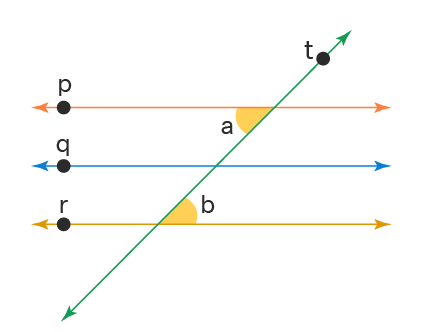
The transitive property of congruence states that if two angles, lines, or shapes are congruent to a third angle, line, or shape, then the first two angles, lines, or shapes are also congruent to each other. For instance, if we have two angles m and n such that m = n and n = p, and we know that m has a measurement of 40°, then by applying the transitive property of angles, we can deduce that p must also have a measurement of 40°.
6. Transitive Property of Inequality
The transitive property can also be applied to inequalities in mathematics.
Inequalities include less than (< greater than (>), less than or equal to (≤), and greater than or equal to (≥). Similar to the transitive property of equality, we can formulate the transitive property of inequalities as follows:
For any real numbers, x, y, and z, the transitive property of inequalities states that:
If x < y and y < z, then x < z.
If x > y and y > z, then x > z.
If x ≤ y and y ≤ z, then x ≤ z.
If x ≥ y and y ≥ z, then x ≥ z.
In case, if any of the relations mentioned above, where either of the premises is a strict inequality, then the final result should also be in strict inequality.
For example, if x ≤ y and y < z, then x < z.
II. Application
Logical Reasoning: The transitive property is commonly used in logical reasoning to make deductions and draw conclusions based on given relationships. It helps us establish connections between different elements and build logical arguments.
Example 1: If A > B and B > C, we can deduce A > C.
Algebraic Equations: The transitive property is employed when solving algebraic equations. We can simplify and manipulate equations to find solutions by establishing relationships between different expressions.
Example 2: If 2x – 1 = 5 and 5 = 3y + 2, we can use the transitive property to conclude that 2x – 1 = 3y + 2.
Geometric Proofs: In geometry, the transitive property is essential for constructing geometric proofs and establishing congruence or similarity between different figures.
Example 3: If triangle ABC is congruent to triangle DEF, and triangle DEF is congruent to triangle XYZ, then we can conclude that triangle ABC is congruent to triangle XYZ.
Comparative Relationships: The transitive property is useful for comparing relationships between elements or quantities and making comparisons based on the established relationships.
Example: If a > b and b > c, then we can infer that a > c, indicating that a is greater than c.
By understanding and applying the transitive property, we can make logical deductions, solve equations, establish relationships, and reason mathematically in various contexts.
Conclusion
The transitive property is a fundamental mathematical concept that helps compare and solve equations. It is used in various mathematical operations such as algebra, trigonometry, and calculus. Students can simplify complex problems and find solutions easily by understanding the transitive property.