


Lesson 9 – Theories of Evolution
Introduction
The theory of evolution is a fundamental concept in biology that explains the diversity of life on Earth. Over time, various scientists have proposed different explanations for how species change and adapt. In this essay, we will explore and compare the theories of evolution put forth by Jean-Baptiste Lamarck and Charles Darwin. By understanding the key differences between their ideas, we can gain a deeper appreciation for the development of evolutionary theory.
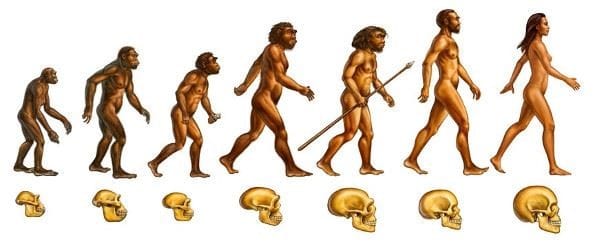
I. Defining The Theory of Evolution
The theory of evolution is a crucial scientific concept that serves as the foundation for studying biology, anatomy, physiology, and various other fields. It posits that species undergo changes over time, which can occur through various means, with natural selection being the most well-described mechanism.
The theory of natural selection not only provides insight into how species evolve over time but also explains the process by which this evolution takes place. This article aims to help students understand the theory of evolution and explore the different postulated theories related to it.
II. Lamarck's Theory of Evolution
1. Lamarck's Background
Jean-Baptiste Lamarck was a French naturalist who proposed his theory of evolution in the early 19th century. His ideas were revolutionary for their time and laid the foundation for later evolutionary thought.
2. Basic Principles of Lamarckism
Lamarck proposed two main principles in his theory:
The Law of Use and Disuse: Lamarck suggested that organisms can develop or lose certain traits based on their usage. If a particular trait is regularly used, it will become stronger and more developed over time. Conversely, if a trait is not utilized, it will gradually weaken and eventually disappear.
The Law of Inheritance of Acquired Characteristics: Lamarck argued that the traits acquired by an organism during its lifetime can be passed on to its offspring. These acquired traits would then become part of the species’ inherited characteristics over generations.
3. Example of Lamarckism
Lamarck’s theory can be illustrated through the example of giraffes. He proposed that the long neck of a giraffe evolved over time because its ancestors continuously stretched their necks to reach higher leaves. According to Lamarck, this neck stretching resulted in the elongation of the giraffes’ necks, which was then inherited by subsequent generations.
II. Darwin's Theory of Evolution
1. Darwin's Background
Charles Darwin, an English naturalist, is widely recognized as the father of modern evolutionary theory. His groundbreaking work on the theory of natural selection revolutionized our understanding of how species evolve.
2. The Theory of Natural Selection
Darwin’s theory of evolution is based on the following key principles:
Variation:
Within any population, there is natural variation in traits. These variations are heritable and can be passed on to offspring.
Overproduction:
Organisms are capable of producing more offspring than the environment can support.
Struggle for Existence:
Due to limited resources, there is competition among individuals for survival.
Differential Reproduction:
Individuals with advantageous variations are more likely to survive and reproduce, passing their favorable traits to future generations.
Adaptation:
Over time, these favorable traits accumulate in the population, leading to adaptations that enhance survival and reproductive success.
3. Example of Natural Selection
An example that exemplifies Darwin’s theory of natural selection is the adaptation of finches in the Galapagos Islands. Darwin observed that different species of finches on different islands had different beak shapes, each suited for a specific type of food source. He concluded that those finches with beaks well-adapted to their food sources had a higher chance of survival and reproduction, leading to the evolution of distinct finch species on each island.
III. Comparing Lamarckism and Darwinism
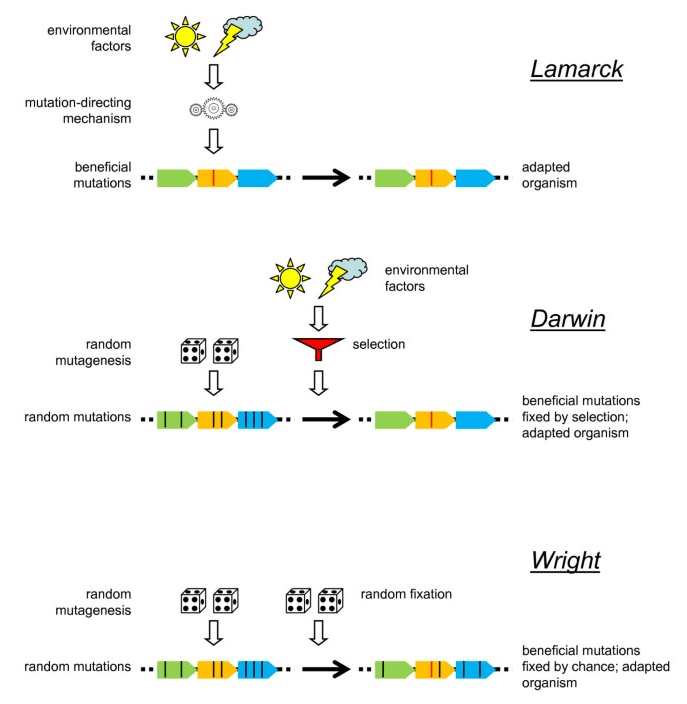
Figure: Comparing Lamarckism and Darwinism
1. Mechanism of Change:
Lamarckism suggests that organisms can actively change their traits during their lifetime, while Darwinism proposes that variations occur randomly and are subject to natural selection.
2. Inheritance of Acquired Characteristics:
Lamarckism supports the idea that acquired characteristics can be inherited, whereas Darwinism does not consider acquired traits as heritable.
3. Timescale and Scope:
Lamarckism implies that species gradually change within their lifetime, while Darwinism suggests that evolution occurs over long periods through cumulative changes.
4. Acceptance and Legacy:
Darwin’s theory of natural selection gained widespread acceptance and became the foundation of modern evolutionary biology. In contrast, Lamarck’s ideas faced criticism and were largely discredited. However, Lamarck’s contribution lies in initiating the discussion on evolution, paving the way for further scientific inquiry.
Theories of Evolution Lamarck vs. Darwin
IV.FAQs
1. Can the theory of evolution coexist with religious beliefs?
Yes, many people of various religious beliefs accept the theory of evolution. They see it as compatible with their faith and consider it a scientific explanation for the processes by which life develops.
2.Are humans still evolving?
Yes, humans are still subject to evolutionary processes, although the pace of change may be slower due to advances in technology, medicine, and culture.
3.What is the difference between microevolution and macroevolution?
Microevolution refers to small-scale evolutionary changes within a species, such as changes in allele frequencies. Macroevolution involves larger-scale changes that lead to the development of new species or higher taxonomic groups.
4.What is the role of genetic mutations in evolution?
Genetic mutations are a source of genetic variation upon which natural selection acts. Mutations can lead to new traits and are essential for the evolutionary process.
5.What are some alternative theories to evolution?
While the theory of evolution is the prevailing scientific explanation for the diversity of life, alternative theories like creationism and intelligent design are held by some individuals, although they are not accepted as scientific theories within the mainstream scientific community.
6.How does the theory of evolution apply to human origins?
The theory of evolution explains that humans share a common ancestry with other primates and have evolved over millions of years through a process of natural selection and genetic change.
7.Are there ongoing debates within the scientific community about the theory of evolution?
While the basic principles of evolution are widely accepted within the scientific community, ongoing research and debate exist regarding specific mechanisms and details of evolutionary processes.
Conclusion
The theories of evolution put forth by Lamarck and Darwin represent important milestones in the development of evolutionary thought. While Lamarckism laid the groundwork for understanding species change, it was Darwin’s theory of natural selection that provided a more comprehensive and widely accepted explanation for the diversity of life on Earth. By exploring and comparing these theories, we can gain a deeper understanding of the mechanisms underlying the fascinating process of evolution.