A lunar eclipse occurs when the Earth comes between the Sun and the Moon, causing the Earth’s shadow to pass over the Moon. This event can be observed by anyone on Earth as long as the Moon is above the horizon. Lunar eclipses happen during a Full Moon, but not every Full Moon, because the Moon must be near one of the points where its orbit intersects with the ecliptic plane.
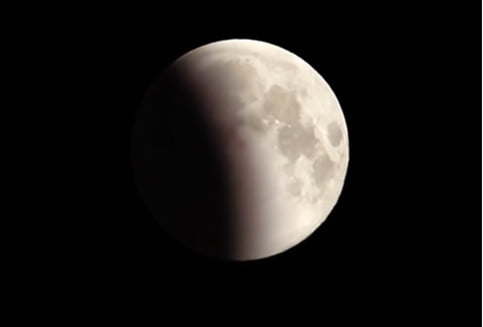
During a lunar eclipse, the Earth comes between the Sun and the Moon, causing the Moon to be in shadow. There are two types of lunar eclipses: a total lunar eclipse and a partial lunar eclipse. A total lunar eclipse occurs when the Moon and Sun are on opposite sides of the Earth, while a partial lunar eclipse happens when only part of the Earth’s shadow covers the Moon.
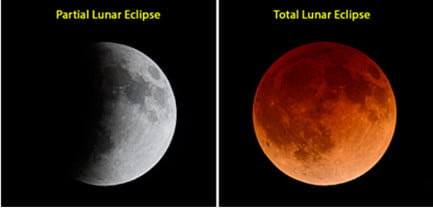
During certain phases of a lunar eclipse, the Moon can take on a reddish hue. This occurs because the only sunlight that reaches the Moon at that time comes from the edges of the Earth, as seen from the Moon’s surface. If you were observing the eclipse from the Moon, you would witness all of Earth’s sunrises and sunsets simultaneously.
A lunar eclipse happens when the Moon passes through the Earth’s shadow, similar to how a solar eclipse occurs when a portion of the Earth passes through the Moon’s shadow.
1. Eclipses do not occur twice a month because the Moon’s orbit around the Earth is tilted about the Earth’s orbit around the Sun.
2. However, eclipses still happen because the Moon’s orbital tilt remains fixed concerning the stars throughout the year, causing it to change about the Sun. This means that about twice a year, the Moon aligns perfectly with the Earth’s shadow, resulting in a lunar eclipse.
During a lunar eclipse, as the Moon enters the Earth’s shadow, known as the umbra, it becomes significantly darker. Once it is completely within the umbra, the Moon appears dimly red due to sunlight scattered through the Earth’s atmosphere.
Interestingly, if you were on the Moon’s surface during an eclipse, you would witness the Sun setting behind the entire Earth, creating a warm red glow. On Earth, you would need to stay up late to observe a lunar eclipse, but if you do, you will witness the Moon in a unique state and catch a glimpse of our planet’s long shadow.
In conclusion, the lesson on lunar eclipses provided a comprehensive understanding of this astronomical phenomenon. Visual aids, such as diagrams and models, were used to help students grasp the intricate mechanics behind lunar eclipses. The lesson also included hands-on activities where students simulated and observed the different phases of a lunar eclipse using props like flashlights and spheres.
There was a problem reporting this post.
Please confirm you want to block this member.
You will no longer be able to:
Please note: This action will also remove this member from your connections and send a report to the site admin. Please allow a few minutes for this process to complete.
Sign up for our fortnightly newsletter with the best travel inspirations.