


Lesson 6 – Ratios and Proportions
Introduction
Welcome to the lesson on how to calculate with proportions and ratios. Proportions and ratios are mathematical concepts that involve comparing two or more quantities of values. We will examine the basic ideas behind proportions and ratios in this lesson and discover how to apply them to various mathematical issues. Numerous fields, including mathematics, science, finance and daily life all require an understanding of ratios and proportions.
Proportions and ratios are used to compare the relative sizes or quantities of different objects or quantities. They help us understand the relationships between different parts of a whole or between different quantities. We can make predictions, find solutions to issues, and analyze data by using proportions and ratios.
I. Definition
1. What is Ratio and Proportion?
Combining proportions and ratios is a common way to handle various mathematical issues, including figuring out the ideal balance of ingredients in a recipe, computing loan interest rates, and deriving conclusions from scientific studies.
| Ratios | Proportions |
|---|---|
|
By describing the relationship between two numbers as a fraction, the ratio compares them. |
Proportions compare two or more proportions and determine how they are related. |
|
Proportions are usually expressed as an equation, where the two ratios are equal. |
|
|
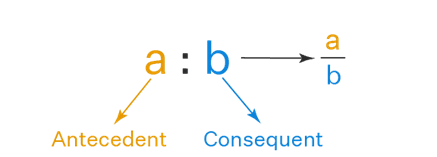
If we have two values A and B, the ratio of A to B can be written as A:B or A/B |
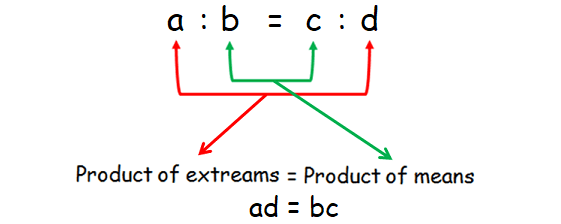
If we have two ratios A:B and C:D, we can write the proportion as A:B = C:D |
2. How do we write ratios?
We can represent ratios as fractions or with the symbol “:”.
Here is a step-by-step tutorial on ratio writing:
- Step 1: Identify the quantities you want to compare.
- Step 2: Determine the order of the amounts.
- Step 3: Use the ratio notation.
- Step 4: Express the ratio as a fraction.
- Step 5: Simplify the ratio (if possible).
Always remember that the order of the quantities in a ratio is crucial because it shows which quantity is being compared to which.
3. How do we use proportions?
Proportions are used to compare the relative sizes or quantities of various objects or quantities. They assist us in establishing close relationships between multiple elements of whole or various quantities.
Proportions are used in different contexts, such as solving problems involving rates, scaling objects or drawings, calculating discounts, and determining missing values in proportional relationships. To set up and solve the proportion correctly, it’s crucial to comprehend the precise context of the issue.
Here is a detailed of how to use proportions:
Step 1: Understand the concept of proportion.
A proportion is an equation proving the equality of two ratios. In other words, A:B and C:D a proportion can be expressed as A:B = C:D.
Step 2: Set up the proportion.
Identify the given ratios or quantities and arrange them in a proportion equation. Make sure the ratios' corresponding components are placed in the same order.
Step 3: Solve the proportion.
There are two standard methods to solve proportions: cross-multiplication and equivalent fractions.
(1) Cross-multiplication method:
Multiply the numerator of the first ratio by the second ratio's denominator and the first ratio's denominator by the second ratio's numerator. Set these products equal to each other and solve for the unknown value.
(2) Equivalent fractions method:
Create equivalent fractions by multiplying the numerator and denominator of one ratio by the same number. Make sure the ratios' corresponding components stay in the same order. Set the two fractions that resulted in the same value and then find the unknown value.
Step 4: Check the solution.
II. Calculation
1. Ratio Formula
The ratio of two quantities A and B can be expressed as:
Ratio = A:B or Ratio = \( \frac{A}{B}\)
Example:
- 2:3 = \( \frac{2}{3}\)
- 53:4 = \( \frac{53}{4}\)
- 9:3 = \( \frac{9}{3}\) = 3
2. Proportion Formula
A proportion is an equation that states that two ratios are equal. It can be written as:
A : B = C : D or \( \frac{A}{B}\) = \( \frac{C}{D}\)
This formula states that the ratio of A to B is equal to the ratio of C to D. The colon (:) or the fraction bar (/) represents the division operation.
Example:
(1) Ratio 1: 3:5
- Ratio 2: 6:10
- Use the proportion formula: 3:5 = 6:10
- Cross-multiply to check: 3 x 10 = 5 x 6
- 30 = 30
(2) Have the following proportion: 4 : 6 = x : 9
- To find the value of x, we can use the proportion formula: \( \frac{4}{6}\) = \( \frac{x}{9}\)
- Cross-multiplying: 4 x 9 = 6 x \(x\) 36 = 6\(x\) \(x\) = \( \frac{36}{6}\) => \(x\) = 6
3. Proportions and ratios related to the problem of solving equations and making comparisons between quantities.
✤ Here are some calculation steps. It helps to identify known and unknown quantities.
Example: A rectangle has a length of 20 cm, the width is unknown, and the width distance ratio is 5/3. Find the width of the rectangle.
\( \frac{5}{3}\) = \( \frac{20}{𝑥}\) => 5*x=20*3 => x = \( \frac{60}{5}\) => x = 12
Equation: \( \frac{5}{3}\) = \( \frac{20}{12}\) = 1.66
Scale setting: Use available information to scale, with one quantity available and the other being “x.”
For example, if the ratio between length and width is 3:2, then the balance is set up as follows: length: width = 3:2
(?) What is the ratio of boys and ratio of girls to all students if there are 35 boys and 25 girls in a class?
- First, we find the total number of students:
- Total number of students = Number of boys + Number of girls: 35 + 25 = 60
- Number of boys to all students as a percentage: \( \frac{35}{60}\) = \( \frac{7}{12}\) = 7:12
- Number of girls to all students as a percentage: \( \frac{25}{60}\) = \( \frac{5}{12}\) = 5:12
(?) If Tom is 175 cm tall and Mary is 1.35 m tall, what is the ratio of their heights?
- Since Tom and Mary's heights are not measured in the same unit, convert them.
- Tom is 1.35 m tall, or 1.35 x 100 cm, or 135 cm.
- Tom and Mary's heights in relation to one another:
- \( \frac{𝐻𝑒𝑖𝑔ℎ𝑡 𝑜𝑓 𝑇𝑜𝑚}{𝐻𝑒𝑖𝑔ℎ𝑡 𝑜𝑓 𝑀𝑎𝑟𝑦}\) = \( \frac{175}{135}\) = \( \frac{31}{27}\) = 31: 27
Conclusion
Critical mathematical concepts like proportions and ratios are used to compare items and establish relationships between them. Understanding the fundamental concepts involved, such as the properties of equivalent ratios, cross-multiplication, and unit rates, is crucial when calculating proportions and percentages.
Setting up a proportion by equating two ratios and then solving for the missing value is essential. Cross-multiplication is a quick way to simplify the problem and get the missing value.