


Lesson 6 – Precession
Introduction
Precession can be easily demonstrated using a spinning top. If a spinning top is placed on a flat surface near the Earth’s surface at an angle and is not spinning, it will tip over because the force of gravity creates a torque on its center of mass.
I. What is Precession?
Precession refers to the gradual change in the direction of Earth’s rotational axis. It should not be confused with two other terms, eccentricity and obliquity. Eccentricity describes the cyclic changes in the shape of Earth’s orbit, ranging from more elliptical to more circular. Obliquity, on the other hand, refers to the variations in Earth’s tilt, which can range between 22.1 and 24.5 degrees as the planet spins on its axis. Precession is similar to the wobbling of a spinning top, where the axis of rotation deviates slightly from its original position.
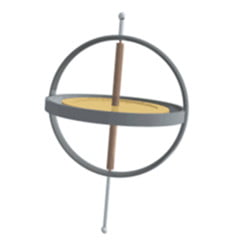
Two types of precession affect the Earth: axial precession and apsidal precession. Axial precession is caused by the gravitational influence of the Sun and Moon, which leads to the Earth bulging near its equator and affecting its rotation. Apsidal precession, on the other hand, is less commonly discussed but can be understood as the wobble of Earth’s entire orbital ellipse. This wobble is mainly caused by the gravitational pull of Jupiter and, to a lesser extent, Saturn.
II. Precession Process
Any basic explanation of Earth’s motion must include two main concepts: rotation and revolution. Rotation refers to the daily spinning of the Earth on its tilted axis, which is approximately 23.5 degrees. This rotation occurs rapidly, taking about 24 hours, and is responsible for the cycle of night and day that we experience. On the other hand, revolution refers to Earth’s orbit around the sun. This revolution takes much longer, approximately 365.25 days. It is the reason why we have a calendar year, and when combined with Earth’s tilt, it also causes the cycle of seasons across much of the planet.
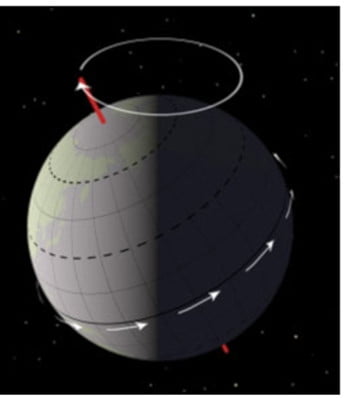
The concept of precession explains the variations in the cycles mentioned above. As the Earth rotates, it wobbles on its axis due to the gravitational pull of the Sun and Moon. This wobble occurs in a cyclical pattern, completing one cycle every 25,771.5 years. Additionally, the revolution of the Earth also experiences a wobble, primarily influenced by the gravitational pulls of Jupiter and Saturn. These planets have their orbits, constantly changing their positions. The precession of Earth’s orbit completes one cycle every 112,000 years.
III. What causes Precession?
Precession is an astronomical phenomenon where the Earth’s axis slowly and continuously rotates over thousands of years. It occurs due to various factors. The main contributor to precession is the gravitational pull from the Sun and the Moon on the Earth’s equatorial bulge. This gravitational force creates a torque that affects the orientation of the Earth’s rotational axis. Other smaller factors include the gravitational pull from other celestial bodies like planets and asteroids, as well as the pressure exerted by solar radiation on the Earth’s atmosphere. These combined forces cause a gradual shift in the position of the Earth’s rotational axis, leading to precession. It’s important to note that precession is also influenced by variations in the Earth’s geological composition and mass distribution, including movements within its core and mantle. Ultimately, it is the complex interaction of these gravitational forces on our planet that gives rise to the phenomenon of precession.
III. Consequences of Precession
Precession is the gradual change in the orientation of an object’s axis of rotation over time. It commonly occurs in celestial bodies and gyroscope systems, but it also has significant consequences in various fields. In astronomy, precession affects the Earth’s axial tilt, leading to long-term shifts in our planet’s climate patterns. This phenomenon is also important in astrological calculations and interpreting the positions of zodiac signs. Additionally, precession has implications in navigation systems as it changes the location of celestial objects relative to Earth. For instance, accurately determining a spacecraft’s trajectory relies on understanding and accounting for precession-induced variations, which is crucial for successful interplanetary missions. Therefore, understanding the consequences of precession is essential for professionals in disciplines such as astronomy, navigation, and engineering.
Conclusion
In conclusion, the lesson on precession has provided a better understanding of this complex astronomical phenomenon and its implications. Precession refers to the gradual and slow shift in Earth’s rotational axis, which is caused by various gravitational influences. This phenomenon plays a significant role in shaping our knowledge of celestial mechanics and is crucial for precise calculations in astronomy and navigation. Additionally, the study of precession has offered valuable insights into long-term climate change patterns, evolutionary biology, and archaeological discoveries related to ancient cultures’ astronomical knowledge.