


Lesson 6 – Multiplication Property of Equality
Introduction
Welcome to the lesson on the multiplication property of equality! This topic is a fundamental aspect of algebra and understanding it is crucial for effectively solving various equations.
In this lesson, we will explore the concept of the multiplication property and how it can be applied to solve equations. We will also highlight the importance of properly utilizing the property to determine the values of unknown variables.
By the end of this lesson, you will clearly understand how to apply the multiplication property of equality in practice and feel confident in your ability to solve multiplication equations. Let’s get started!
I. Definition
1. What is Multiplication Property of Equality?
The multiplication property of equality is a mathematical rule allowing you to multiply both sides of an equation by the same non-zero number to simplify or solve the equation.
This property states that if two quantities are equal, then multiplying both sides of the equation by the same number will result in another equation that is also true.
Ex: if a = b, then a x c = b x c.
2. Multiplication property of Equality formula
The formula for the Multiplication of Equality is:
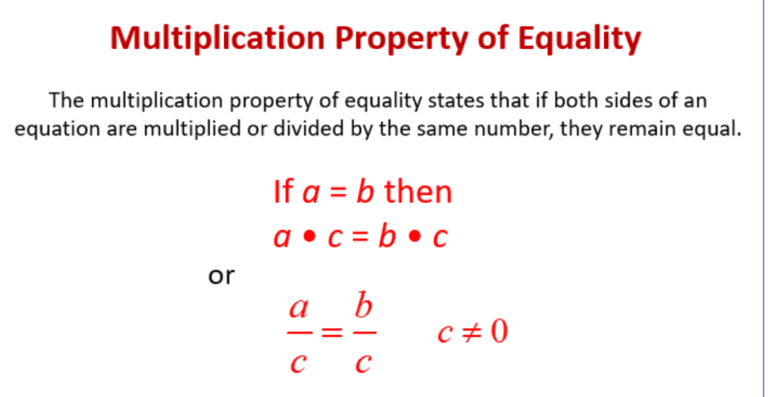
For example: 3x = 9
We can divide both sides by 3 x = 3
3. Multiplication property of Equality examples and non-examples
For example:
Solve the equation 4x = 16 using the multiplication property of equality. We can divide both sides by 4 to get x = 4, which is the solution to the equation.
Simplify the equation 2(a + b) = 4(a + b) using the multiplication property of equality. We can divide both sides by (a + b) to get 2 = 4, which is not a true statement. Therefore, there is no solution to the equation.
For non-examples:
Solve the equation 5x + 2 = 17 using the multiplication property of equality. We cannot use the multiplication property of equality directly to solve this equation because it involves addition and subtraction. Instead, we need to use inverse operations to isolate the variable on one side of the equation.
Simplify the equation 3x – 2 = 4x + 1 using the multiplication property of equality. We cannot use the multiplication property of equality directly to simplify this equation because it involves addition and subtraction. We need to use inverse operations to get the variable on one side and simplify it.
II. Application
Imagine you are a carpenter who needs to build a fence around a rectangular garden. The garden’s length is 10 feet longer than its width, and its perimeter must be 70 feet. To figure out how long each side of the fence needs to be, you can use the multiplication property of equality.
First, let’s assign a variable to the width of the garden. Let’s say x represents the width. The length of the garden is 10 feet longer than the width so we can represent the length as x + 10.
Next, we can use the formula for perimeter to set up an equation: perimeter = 2(length + width) = 70 feet. Substituting our expressions for length and width, we get:
2(x + 10 + x) = 70
Simplifying, we get:
2x + 20 = 35
Now we can use the multiplication property of equality to solve for x:
2x + 20 = 35
2x = 15
x = 7.5
This tells us that the width of the garden is 7.5 feet. To find the length, we can plug in x = 7.5 to the expression for length:
x + 10 = 7.5 + 10 = 17.5
So the length of the garden is 17.5 feet. To find the length of each side of the fence, we can add the dimensions of the garden together and multiply by 2:
(7.5 + 17.5) x 2 = 50 feet
Therefore, each side of the fence needs to be 50 feet long.
Conclusion
In conclusion, the multiplication property of equality is a useful tool in solving algebraic equations. This property states that if two quantities are equal, then multiplying both sides of an equation by the same non-zero number will result in another equation that is also true.
By using this property, we can simplify or solve equations and isolate the variable to find its value. It is important to note that the multiplication property of equality can only be applied to multiplication and not to addition or subtraction.
By practicing with examples and non-examples, students can develop their understanding of this property and apply it to solve more complex equations.