


Lesson 5 – Subtraction Property of Equality
Introduction
The subtraction property of equality is a fundamental concept in mathematics. It states that if you subtract the same quantity from both sides of an equation, the two sides will remain equal.
In other words, you can add or subtract the same quantity from both sides of an equation without changing the truth of the equation. This concept is important in solving equations and inequalities in algebra, geometry, and many other math areas. Understanding and applying the subtraction property of equality is essential for success in higher-level math courses. In this lesson, we will explore this concept in depth and practice applying it to various mathematical problems.
I. Definition
1. What is “Subtraction Property of Equality”?
According to the subtraction property of equality, which is a cornerstone of mathematics, if a = b, then a – c must also equal b – c. To put it another way, an equation is identical if the same amount is subtracted from both sides. Equations, expressions, and algebraic equation manipulation are frequently done using this characteristic. If 3x + 5 = 11, for instance, we can utilize the subtraction condition of equality to take 5 off both sides, making 3x = 6.
2. Subtraction Property of Equality Definition
The equality’s subtraction property asserts that even after subtracting the same amount from both sides, the two sides of the equation still hold true to their original values. In layman’s terms, we can state that whenever a number is subtracted from one side of an equation, the same amount must also be deducted from the other side of the equality.
3. Subtraction property of equality Formula
The formula for the subtraction property of equality is:
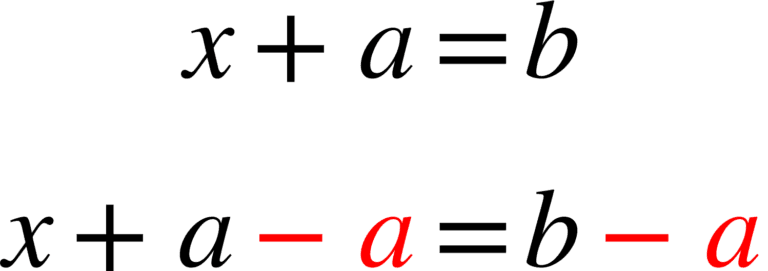
IF A = B, THEN A – C = B – C
This property is a foundational concept in algebra that affirms that if two values are equal, then subtracting the same number from both sides of the equation will still keep them equal. This formula is crucial in solving equations and simplifying expressions in algebra.
4. Verification of Subtraction Property of Equality
Now that we are aware of the equality’s subtraction feature, let’s check it using a few examples.
We may calculate that 12 + 8 = 20.
We now have 12 + 8 – 5 = 20 – 5 12 + 3 = 15 if we take 5 off both sides of the equation.
This indicates that equality holds even if the same integer is subtracted from both sides of an equation.
To comprehend the use of the property, let’s look at another example.
Take the algebraic formula x + 4 = 40. We must now take 4 away from both sides of the equation in order to determine the value of x.
In light of this, we obtain x + 4 = 40 x + 4 – 4 = 40 – 4 x = 36.
5. Subtraction property of Equality examples and non-examples
For examples:
If 3x + 4 = 7, then we can use the subtraction property of equality to subtract 4 from both sides of the equation, resulting in 3x = 3.
If a – 5 = 7, then we can use the subtraction property of equality to subtract -5 from both sides of the equation, resulting in a = 12.
For non-examples:
If 4x = 24. And we subtract 5 from the left-hand side and 6 from the right-hand side, we get: 4x – 5 = 24 – 6
This simplifies to: 4x – 5 = 18
This equation is not equivalent to the original equation because we subtracted different values from each side. Therefore, this is a non-example of the subtraction property of equality.
II. Application
Here are some applications in the word problems that related to Subtraction Property of Equality. Let’s read and give the solutions to these examples
Example 1: Finance
A company has a debt of $500,000 that it wants to pay off in 10 years. If it pays off $50,000 each year, how much debt will be left after 5 years?
Solution:
To solve this problem, we can use the subtraction property of equality. We can start by subtracting the total amount paid off after 5 years from the total debt of $500,000.
Let’s use ‘x’ to represent the remaining debt after 5 years. Then, we can write the equation as:
x = 500,000 – (50,000 x 5)
Here, 5 represents the number of years the company has been paying off the debt. We can simplify the equation using multiplication:
x = 500,000 – 250,000
x = 250,000
Therefore, the remaining debt after 5 years is $250,000.
Example 2: Time and distance
A train travels at a speed of 80 miles per hour. If it has already traveled 240 miles, how much distance is left for the train to travel in 3 hours?
Solution:
We can start by using the formula: distance = speed x time
We know that the train is traveling at a speed of 80 miles per hour and it has already traveled 240 miles. So, we can find the time it has taken to travel this distance by dividing distance by speed:
240 miles ÷ 80 miles per hour = 3 hours
This means that the train has been traveling for 3 hours already. Now, we need to find how much distance is left for the train to travel in the remaining 3 hours. To do this, we can use the same formula: distance = speed x time
distance = 80 miles per hour x 3 hours = 240 miles
Therefore, the distance left for the train to travel in the remaining 3 hours is also 240 miles.
Conclusion
In conclusion, the subtraction property of equality is a key idea in mathematics that enables us to subtract the same amount from both sides of an equation without affecting its validity. Equation solving and algebraic expression simplification benefit greatly from this characteristic. Students learn how to answer a variety of word problems and equations by using the subtraction concept of equality in this lesson. In addition, they now know how to spot circumstances in which the equality’s subtraction property may be used. Students can improve their skills in algebra and other mathematical topics by grasping this principle, as well as gain problem-solving abilities that can be applied in real-world situations.