


Lesson 5 – Cross Product
Introduction
Mathematicians use the cross-product to determine the vector in three-dimensional space perpendicular to two supplied vectors. The cross product is also known as the vector product. This session will teach us to identify cross-products and distinguish between vector and dot products.
I. Definition
1. Cross Product
In three-dimensional space, the cross-product is a mathematical operation that takes two vectors and produces a third vector perpendicular to the first two. It is represented by the symbol “×” or “⨯” and finds use in several sciences, engineering, and geometric contexts. Geometrically, the area of a parallelogram with sides determined by the two vectors can be represented as the cross product.
A binary operation on vectors in three-dimensional vector space is called a vector product (vector multiplication) or directed product in mathematics. It is one of the two vector multiplications that occurs most frequently. The cross product’s operands and output are both vectors, in contrast to the scalar product’s (dot product) scalar product multiplication.
The dot product is used to determine the length of the vector and the angle between two vectors.
II. Properties
Numerous characteristics of the cross product, also called the vector product, make it a valuable tool in mathematical and physical applications. Some of these properties include:
1. Size of the vector:
The magnitude of the vector is also known as the length of the vector \(\vec{x}\) signified ||x||.
With vector \(\vec{AB}\), then the vector magnitude ||AB|| is the length of line segment AB
2. Vector direction:
The direction of a vector x with coordinates x.(X1, X2) is a vector you with coordinates ux1x, x2x.
A vector whose coordinate “u” is the direction of a vector in the Oxy coordinate system. It is also the slope of that vector with respect to the Ox and Oy axes. The coordinates of the vector “u” in this case are deduced from the upper slope.
To calculate the direction of a vector, we must calculate the angle formed by that vector with two coordinate axes, Ox and Oy
That is, we have to calculate α and β, and from α and β deduce the coordinates of the vector, which is also the direction of the vector x.
Applying some properties for calculating the angle of a right triangle, we have:
cos(α) = \( \frac{𝑎𝑑𝑗𝑎𝑐𝑒𝑛𝑡𝑠𝑖𝑑𝑒}{ℎ𝑦𝑝𝑜𝑡𝑒𝑛𝑢𝑠𝑒}\)
=> cos(α) = \( \frac{𝑥1}{∥𝑥∥}\)
cos(β) = \( \frac{𝑥2}{∥𝑥∥}\)
III. Rules
When two vectors, A and B, are crossed, the resulting vector is perpendicular to both A and B. The magnitude of the resultant vector is determined by multiplying the volumes of A and B by the sine of the resulting angle.
A × B = |A| |B| sin(θ) n
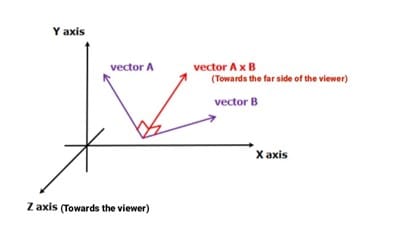
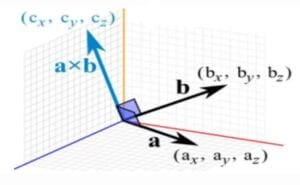
- Result of viewing the angle C ➔ (x,y,z) of A ➔ (x,y,z)*B ➔ (x,y,z) is defined by:
Cx = Ay * Bz – Az * By
Cy = Az * Bx – Ax * Bz
Cz = Ax * By – Ay * Bx
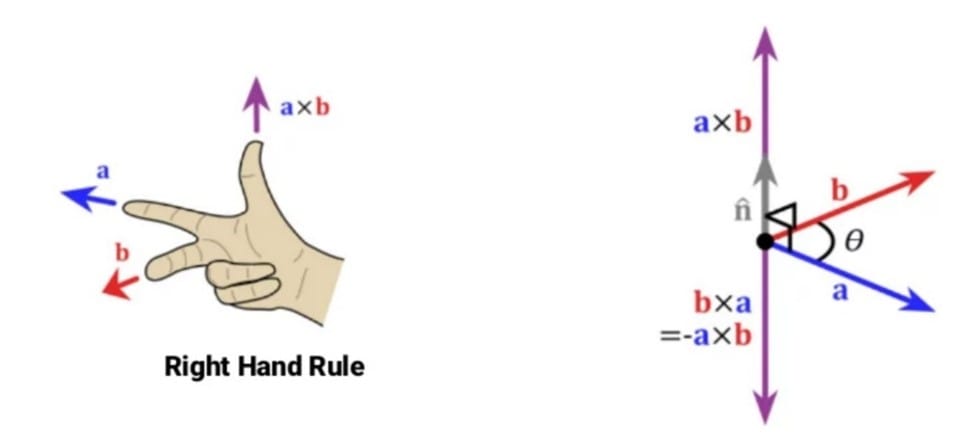
- Apply the right-hand rule if the fingers of your right-hand curl in the direction from vector A to vector B, then your thumb will point in the direction of the resulting vector.
IV. Example
1. Calculate cross product of 2 vectors \( \vec{a}\) = (2,3,4) and \( \vec{b}\) = (5,6,7)
cx=aybz-azby=3∗7-4∗6= -3
cy=azbx-axbz=4*5-2*7= 6
cz=axby-aybx=2*6-3*5= -3
➔ c (x, y, z) = a (x, y, z) . b (x, y, z) = (-3, 6, -3)
2. Size of the vector
Based on the above figure, with AC=3, BC=2, surely you can calculate the magnitude of vector AB based on Pythagorean theorem. We have:
\(AB^2\) = \(AC^2\) + \(CB^2\)
\(AB^2\) = \(3^2\) + \(2^2\)
AB = \( \sqrt{9+4}\) = \( \sqrt{13}\)
Conclusion
A mathematical procedure called the cross-product uses two vectors in three dimensions. It also produces a new vector perpendicular to the two initial vectors, known as the vector product. The cross’s product magnitude results from multiplying the magnitudes of the two original vectors by the sine of the angle that separates them. The right-hand rule can be used to determine the direction of the cross-product. Understanding the characteristics of vectors, such as their magnitude, direction, and components, is crucial to execute a cross-product.