


Lesson 4 – Unit Conversion and Dimensional Analysis
Introduction
In everyday life, there is often a need to convert from one unit of measurement to another. Dimensional analysis is a method employed to convert units of measurement by utilizing proportional relationships or conversion factors. By referring to this article, you can understand the definition of dimensional analysis, its practical applications, and its limitations. Furthermore, you will learn how to apply dimensional analysis to convert from one system of units to another.
I. Unit Conversion
Different situations require the use of specific units. For example, the area of a room may be measured in meters. At the same time, the length of a pencil is expressed in centimeters and its thickness in millimeters. Consequently, there is a need to convert between different units.
To better understand, let’s consider the scenario where you want to determine the number of meters in 3 kilometers. We know that 1 kilometer is equivalent to 1,000 meters. Therefore, 3 kilometers can be calculated as three multiplied by 1,000 meters, resulting in 3,000 meters. In this case, the conversion factor is 1,000 meters.

Introduction to Physics – Unit Conversions
II. Dimensional Analysis
1. Definition:
Dimensional analysis, referred to as the Factor Label Method or the Unit Factor Method, utilizes conversion factors to achieve consistent units within a coherent system. A basic understanding of units and dimensions is essential for solving mathematical problems involving physical quantities. The fundamental concept of dimensions states that only amounts with the same dimension can be added or subtracted. This concept helps us to facilitate the derivation of relationships between physical quantities.
Dimensional analysis is a method used to study the relationship between physical quantities by analyzing their units and dimensions. It enables converting units from one form to another by considering the fundamental dimensions involved, warranting that the teams remain consistent when solving mathematical problems.
The significance of dimensional analysis becomes apparent in engineering and science, where it elucidates the relationships between various physical quantities based on fundamental qualities like length, mass, time, and electric current, as well as units of measure such as miles vs. kilometers or pounds vs. kilograms.
In physics, two physical quantities are studied: fundamental and derived. Actual units encompass mass, length, amount of substance, time, luminous intensity, and electric current. When combining two or more virtual teams, derived quantities are obtained.
2. Dimensional analysis process:
Dimensional analysis employs three fundamental principles to facilitate conversions, which can be broken down into the following steps:
Step 1.
Conversion factors establish the equality between two units. The initial step in dimensional analysis involves identifying the necessary conversion factor(s) for the desired conversion. For instance, in the case of the egg problem, the statement that “1 dozen eggs = 12 eggs” is utilized as a conversion factor.
Step 2.
When multiplying by a conversion factor expressed as a ratio, you only multiply by one since the ratio’s two parts are equal.
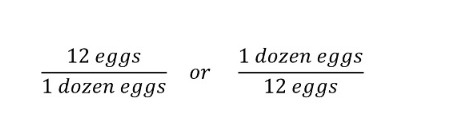
The ratio’s two parts are equal
The next step in dimensional analysis entails setting up a mathematical problem incorporating one or more conversion factors to reach the desired units. In the egg problem, if you possess two dozen eggs and want to determine the number of individual eggs, you would set up the situation as follows:
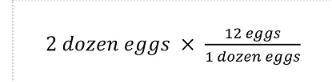
Set up a mathematical problem
Step 3.
Units, like variables or numbers, “cancel” when dividing a team by itself. Consequently, the final step in dimensional analysis involves carrying out the mathematical calculations, canceling out units along the way. In the egg example, the “dozen eggs” in the denominator of the ratio cancels out the “dozen eggs” in the original quantity, resulting in “eggs” as the sole remaining unit in the problem. This is demonstrated in the final answer of 24 eggs.
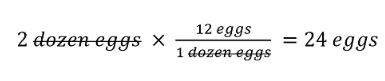
Cancel out units
3. Example of Dimensional Analysis:
The converted values must represent the same quantity to utilize a conversion factor. For instance, 60 minutes is equivalent to 1 hour, 1000 meters is equal to 1 kilometer, and 12 months is equivalent to 1 year.
To illustrate this concept, consider the scenario where you have 15 pens. When you multiply this quantity by 1, you still have the same number of 15 cells. However, a conversion factor is required to determine how many packages of pens are equal to 15 individual pens.
Let’s imagine that you have packaged sets of ink pens, with each package containing 15 cells. Suppose you have 6 boxes in total. To calculate the total number of pens, you would multiply the number of packets by the number of pens in each package, resulting in 15 × 6 = 90 cells.
Conversion factors are frequently encountered in various aspects of everyday life. They can be found in simple examples, such as the time taken by a harmonic oscillator, and in more complex situations, like calculating the energy of a vibrating conduction wire or determining the relationship between demand and capacity for a rotating disk.
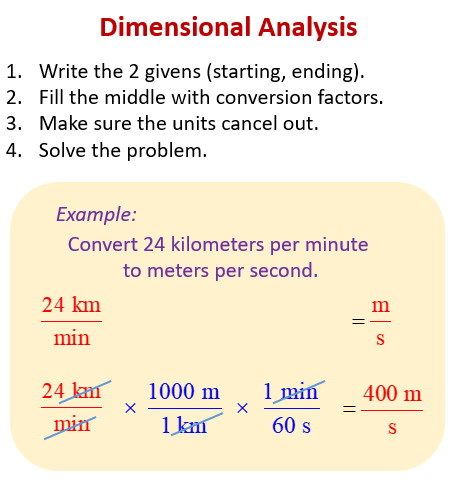
Dimensional Analysis
4. Application of Dimensional Analysis:
Physics studies rely heavily on dimensional analysis as a crucial measurement element in real-world physics. It serves several purposes and finds various applications. The reasons for using dimensional analysis include:
- Ensuring the consistency of a dimensional equation.
- Determining the connection between physical quantities and physical phenomena.
- Converting units from one system to another
- Validating equations or any other tangible correlations based on homogeneity.
- Generating formulas using dimensional analysis.
- Conveying the physical characteristics of a quantity through its dimensions.
…
5. Limitations of Dimensional Analysis:
However, dimensional analysis has limitations:
- It does not provide information about dimensional constants.
- It cannot derive formulas involving exponential, trigonometric, or logarithmic functions.
- It does not indicate whether a physical quantity is a scalar or a vector.
III. Practice Problems
Length Conversion:
Volume Conversion:
Temperature Conversion:
Speed Calculation:
Density Calculation:
Dimensional Analysis:
Energy Conversion:
Time Conversion:
Area Calculation:
Pressure Conversion:
Conclusion
This module presents the concept of dimensional analysis, sometimes referred to as the factor-label approach, which is used to change units of measurement in order to solve mathematical issues. Dimensional analysis is a method that establishes correlations between physical quantities by comparing their dimensions on both sides.
The conversion procedure entails determining the requisite conversion factors, establishing mathematical equations utilizing these factors, and executing the calculations while eliminating units.