


Lesson 4 – The Scientific Method
Introduction
A biology investigation typically begins with a biologist making an intriguing observation that captures their attention. For example, a cancer biologist might note a specific type of cancer resistant to chemotherapy and become curious about the underlying reasons. Similarly, marine ecologists might be alarmed by the bleaching of coral reefs in their research area and embark on a quest to uncover its causes.
But what comes next? How do biologists delve deeper into these observations? And how can you explore and investigate your comments on the natural world? This article will explore the scientific method, a systematic problem-solving approach employed by biologists and various other scientists.
This lesson helps students better visualize how the scientific method is used, and the important steps of the process are also described in detail. This lesson will focus on the following:
- Definition of Scientific method.
- Main steps of the scientific method.
- Example of a case study to illustrate the steps regarding the topic.
I. Definition
1. What is the scientific method?
The scientific method is a structured approach that scientists follow to study and make sense of the natural world. It provides a reliable and fair way to conduct scientific investigations and draw reliable conclusions. Scientists use this method by observing and gathering information, conducting experiments or studies, analyzing the findings, and making logical conclusions. The goal is to build a solid understanding of how things work in our world. Scientists can support or question their initial observations by testing ideas and using evidence.
2. The steps of the scientific method
The scientific method encompasses five fundamental steps, accompanied by an additional feedback step, which collectively guide researchers in their quest for understanding:
1. Observe a phenomenon or event.
2. Pose a relevant question based on the observation.
3. Develop a hypothesis, an explanation that can be tested.
4. Generate a prediction derived from the hypothesis.
5. Conduct experiments or tests to evaluate the prediction.
6. Iterate: Utilize the obtained results to form new assumptions or predictions.
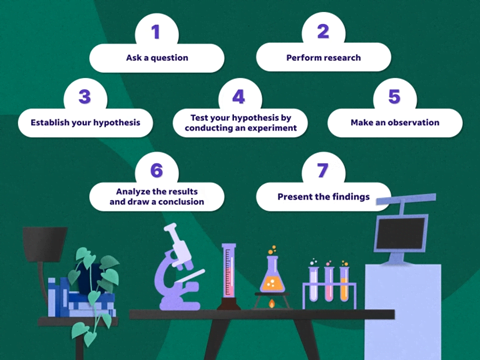
The scientific method is a universal approach utilized across various scientific domains, including chemistry, physics, geology, and psychology. While scientists in these fields may inquire about distinct phenomena and employ different experimental procedures, they adhere to the same underlying methodology, seeking logical and well-supported answers by empirical evidence.
II. Scientific method example: Failure to toast
Let’s enhance our understanding of the scientific method by applying its steps to a practical problem encountered in our daily lives: the failure to toast bread properly. Following the scientific method, we can systematically tackle this issue through a logical and investigative approach.
1. Observe a phenomenon or event.
Scientists closely study what they call phenomena over time and across different places in order to understand and explain how our world works. Phenomena are observable events, behaviors, relations, or ideas that can be investigated. In this activity, you will brainstorm and make predictions about a phenomenon that can be observed.
Imagine putting two slices of bread into the toaster and pressing the button, only to find that the bread remains untoasted.

Types of observational research:
Naturalistic observation
Naturalistic observation takes place immediately in the setting where the phenomenon occurs. The observations are made as inconspicuously as possible, with the researcher avoiding direct interaction with the subjects.
Participant observation
Researchers actively participate in the study through participant observation. A researcher may conduct interviews, take notes, examine documents, and take photographs in addition to watching behaviour.
Structured observation
Structured observation involves researchers observing in a lab or simulated environment rather than in the field. A structured observation is intended to capture a specific, constrained set of behaviors. This strategy is less natural, but it allows for fewer variables to be present.
2. Pose a relevant question based on the observation.
Why didn’t my bread toast?

3. Develop a hypothesis, an explanation that can be tested.
A hypothesis is a potential explanation that can be tested. In this case, a theory could be that the electrical outlet is malfunctioning, leading to the inability to toast the bread.

This hypothesis is only sometimes the correct explanation. Instead, it’s a potential cause we can test to determine whether it’s proper or requires a new hypothesis.
4. Generate a prediction derived from the hypothesis.
Predictions are expected outcomes if the hypothesis is correct. In this scenario, a prediction could be that if the electrical outlet is indeed the problem, plugging the toaster into a different outlet should resolve the issue.

5. Conduct experiments or tests to evaluate the prediction.
An experiment or observation is conducted based on predictions to evaluate the hypothesis. For instance, plugging the toaster into a different outlet and observing whether it successfully toasts the bread.

- If the bread toasts, it supports the hypothesis that the initial outlet was faulty.
- If the bread still doesn't toast, it challenges the hypothesis, indicating that another factor might be responsible, such as a broken wire in the toaster.
Results that support a hypothesis don’t conclusively prove its correctness but make it more likely, while contradictory results lead to reconsidering or rejecting the idea.
6. Iterate
The scientific method involves iteration and reflection on the results obtained. This step allows for refining the hypothesis, conducting further tests to confirm it, or developing new hypotheses based on the outcomes.
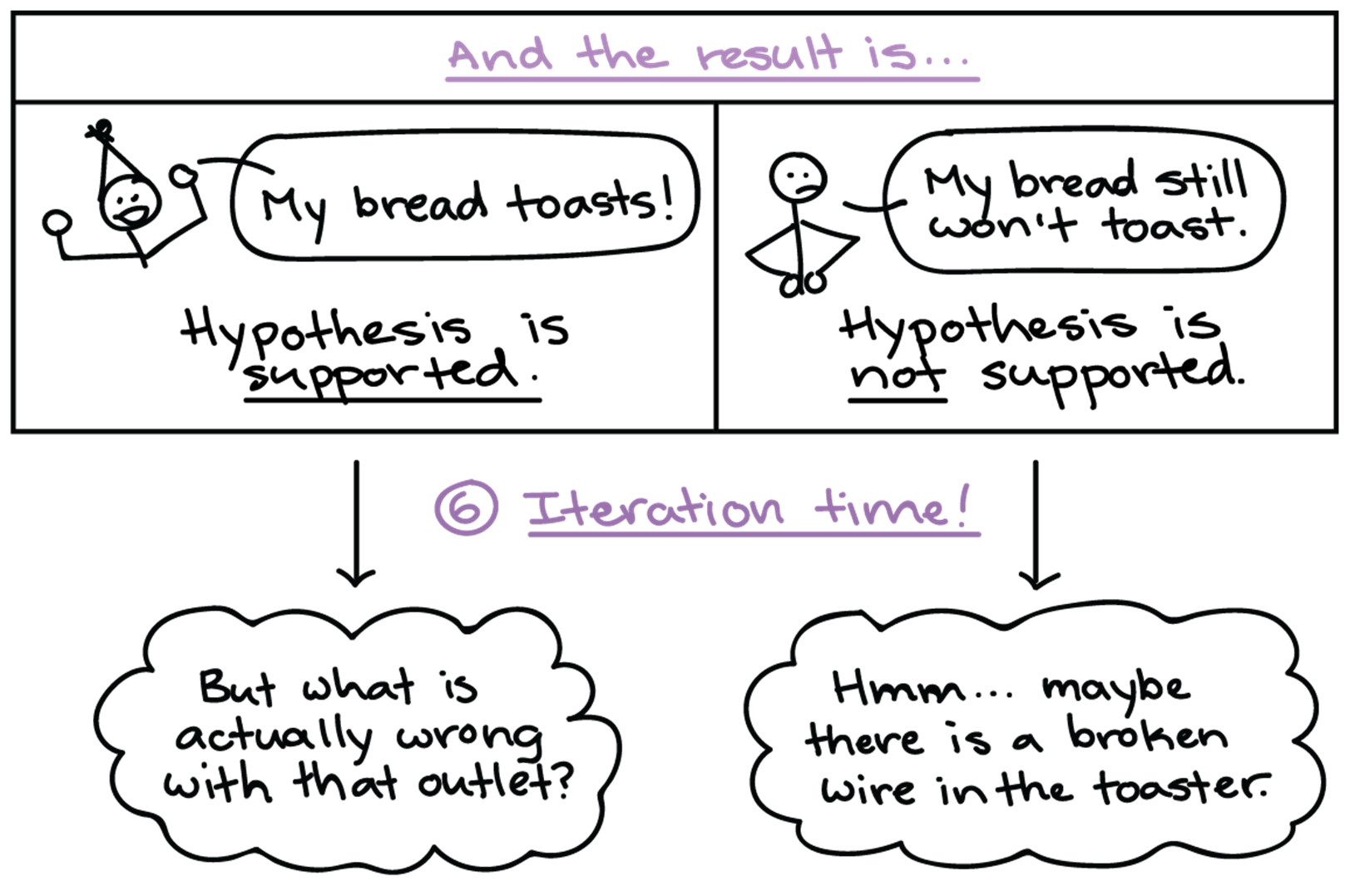
- In the case of a supported hypothesis, further investigations might focus on determining the specific issue with the electrical outlet.
- If the hypothesis is contradicted, a new hypothesis, such as a broken wire in the toaster, can be proposed and tested.
The scientific method often follows an iterative process, where the results of one cycle inform the next round of questioning and experimentation, facilitating a deeper understanding of the problem at hand.
III. Frequently asked questions:
- 1. Q: Give a simple hypothesis example.
A: Drinking sugary beverages every day leads to becoming overweight. This simple hypothesis suggests a connection between regular consumption of sugary drinks and the risk of obesity.
- 2. Q: Define the term "complex hypothesis."
A: A complex hypothesis explores how multiple factors (dependent variables) are influenced by various factors (independent variables). In simpler terms, it looks at how different things can affect each other in multiple ways.
- 3. Q: Who created the scientific method?
A: The scientific method is the product of centuries of debate and contributions from various thinkers and scientists. It incorporates observation, reasoning, and experimentation elements to understand the natural world. Over time, influential figures like Aristotle, Galileo, Newton, and Bacon have shaped and refined the scientific method, which continues to evolve as scientists explore new frontiers.
- 4. Q: Is the scientific method used by scientists?
A: Scientists may not strictly adhere to the exact steps of the scientific method taught in classrooms, but they still uphold its core principles. They adapt the technique to real-world conditions, making adjustments and sometimes skipping or repeating steps. However, the fundamental goal remains the same: using observations, experiments, and data to evaluate and validate explanations of how things work in the natural world.
Conclusion
In conclusion, The Scientific method provides scientists with a structured and reliable approach to studying the natural world. By following its steps of observation, hypothesis formulation, experimentation, and iteration, researchers can gain a deeper understanding of phenomena and contribute to scientific knowledge. While adaptations may be made in practice, the core principles of the scientific method remain essential in advancing our knowledge of the world around us.