


Lesson 4 – How to Solve Ratio Problems Involving Totals
Introduction
Finding the ratio of two or more quantities about their total is necessary to solve a frequent form of math problem known as a ratio problem involving total. These issues can arise in several settings, including daily life, business, and finance.
To begin with, it’s critical to comprehend the idea of ratio to solve ratio problems using total. Comparing two or more quantities of the same type results in a ratio. There are numerous ways to express ratios, such as using fractions, decimals, or a colon (:).
You must first identify the components of the ratio and ascertain its total number to answer this kind of problem. When you know the total number of parts, you can use that knowledge to calculate the value of each part or one of the ratio’s quantities.
Overall, resolving ratio issues using total calls for a solid grasp of fundamental mathematical ideas and the capacity to apply those ideas in practical settings. Anyone can solve these kinds of issues with time and effort.
I. Definition
1. The following concepts must be mastered by pupils in order to solve the ratio-related sum problem:
Recognizing fundamental math ideas: We need a strong foundation in basic math ideas like fractions (\( \frac{4}{3}\); \( \frac{5}{8}\)) before we can solve more challenging ratio problems. 4,5), percentage (100%; 25%), and decimal (3.18; 4.5). Before questioning dimensions, be sure you have a firm grasp of these ideas.
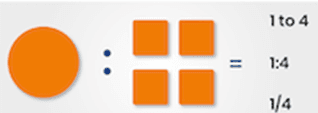
Identifying a ratio’s components: It’s crucial to recognize the many components of a ratio and comprehend how they relate to one another in ratio situations. Divide the issue into manageable components and use models or diagrams to aid in problem visualization.
Sum: Students must compute the sum of the values of the quantities in the ratio to answer ratio issues that include aggregates. To learn and sum quickly, you need to practice a lot.
How to determine a part’s value: We use this information to determine the worth of a part once we are aware of the entire value. The problem must be phrased correctly, and the proper math must be applied to achieve the solution.
2. Properties of Ratios
Ratio calculations compare the amounts or magnitudes of two or more corresponding values. They are frequently used to express relationships and draw comparisons in various disciplines, including mathematics, finance, science, and engineering.
Here are some important properties of ratios:
Equality:
Ratios can be equal. Two ratios are deemed equivalent if their values are the same.
Proportional Relationship:
Ratios can indicate a proportional relationship between two quantities. Two quantities are said to be in proportion if their ratios are equal.
Simplification:
By dividing the numerator and denominator by their greatest common divisor (GCD), ratios can be simpler. The ratio is simplified through this process.
Scaling:
By multiplying or dividing the numerator and denominator by the same nonzero amount, ratios can be scaled up or down. The proportion represented by the final ratio is the same as the initial ratio.
Order:
Ratios have an order. The order of the numbers in a ratio matters, as it indicates the relationship between the quantities being compared.
Unit Independence:
Ratios are independent of the unit. They do not rely on the particular units being used and instead express the relative relationship between two quantities.
Addition and Subtraction:
If two ratios have the same units, they can be added or subtracted. Ratios are calculated by adding or subtracting the numerators, while the denominators remain unchanged.
Multiplication and Division:
Ratios can be divided or multiplied. When multiplying ratios, the denominators are multiplied together along with the numerators. Similarly, when dividing ratios, the denominators and numerators are split equally.
These properties help us understand and manipulate ratios, allowing us to solve problems involving proportions and comparisons between quantities.
3. Compound Ratio Formula
We can determine the total ratio of several ratios using the compound ratio formula. The compound ratio is the result of multiplying the individual ratios together.
The compound ratio can be calculated using the following formula:
Compound Ratio = Ratio 1 × Ratio 2 × Ratio 3 × … × Ratio n
“Ratio 1,” “Ratio 2,” and so on: The individual ratios that are being combined.
All the numerators are multiplied together to create the compound numerator, and all the denominators are multiplied together to create the compound denominator to create the compound ratio.
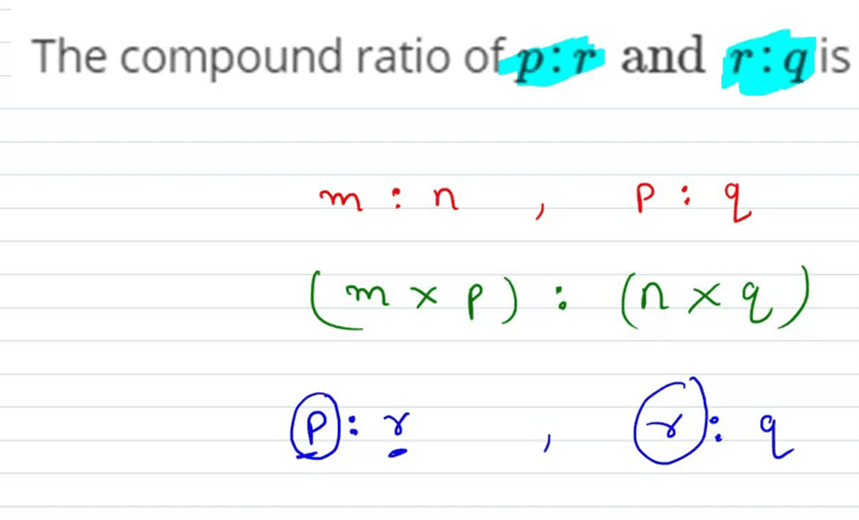
Example:
- Three ratios: 2:3, 4:5, and 6:7. To find the compound ratio, we multiply them together
- Compound Ratio = \( \frac{2}{3}\) × \( \frac{4}{5}\) × \( \frac{6}{7}\)
- To simplify this compound ratio, we multiply the numerators (2×4×6) and the denominators (3×5×7)
- Compound Ratio = \( \frac{48}{105}\)
➔ The compound ratio of the three given ratios is 48:105.
Note
Before using the compound ratio formula, appropriate conversions or adjustments may be needed if the ratios have different units or dimensions.
II. Examples
1.
If the ratio of boys to girls in a class is 2:3 and there are 75 students, how many girls are in the class?
- To solve this problem, you need first to add the parts of the ratio to find the total number of parts: 2+3 = 5
- Then, you need to find the value of one part: \( \frac{75}{5}\) = 15
- Now that you know the value of one part, you can find the number of girls in the class: 3 parts (girls) x15 = 45 girls
- Therefore, there are 45 girls in the class.
2.
You convert money from euros to VND based on the exchange rate: 1 euro = 25,223 VND
- Let's say you have 100 euros; we have the calculation: 25,223 * 100 = 2,522,300.
- So the amount you get after converting to Vietnamese currency is 2,522,300 VND
3.
There are 120 persons in the organization, with a 3:5 gender split. In the group, how many women are there?
- Determine the components of the ratio: 3 sections represent males and 5 parts represent women in this challenge because the ratio is 3:5.
- Determine the total number of components: To determine the total number of parts, add the ratio's parts: 3+5 = 8.
- Determine the value of one component: 120÷8 = 15.
- So the number of women in the organization: 5*15 = 75
Conclusion
Understanding how ratios operate and how to transform them into fractions or percentages is necessary to solve ratio issues that include a total. Before using fundamental mathematical operations, it is critical to determine the ratio’s overall sum and constituent elements.
Setting the ratio is very applicable in mathematics, physics, and geography, but even daily, we still need knowledge about scaling.