


Lesson 4 – Cycle of the Seasons in Astronomy
Introduction
By exploring this topic, students can gain a deep understanding of how the Earth’s movement through space directly influences the annual climatic changes we experience. This exploration reveals the intricate relationship between the Earth’s orbit, axial tilt, and rotation, demonstrating how these factors collectively drive the seasonal variations in temperature, daylight, and weather patterns. Through studying these celestial mechanics, students can appreciate the interconnectedness of our planet’s position in the solar system and the dynamic environmental changes that result from its journey through space. This knowledge not only enhances their grasp of astronomy but also provides valuable insights into the natural rhythms that shape our daily lives.
I. Earth's Cycle of the Seasons
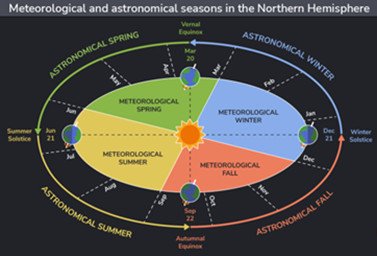
The Earth’s cycle of seasons is a fascinating natural phenomenon that occurs because of the tilt of our planet’s axis and its orbit around the Sun. These two factors play a crucial role in determining the changing seasons throughout the year. Earth is tilted at an angle of approximately 23.5 degrees relative to its orbit. This tilt means that different parts of the planet receive varying amounts of sunlight at different times of the year.
When the Earth’s axis tilts toward the Sun, it causes one hemisphere to receive more direct sunlight, resulting in summer. This is known as the summer solstice, which occurs around June 21st in the northern hemisphere and December 21st in the southern hemisphere. As the Earth continues its orbit around the Sun, the axis starts to tilt away from the Sun, causing one hemisphere to receive less direct sunlight. Consequently, winter takes place during this time, known as the winter solstice. It happens around December 21st in the northern hemisphere and June 21st in the southern hemisphere. The two intermediate positions, called spring and autumn or fall, occur between summer and winter when the Earth’s axis is not directly tilted towards or away from the Sun.
Understanding the Earth’s cycle of seasons helps us appreciate the diversity and beauty of our planet. The changing seasons impact various aspects of our lives, from climate and weather patterns to agriculture and wildlife behavior. Moreover, it highlights the intricate dance between the Earth and the Sun, demonstrating how a slight tilt and an orbit can result in such dynamic and predictable changes throughout the year.
II. The Ecliptic and Celestial Equator
The ecliptic and the celestial equator are two important concepts in astronomy that help us understand the positions and movements of celestial objects. The ecliptic is the apparent path that the Sun appears to take across the sky throughout the year. It is created by the shifting position of the Sun against the background of stars as the Earth orbits around it. The ecliptic is divided into 12 equal parts, known as the zodiac signs, which are used in astrology.
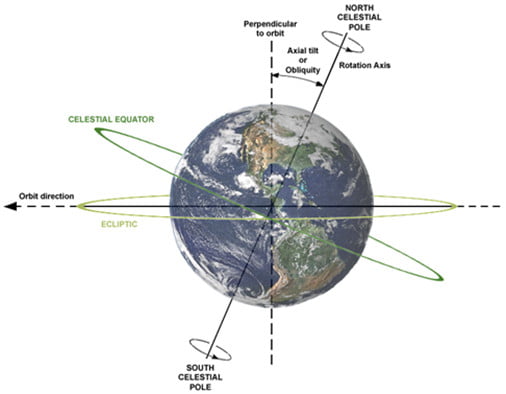
The celestial equator is an imaginary line that extends the Earth’s equator into space. It divides the celestial sphere into the northern and southern hemispheres, similar to how the Earth’s equator divides the planet. Astronomers use the celestial equator as a reference point to determine the declination of celestial objects, which is their angular distance north or south of the celestial equator. By knowing an object’s coordinates about the celestial equator, astronomers can accurately locate and track its position in the sky.
Conclusion
In conclusion, delving into the study of the circle of the seasons in astronomy offers a profound and comprehensive understanding of this intricate celestial phenomenon. By examining the Earth’s axial tilt, orbital dynamics, and their effects on the changing seasons, one gains valuable insights into the fundamental mechanisms that govern our planet’s climate and the cyclical patterns observed in the sky. This knowledge not only enriches our appreciation of the natural world but also enhances our grasp of the broader cosmic interactions that influence life on Earth.