


Lesson 3 – Important Points on the Celestial Sphere
Introduction
When you look up at the sky, it may seem like you are at the center of a large crystal sphere with the stars fixed on its surface. This sphere is called the celestial sphere. It doesn’t have a specific size; we measure the positions of the stars by specifying angles. We can only see half of the sphere, as the other half is hidden below the horizon. In this section, we will explain the different coordinate systems used to describe the positions of stars and other celestial bodies on the celestial sphere.
I. What is the Celestial Sphere?
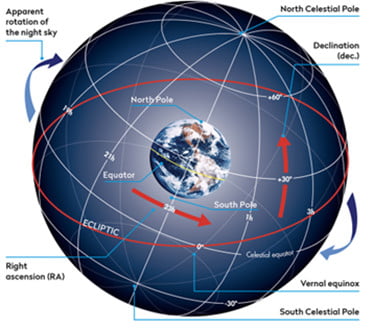
The celestial sphere is a concept used by astronomers and stargazers to understand the positions and movements of celestial objects in the night sky. It is an imaginary sphere that surrounds the Earth and acts as a visual representation of the sky as seen from our planet.
By connecting all celestial objects, the celestial sphere simplifies our understanding of their positions relative to Earth. It is like a giant globe that covers the Earth, with the Earth at its center. The stars and other objects appear to be projected onto the inner surface of this sphere, allowing us to use coordinates such as right ascension and declination to locate them.
As the Earth rotates on its axis, the celestial sphere appears to rotate with it. This causes the stars and objects to appear to move across the sky. By studying the celestial sphere, we can predict the movement and positions of celestial objects throughout the night and year. This provides us with valuable information about the universe beyond our planet.
II. North Celestial Pole
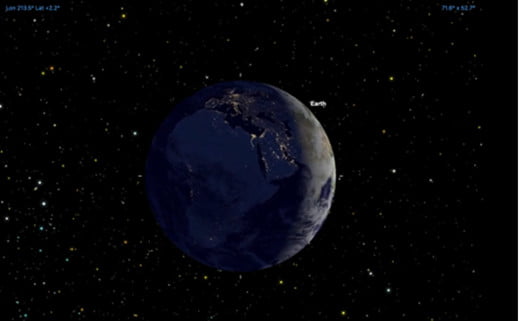
The North Celestial Pole is a crucial concept in astronomy that helps us navigate the night sky. It is the point in the sky directly above the Earth’s North Pole. Similar to how the Earth’s equator divides it into the northern and southern hemispheres, the celestial equator divides the sky into the northern and southern celestial hemispheres. The North Celestial Pole is an extension of the Earth’s axis and remains fixed while the stars appear to move around it due to the Earth’s rotation.
Because the North Celestial Pole aligns with the Earth’s axis, it assists us in determining the direction of true north. Astronomers and navigators often use a tool called a star tracker or a sextant to locate the North Celestial Pole. One specific star, Polaris, also known as the North Star or the Pole Star, is particularly helpful in finding the North Celestial Pole. It is nearly directly above the North Pole, so if you position yourself facing Polaris, you are facing north. The North Celestial Pole is a vital reference point for astronomers, but it is also fascinating for stargazers and those who enjoy exploring the wonders of the night sky.
III. South Celestial Pole
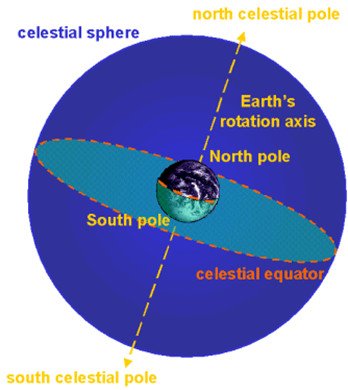
The South Celestial Pole is a significant astronomical concept that pertains to the position of stars in the southern hemisphere. Similar to the North Star (Polaris) in the northern hemisphere, the South Celestial Pole acts as the reference point for celestial navigation in the south. It is the point in the sky directly above the Earth’s South Pole. Unlike its northern counterpart, there is no bright star near the South Celestial Pole that is easily visible to the naked eye. Instead, we rely on the constellation Crux, also known as the Southern Cross, to locate this point. The Southern Cross can be found in the southern sky and consists of four main stars forming a cross shape, with two brighter stars pointing towards the location of the South Celestial Pole.
The South Celestial Pole is crucial for navigating the southern skies. Near this point, the stars appear to rotate clockwise as the Earth spins on its axis. This means that the position of the stars in the southern hemisphere changes throughout the night, unlike the relatively fixed position of stars near the North Star. By knowing the location of the South Celestial Pole, astronomers and navigators can determine their latitude in the Southern Hemisphere. They can also use it to locate specific stars or constellations that are helpful for navigation and identification. Whether it is sailors trying to find their way across the Southern Ocean or astronomers studying the mysteries of the universe, understanding the concept of the South Celestial Pole is essential for exploring the Southern skies.
Conclusion
The celestial sphere is a fundamental concept in astronomy. It is an imaginary sphere that surrounds the Earth and serves as a framework for studying celestial objects. This includes stars, planets, and other astronomical bodies. The North and South poles on the celestial sphere correspond to the Earth’s rotational axis extended into space. Understanding the concept of the celestial sphere and its relationship with the North and South poles is crucial for professionals in fields related to astronomy and navigation.