


Lesson 3 – How to Use Proportions to Solve Ratio Problems
Introduction
In this lesson, we’ll be delving into the topic of using proportions to solve ratio problems. Ratios, which are mathematical concepts that compare the relative sizes of two or more quantities, are fundamental in the field of mathematics. They are often employed to depict the relationships between different components or segments of a whole. Besides, proportions offer an efficient tool for resolving a variety of ratio problems. By setting up and solving such proportions, we can discover unknown quantities, compare ratios, or scale up or down quantities based on given ratios. This lesson will provide a step-by-step approach to solve ratio problems using proportions, and real-life examples will also be examined to demonstrate how this concept can be applied. By the end of the lesson, you will have a solid understanding of how to use proportions to tackle a range of ratio problems.
I. Definition
1. What is Ratio?
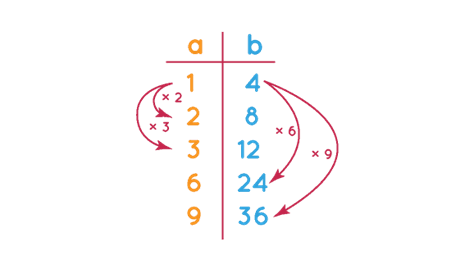
Simply put, a ratio compares two related integers in its most basic form. A ratio is a number that shows one amount as a portion of another thing. An example is the ratio of the two integers 5 and 6, which is 5:6. It also symbolizes the frequency with which one quantity equals another. The ratios’ component numbers are referred to as “terms.” The term antecedent refers to the more significant portion of the ratio (numerator), while consequent or descendent refers to the lower element of the Proportion (denominator). For instance, if the ratio is 4:6, the antecedent is 4, and the consequent is 6.
2. What is Proportions?
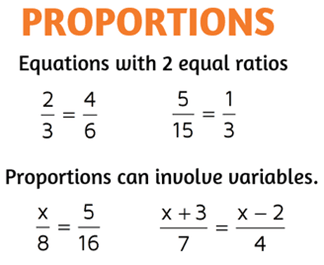
The Proportion is indicated by ‘::’ or ‘=.’ If the x:y ratio is the same as the a:b ratio, then x, y, a, and b are in Proportion. It is represented by the symbols x:y=a:b or x:y: a:b. When four words are in Proportion, the second and third values, which represent the intermediate values, must match the first and fourth values, which represent the extreme values.
II. Formula
1. Ratio and Proportion in Daily life?
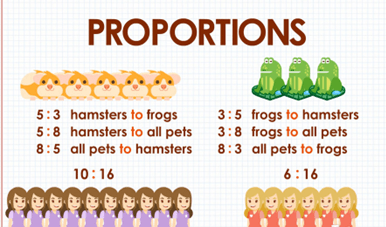
Mathematics and daily life both use the ideas of ratio and Proportion. For instance, the ratio can be seen in many aspects of daily life, such as speed (distance/time), price (dollar/ rupee), etc. Similar principles of Proportion can be seen in everyday life.
2. You can use the following formula to employ proportions to solve ratio problems:
If you have a ratio of a : b and you want to find the value of x when the ratio is a : c, the formula is:
\( \frac{𝑎}{𝑏}\) = \( \frac{𝑥}{𝑐}\)
According to this equation, the ratio of a to b corresponds to the ratio of x to c.
This formula can solve various ratio problems by setting up the appropriate proportions and solving for the unknown value.
Note
The ratio will remain unchanged when multiplied and divided by the same non-zero value.
To solve for x, you can cross-multiply and solve the resulting equation.
3. Tricks for Ratio and Proportion
- If \( \frac{𝑎}{𝑏}\) = \( \frac{c}{d}\), then \( \frac{𝑎}{d}\) = \( \frac{b}{c}\)
- If \( \frac{𝑎}{𝑏}\) = \( \frac{c}{d}\), then \( \frac{𝑎}{c}\) = \( \frac{b}{d}\)
- If \( \frac{𝑎}{𝑏}\) = \( \frac{c}{d}\), then \( \frac{b}{a}\) = \( \frac{d}{d}\)
- If \( \frac{𝑎}{𝑏}\) = \( \frac{c}{d}\), then \( \frac{a+b}{b}\) = \( \frac{c+d}{d}\)
- If \( \frac{𝑎}{𝑏}\) = \( \frac{c}{d}\), then \( \frac{a-b}{b}\) = \( \frac{c-d}{d}\)
Componendo – Dividendo Rule = If \( \frac{𝑎}{𝑏}\) = \( \frac{c}{d}\), then \( \frac{a+b}{a-b}\) = \( \frac{c+d}{c-d}\)
- If \( \frac{𝑎}{𝑏}\) = \( \frac{b}{c}\), then \( \frac{a}{c}\) = \( \frac{a^2}{b^2}\)
- If \( \frac{𝑎}{𝑏}\) = \( \frac{c}{d}\), then a = c and b = d
- If \( \frac{𝑎}{b+c}\) = \( \frac{b}{c+a}\) = \( \frac{c}{a+b}\) (and a+b+ c ≠0), then a = b = c
4. How to use proportions to solve ratio problems?
You can take the following actions to employ proportions to solve ratio problems:
Step 1: Understand the problem and identify the ratios involved.
- Read the issue attentively, then note the information that has been provided and what has to be located.
- Identify the ratios involved in the problem. Ratios are usually written as a:b or a to b.
Step 2: Create a percentage depending on the information provided.
- Based on the situation, determine which ratios are connected to each other.
- Create a percentage with the formula \( \frac{a}{b}\) = \( \frac{c}{d}\), where a and b represent one ratio and c and d represent the other.
Step 3: Solve the proportion.
- Cross-multiply the first ratio's numerator by the denominator of the second ratio, and vice versa.
- Set the resulting cross-products equal to each other and solve for the unknown value
Step 4: Double-check your solution.
- Verify that the solution makes sense in the context of the problem.
- Ensure that the ratio relationship is consistent.
III. Example
1.
You can set up the percentage as follows if the ratio of apples to oranges is 3:5, and you want to know how many apples there are for every 20 oranges:
- \( \frac{3}{5}\)= \( \frac{𝑥}{20}\)
- To solve for x, you cross-multiply: 5*x = 3*20 x = \( \frac{3*20}{5}\) x = \( \frac{60}{5}\) x = 12
-> When there are 20 oranges, there will be 12 apples, according to the given ratio.
2.
A cake recipe asks for 2 cups of flour and 3 cups of sugar. How much sugar do you need to create four cakes?
- The given proportion is 2 cups flour to 3 cups sugar.
- We must calculate the amount of sugar required to create 4 cakes.
- The proportion is: \( \frac{2}{3}\) = \( \frac{4}{x}\) 2x = 3*4 2x = 12 x = \( \frac{12}{2}\) => x = 6
-> The original recipe with 2 cups of flour will require 3 cups of sugar, so if we want to make 4 cakes, the recipe will still use the same ratio.
-> 6 cups of sugar are the amount needed to make 4 cakes.
3.
There are 64 marbles, the ratio of blue marbles to red marbles is 3:5. So how many red marbles are there in the bag?
- \( \frac{3}{5}\) = \( \frac{x}{64}\) 3*64 = 5*x 192 = 5x x = \( \frac{192}{5}\).
-> x ≈ 38.4
IV. Difference between Ratio and Proportion
| No | Ratio | Proportion |
|---|---|---|
|
1 |
Ratio is often used to compare the sizes of two objects with the same units |
The two ratios are expressed under the proportion |
|
2 |
It is represented by a colon “:” or a slash “/” |
Proportion is expressed by using two colons between the numbers “::” or by the equal sign “=” (3:4 = 6:8) |
|
3 |
It is an expression |
It is an equation |
|
4 |
“To every” is the keyword to determine the ratio in the problem |
“Out off” is the keyword to determine the ratio in a problem with a solution |
Note
Quickly answer the following ratio and percentage problems.
If \9 \frac{x}{y+z}\) = \( \frac{y}{z+a}\) = \( \frac{z}{x+y}\) and x+y+z is not equal to 0.
If two ratios are equivalent to a fraction, only two can be compared.
- If \( \frac{𝑎}{𝑏}\) = \( \frac{𝑥}{𝑦}\), a*y = b*x follows
- \( \frac{𝐴}{𝑥}\) = \( \frac{𝑏}{𝑦}\) if \( \frac{𝑎}{𝑏}\) = \( \frac{𝑥}{𝑦}\)
- If \( \frac{𝑎}{𝑏}\) = \( \frac{𝑥}{𝑦}\), \( \frac{𝑏}{𝑎}\) = \( \frac{𝑦}{𝑥}\)
- If \( \frac{𝑎−𝑏}{𝑏}\) = \( \frac{𝑥−𝑦}{𝑦}\), then \( \frac{𝑎}{𝑏}\) = \( \frac{𝑥:𝑦}{𝑦}\)
- If \( \frac{𝑎}{𝑏}\) is equal to \( \frac{𝑥}{𝑦}\), then \( \frac{𝑎+𝑏}{𝑎−𝑏}\) = \( \frac{𝑥+𝑦}{𝑥−𝑦}\)
- If \( \frac{𝑎}{𝑏}\) = \( \frac{𝑥}{𝑦}\), then a + b = x + y
Conclusion
Finally, we have learned ratios are used to compare two quantities and can be reduced to their simplest form. We also understand how ratios and proportions work. Each percentage must have the same units since proportions are equations that demonstrate that two ratios are equal. Through word problems, we have applied our understanding of how to set up and solve proportions to various ratio problems in real-world scenarios. Always remember that proportions can be used in multiple situations and are a helpful tool for solving ratio problems. You will master ratios and proportions if you continue to practice and apply these ideas!