


Lesson 3 – How to Think in Scientific Ways
Introduction
Thinking like Scientists. Why don’t we?
Being “brainy” in how you think of everything that happened in your life is not an impossible mission if you know the secret magical tool – Scientific thinking – that worked for Albert Einstein, Marie Curie, Stephen William Hawking, and many other famous scientists. Scientific thinking can work effectively for you too, even if you don’t have to become a scientist, but it tool will help you to think like one, sometimes.
Scientific thinking is one of the most essential human abilities, and this can be improved when we know how to apply appropriate methods to interpret our ideas effectively. In this lesson, scientific thinking will be discussed based on the following points:
- What is the definition of scientific thinking?
- How can we distinguish between ordinary and scientific thinking?
- How to enhance scientific thinking skills?
I. Definition
The simplest definition of scientific thinking is the human ability (it will become a habit when the dividual actively influences its principle) of thinking like a scientist. The new generation’s mindset of science is a way of understanding the physical world, primarily found in observable physical shreds of evidence, reasoning, and examination repetition. That means scientists explain the world based on their observations, not including their biases. They set up a way to test these new ideas whenever they develop new ideas about the world works.
In short, scientific thinking involves intentional information seeking, including asking questions, testing hypotheses, making observations, recognizing patterns, and making inferences (defined by Kuhn, 2002; Morris et al., 2012). Regarding Kuhn’s professional research, scientific thinking is defined as a “specific reasoning strategy,” another way to speak purposeful thinking that can be thought of as “knowledge seeking,” not about science itself or scientific aptitude. It is about something people do, not something they have. Scientific thinking is engaged in by most people rather than a rarefied few.
II. Distinguish between ordinary and scientific thinking
Thinking is known as a human being’s cognitive and exploratory behavior in which someone tries to reflect in their mind in an unbiased manner the substance of the things, things, and occurrences of reality surrounding them. On the other hand, science consists of collecting, developing, and systematizing data about the world to explain life events and phenomena of the world around us found in scientific laws.
While in empirical thinking, man operates with his subjective experience and uses the simplest forms of analysis. Besides, an individual applies objectivity, consistency, and evidence methods in scientific thought. It is required to understand better how to act in certain situations based on our goals and objectives. We can identify two categories of people based on their thinking styles:
- Scientific thinker: As the rule mentioned above, scientific thinkers are very active, psychologically flexible, independent, willing to accept new things, and ready for change rapidly. They prefer to argue and discuss, striving to assess the world objectively.
- Unscientific thinker: People are attracted to everything interesting, mysterious, and of practical use. They are driven by feeling in life, leaving the substance of things, evidence, and verification of results in the background.
We do not intend to judge which style of thinking is better. Still, we can point out that scientific thinking (even when it is only used occasionally) has several tangible advantages for practical individuals:
- Firstly, it contributes to acquiring basic knowledge about many objects.
- Secondly, it develops accurate, mathematical but also creative, and abstract thinking.
- Thirdly, scientific thinking formulates a curious mind and motivates a dividual to solve problems in various sectors of life such as education, working professional, business, and personal. Moreover, it creates the value of mutual understanding and mutual support within team works and socialization.
III. Learn scientific thinking skills
Moiya McTier – An astrophysicist, folklorist, and American scientist – offers three simple steps below:
Study to distinguish between observables and assumptions
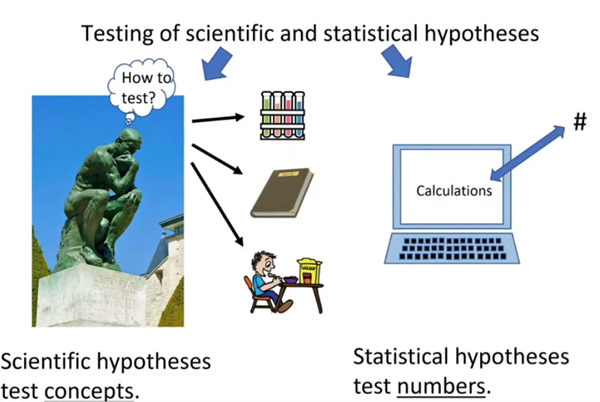
To make assumptions, the researcher must completely understand the following two factors: Method of reaching a decision, Identification of study categories. Scientists can develop and identify a variety of scientific hypotheses based on the type of scientific study they conduct, as well as how to create proper scientific hypotheses. Making judgments based on the research subject’s logical thinking or personal reasoning in order to create research hypotheses. The researcher can construct relationships based on traits, observations, and experiences.
Automatic assumptions (heuristics) are the brain mechanism to convert observation to action as quickly as possible. We assume the weather is warm when we look through the window and see the blue sky and sunshine. On questioning this assumption, by stepping outside, we find it’s cold instead of warm, as we expected. The same theory applied in business cases, we need to verify our natural assumptions by actual observation and real-life experiences: Is the client happy with your services, or are you assuming based on their buying record and their engagements? Avoid making any mistakes; let’s get started by asking good questions.
Be guided by your question, rather than how to solve them
Asking smart questions before hands for each step of the way in every problem you’re facing. Don’t hesitate to spend too much focus on the tasks. Scientists take things slowly, only taking them to the next step when they’re a clear idea of the last. Typically, we intend to gallop towards achieving the task.
If the numbers are down on last year, and the task is to improve them, we may need to sell more products. Better, however, to ask questions. Why were the numbers down? Let’s answer these questions we make up before moving towards a remedy.
Create a working hypothesis for every question
Focused on a question, but the thing is, how will you know when you come up with the correct answer for it? Working hypotheses are now doing their jobs. Scientists formulate various assumptions that give them a direction to get closer to the correct answer. They’re on the right track if these findings’ assumptions match their hypothesis. Otherwise, they need to modify their ideas and generate new questions. In daily life problems, we also unconsciously use theories. They all lie hidden in a lot of working discussions or conversations.
Practice scientific thinking and the attributions to the modern scientific picture
The fast-paced development of scientific thinking has greatly influenced the formation of a scientific picture of the world — a particular type of knowledge system from different sectors, united by a single general scientific principle that combines biological, chemical, physical, and mathematical laws, giving a general description of the world.
Additional to the scientific picture, human beings have philosophical, artistic, and religious points of view on the surrounding reality. But only scientific perception can be objective, systematic, synthesizing, and analyzing. Moreover, the reflection of scientific perception can be found in religion, philosophy, and the products of artistic activity.
Knowledge of science subjects and scientific thinking have greatly influenced alternative ways of perceiving the world. We can easily observe the evidence of the achievements in science; there are rapid changes in church dogmas, social norms, art, and even in the everyday life of people.
Conclusion
Through this lesson, Scientific thinking is described as a perception mechanism of reality, improving knowledge quality and improving the individual’s self-esteem. In other words, Scientific thinking enhances the life of each individual and society, understanding life’s meaning and finding one’s purpose.