


Lesson 2 – Elements of the SI Units
Introduction
A SI unit is a globally recognized system of measurements widely employed in technical and scientific research to prevent unit ambiguity. A standardized unit system is significant as it facilitates a universal understanding of measurements. Physics uses various S.I. units to represent distinct quantities, which can be categorized into base and derived units. In this article, we focus on providing an understanding of these groups.
I. S.I. Base Units
A total of 7 fundamental S.I. base units exist. The following list provides these units along with their S.I. unit and symbol:
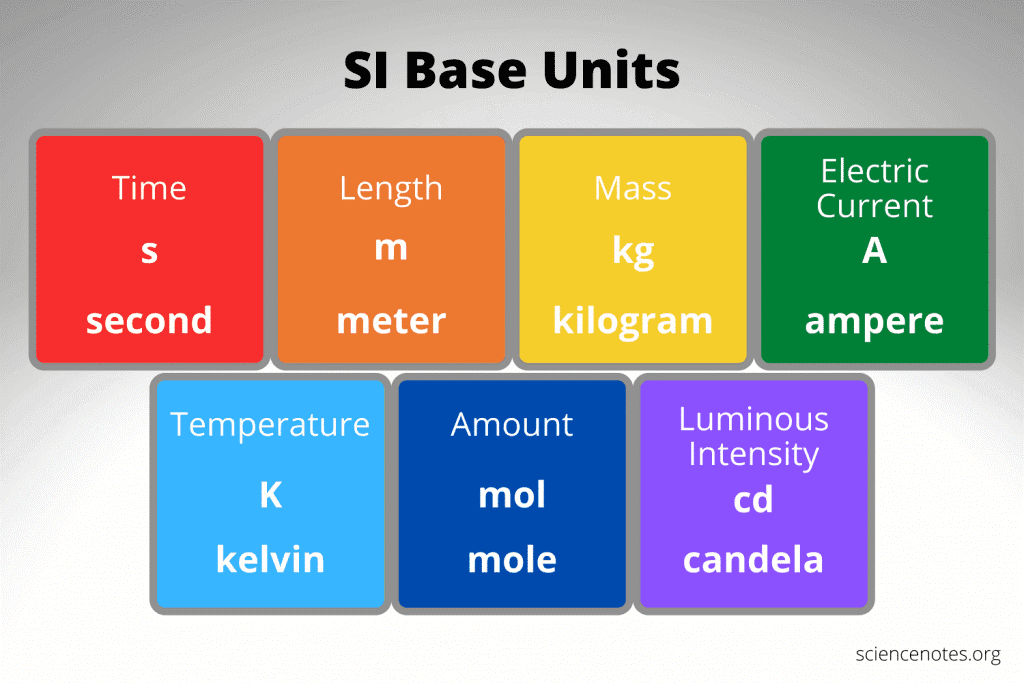
S.I. base units
Unit of length, meter:
Unit of mass, kilogram:
Unit of time, second:
Unit of electric current, ampere:
Unit of thermodynamic temperature, Kelvin:
Unit of the amount of substance, mole:
Unit of luminous intensity, candela:
It is important to note that these seven units are considered independent of each other and are thus referred to as base units.
II. S.I. Derived Units
Derived quantities, distinct from base amounts, are established by relating them to the seven base quantities through a system of quantity equations. Presented below are some of the extensively utilized S.I.-derived units in physics.
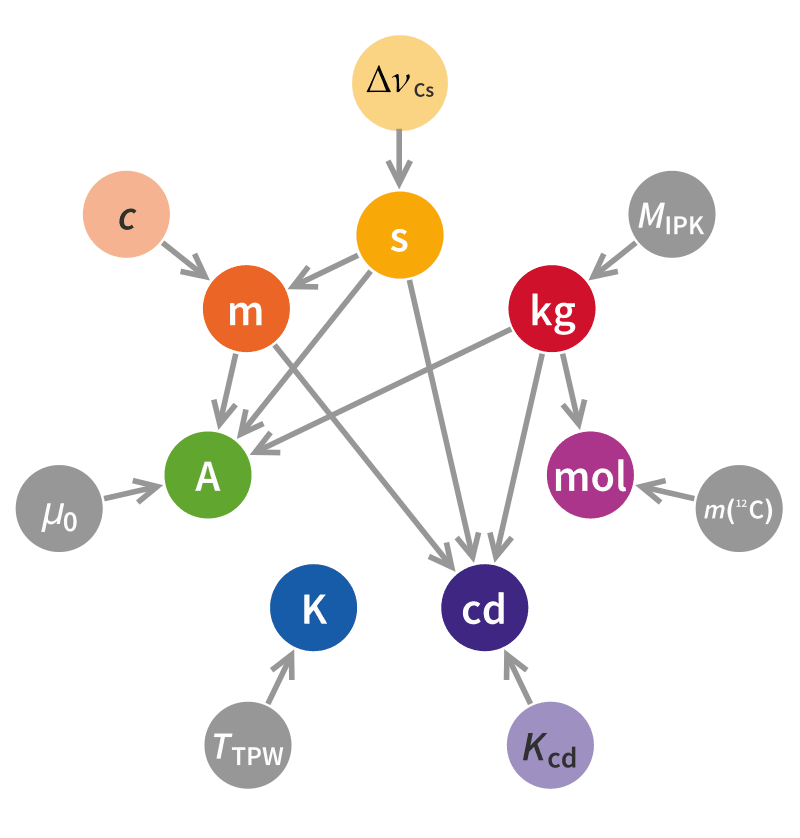
S.I. Derived Units
| Name | Symbol | Quantity | SI Base Units |
|---|---|---|---|
|
Hertz |
Hz |
Frequency |
\text{s}^-1 |
|
Randian |
rad |
angle |
1 |
|
Steradian |
sr |
solid angle |
1 |
|
Newton |
N |
force |
kg.m\text{s}^-2 |
|
Pascal |
Pa |
pressure |
kg.\text{m}^-1.\text{s}^-2 |
|
Joule |
J |
energy |
kg.text{m}^2.\text{s}^-2 |
|
power |
Watt |
W |
kg.text{m}^2.\text{s}^-3 |
|
Couloumb |
C |
electric charge |
s.A |
|
Volt |
V |
voltage or potential difference |
kg.text{m}^2.\text{s}^-3.\text{A}^-1 |
|
Farad |
F |
electrical capacitance |
\text{kg}^-1.\text{m}^-2.\text{s}^4.\text{A}^2 |
|
Ohm |
Ω |
electrical capacitance |
kg}.\text{m}^2.\text{s}^-3.\text{A}^2 |
|
Siements |
S |
electrical conductance |
\text{kg}^-1.\text{m}^-2.\text{s}^3.\text{A}^2 |
|
Weber |
Wb |
magnetic flux |
kg.\text{m}^2.\text{s}^-2.\text{A}^-1 |
|
Tesla |
T |
magentic flux density |
kg.\text{s}^-2.\text{A}^-1 |
|
Henry |
H |
electrical intruductance |
kg.\text{m}^2.\text{s}^-2.\text{A}^-2 |
|
Degree Celsius |
°C |
temperature relative to 273.15K |
K |
|
Lumen |
lm |
luminious flux |
cd |
|
Lux |
lx |
illuminatance |
cd.\text{m}^2 |
|
Becquerel |
Bq |
radioactive decays per unit time |
\text{s}^-1 |
|
Gray |
Gy |
absorbed dose of ionizing radiation |
\text{m}^2.\text{s}^-2 |
|
Sievert |
Sv |
equivaleant dose of ionizing radiation |
\text{s}^-1.mol |
|
Katal |
kat |
catalytic activity |
\text{s}^-1.mol |
Students are strongly advised to properly acquaint themselves with the aforementioned indispensable lists of S.I. units in physics. During exams, providing both the units and dimensions corresponding to a given quantity is crucial, as an answer without its team is considered incomplete.
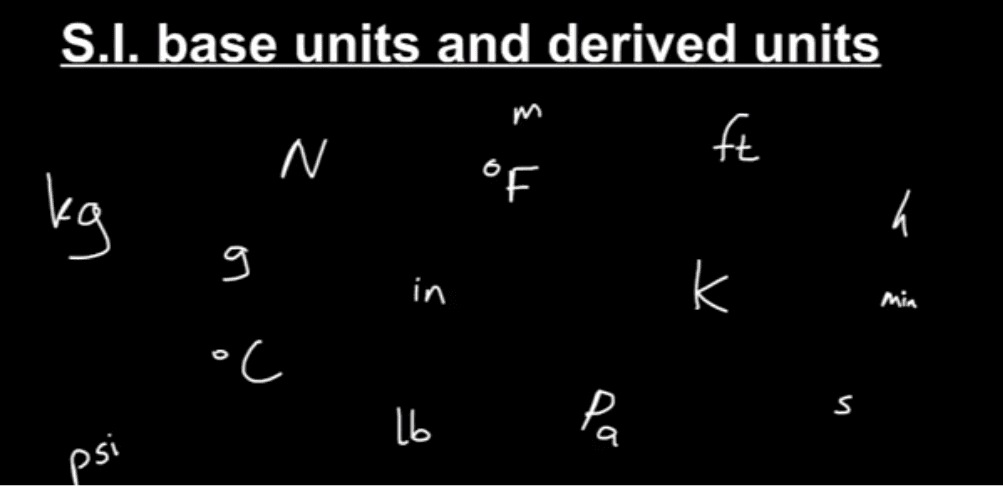
S.I. base units and derived units
FAQs
Q1. What is the SI?
The International System of Units (SI) is the modern form of the metric system, which is the world's most widely used system of measurement. It is the standard system for units of measurement in science, industry, and everyday life.
Q2. What are the basic SI units?
Q3. How are SI units defined?
Q4. What are prefixes in the SI system?
Q5. Why was the SI system introduced?
Q6. How often are SI units updated?
Q7. Is the SI system used globally?
Q8. What is the role of the International Bureau of Weights and Measures (BIPM)?
Q9. Are there exceptions to using the SI system?
Q10. How can I convert between SI units and other systems?
Conversion between SI units and other systems can be done using conversion factors. There are many online tools and reference materials available to help with these conversions.
These answers cover some general aspects of the SI system, but specific questions may arise based on the context or the elements of the SI system you are interested in.
Conclusion
The SI system outlines seven independent base units in terms of dimensions. These units include the second (s), meter (m), kilogram (kg), ampere (A), kelvin (K), mole (mol), and candela (cd). By algebraically combining these base units, 22 derived teams are formed. Derived units are expressed as combinations of multiplication or division of fundamental units and may possess specific names.