


Lesson 2 – Commutative Property of Multiplication
Introduction
Multiplication is a fundamental math operation that is used in everyday life and plays a significant role in various mathematical concepts. In this lesson, we will explore the commutative property of multiplication, which is an essential rule in arithmetic that governs the way numbers are multiplied. We will learn what the commutative property of multiplication is, how it works and its importance in solving arithmetic problems. By the end of the lesson, you will have a solid understanding of this property and be able to confidently apply it to solve math problems efficiently. Let’s get started!
I. Definition
1. Commutative property of multiplication

Commutative property of multiplication is a mathematical rule that states that changing the order of the factors in a multiplication problem does not change the product. In other words, if a and b are two numbers, then a x b = b x a. This means that the order of the numbers being multiplied can be rearranged without affecting the outcome of the multiplication.
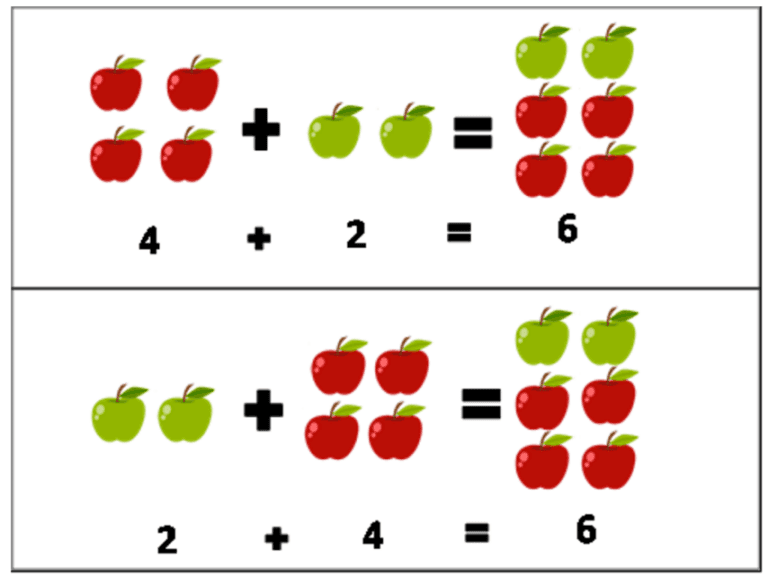
You should be aware that the Commutative Property of Multiplication only holds true for multiplication and not for other mathematical operations like addition or subtraction.
For example:
2 x 3 = 3 x 2
5 x 4 x 2 = 2 x 4 x 5
10 x 7 x 6 x 3 = 3 x 7 x 10 x 6
In all of these examples, the order of the factors has been changed, but the product remains the same.
For non-examples:
4 x 5 + 2 ≠ 2 + 5 x 4
6 x (2 + 4) ≠ (2 + 4) x 6
In these non-examples, changing the order of the factors does not result in the same product.
2. Commutative property of Multiplication formula
The formula for the Commutative Property of Multiplication is:
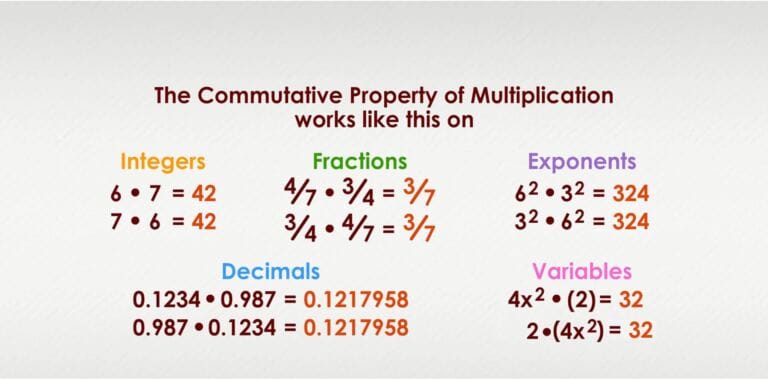
Where “a” and “d” are any two numbers being multiplied. This formula states that the order in which we multiply two numbers does not affect the product.
II. Application
Here are a few applications of the commutative property of multiplication:
- Grocery Shopping: Imagine buying two bags of apples, each containing 5 apples. The total number of apples you need to buy is 10 (5+5). By applying the commutative property of multiplication, you could also think of this as 2 x 5 = 5 x 2. This means you can buy 5 bags of apples, each containing 2 apples, or 2 bags of apples, each containing 5.
- Baking: You often need to multiply fractions or decimals. For example, if a recipe requires you to use 1/3 cup of sugar and you need to double the recipe, you can apply the commutative property of multiplication. 2 x 1/3 = 1/3 x 2. Therefore, you will need 2/3 cup of sugar for the doubled recipe.
- Sports: In basketball, players often need to calculate their total score at the end of the game. If a player makes 6 baskets and each basket is worth 2 points, the total score would be 12 points (6 x 2). Applying the commutative property of multiplication, the player could also calculate his or her total score as 2 x 6 = 6 x 2.
- Gardening: If you have a garden bed that is 3 feet wide and 5 feet long, the total area of the bed is 15 square feet (3 x 5). However, using the commutative property of multiplication, you could also calculate the area as 5 x 3 = 15 square feet.
These are just a few examples of how the commutative property of multiplication can be applied in real-life situations.
Conclusion
In conclusion, the commutative property of multiplication is a basic but essential mathematical concept that is frequently used in elementary arithmetic. It states that the order of multiplication does not matter, and the result remains the same regardless of the order of the numbers. Understanding this property enables us to simplify multiplication problems and solve them more efficiently. By applying this rule correctly, we can save time, avoid errors, and improve our overall mathematical skills. Remembering the commutative property of multiplication is crucial in building a strong foundation for advanced mathematical concepts. Thank you for joining us in this lesson, and we hope you found it helpful and informative!